This article, written by Jay Przyborski, master naturalist and volunteer guide at the Laura W. Bush Native Texas Park, originally appeared in the May/June 2026 issue of Texas Gardener.
“My mother and grandmother taught me to notice and appreciate the beauty of the world around me. They taught me that caring for nature isn’t a pastime, it’s a responsibility.” – Mrs. Laura W. Bush
Near Dallas’s urban core, on the campus of Southern Methodist University, a wild oasis grows. The Laura W. Bush Native Texas Park at the George W. Bush Presidential Center is the brainchild of Mrs. Bush, who continues the great tradition of first ladies from Texas who celebrate and conserve the natural bounties of our state – especially its wildflowers.
Fewer than 20 years ago, the 23 acres where the Bush Presidential Center now resides were occupied by aging apartment buildings, parking lots and World War II-era homes. When SMU competed against six other academic and municipal institutions to house the Bush Center complex, the site, which is sandwiched between the eight-lane North Central Expressway and the affluent, residential town of University Park, was 75% paved. Now, it is an urban oasis for native plants, animals and nature lovers – housing not only the presidential library and museum, but also hosting 15 acres of native Texas habitat.
As is often the case with married couples, President Bush asked his wife to handle the landscaping for the site, and from the outset, the former first lady envisioned a vast, natural garden that returned the land to some semblance of its past – rooted in native ecology rather than traditional ornamental design.
When Mrs. Bush was growing up in Midland, Texas, her mother, Jenna Welch, instilled in her a love of nature. Mrs. Welch, originally from El Paso, had a passion for native plants of the Chihuahuan desert. She was a knowledgeable, self-taught birdwatcher, a member of a Midland Naturalists group and the leader of her daughter’s Girl Scout troop. Mrs. Bush has often spoken of how her mother taught her how to identify constellations, wildlife and plants.
When planning of the park commenced, the Bushes had just spent 13 years working with landscape restorationists on a 120-acre prairie at their ranch in Crawford, a massive undertaking that required five years of Bermuda grass removal before planting and seeding could begin in earnest. As a result, Mrs. Bush and her team were aware of the labor and the steep hurdles that come with such work.
To execute her vision, Mrs. Bush enlisted the landscape architecture firm of Michael Van Valkenberg Associates, Inc. Based out of Boston, MVVA designed the site, including the landscape’s connection both to the building and the surrounding campus. Herb Sweeney led site planning and project management for MVVA. “Most presidential libraries and museums don’t have a strong connection to the surrounding campus or neighborhood. By contrast, Mrs. Bush envisioned a landscape that wasn’t just a setting for the building; it was to be a park for the surrounding community.” The Bushes also requested that the entire site be as sustainable as possible. “We knew we couldn’t replicate a Blackland Prairie, because this is disturbed land. But it was a great opportunity to create a site with limited maintenance inputs, not 23 acres of lawn that required irrigation and mowing.”
For this Boston-based design team, it was crucial to work with experts who understood Texas plants and ecology. Emily Manderson, now with Blackland Collaborative, was at that time an environmental designer at the Lady Bird Johnson Wildflower Center. “The idea was to feature the best of the Texas prairie ecosystems, to create a prairie that would be emblematic.” Manderson’s work included creating the park’s seed mixes. To find the right recipe for the central Dallas site, located in the Blackland Prairie ecoregion, teams from MVVA and the Wildflower Center visited wild spaces in North Texas that helped inspire the park’s organization. They observed prairies, limestone outcroppings, open woodlands and bottomland forests, and each of these can be found in some form in the park.
The Wildflower Center had pioneered the use of native, short prairie grasses as lawn, and a major objective of the park’s design was to balance such lawn with wildscape. Creating seed mixes and selecting plants for the natural areas was not as simple as selecting species that would have been found on the land centuries ago, since the new landscape would not be made entirely of native soil. Blackland Prairie soils are heavy, rich, alkaline clays, which are extremely difficult to work with in new-site construction and grading. While existing onsite soils were used to the greatest extent possible, sandy loam was engineered and brought onsite. This provided opportunities to use plant species typically found in adjacent ecoregions, but not Blackland Prairie. Before application to the entire site, seed mixes were trialed in an 8,150-square foot mock-up for 15 months prior to installation. Certain species, such as partridge pea (Chamaecrista fasciculata), were reduced in the final mix as a result of their overabundance on the trial plots.
Guided by nature
The 13 years since the park opened in 2013 have confirmed what most gardeners know: much of the hard work comes after plants go in the ground. Maintaining this large, wild space has presented its stewards both with challenges and with many lessons. Chief among those lessons is that one must have some degree of laissez-faire sensibility.
An excellent example of this occurred in the early years of the park’s creation when, one hot September afternoon, a large team assembled in the wildflower meadow. The George W. Bush Presidential Center operations manager was there with the landscape maintenance crew, the environmental consultant, and volunteer Texas Master Naturalists. The meadow was to be the centerpiece of the park, designed as an annual, springtime show of floral fireworks celebrating the glory of Texas wildflowers.
The previous two springs, one flower monopolized the meadow at the expense of others: the American basketflower (Plectocephalus americanus). From one side of the 15-acre park to the next, thousands upon thousands of basketflowers covered the land. There is nothing wrong, per se, with basketflower. To the contrary, one could say these statuesque, pollinator-magnets are one of Texas’s more underrated wildflowers. But the meadow was never meant to be a basketflower monoculture, and greater diversity was everyone’s objective.
As a result, discussion that day centered on whether the meadow should be scraped and reseeded. Unlike the previous two years, that August had been uncharacteristically rainy, and, as the team stared at the ground in consternation, they saw couplets of tiny green leaves dotting the ground in abundance. When plants are that young, they are extremely difficult to identify, but it seemed a waste to scrape away those thousands of future wildflowers. The decision was made to keep them. After all, a scrape-and-seed approach would not guarantee a particular result, so why not roll the dice with whatever had already decided to live?
The gamble paid off in spades. The following spring was one of the most spectacular and diverse in the park’s history. Yes, there were basketflowers, but also much more. Profusions of blooms in many colors graced the Bush Center from March to June: bluebonnets (Lupinus texensis), Indian blankets (Gaillardia pulchella), black-eyed-susans (Rudbeckia hirta), Drummond’s phlox (Phlox drummondii), Mexican hat (Ratibida columnifera), and prairie verbena (Glandularia bipinnatifida), to name a few.
There were lessons to remember: this team of collaborators brought a lot of manpower to the meadow that day, and instead of attempting to exert their will, they allowed nature to take its course. This change from one year to the next was probably driven by several factors, including the timing and volume of precipitation. It was an early reminder that the landscape often responds best when left to find its own balance.
A bluebonnet meadow
On Saturdays in spring and fall, Master Naturalists lead tours of the park, and often field questions from visitors on how they can create their own wildflower plantings. Lois Diggs, who has been a tour guide since the park’s inception, has a piece of advice: “You have no control. When you put out a seed mix, don’t expect the plants to do exactly what you want or expect.”
The park’s wildflower meadow has been a case in point. Though most of the park’s natural areas are largely allowed to evolve and shift however nature sees fit, it was Mrs. Bush’s request that the wildflower meadow showcase our state flower, the bluebonnet.
Adding bluebonnets to a landscape is sometimes easier said than done. However, according to Manderson, “We knew the bluebonnet meadow would be a challenge, because the request was that it could serve as a lawn during the rest of the year, and bluebonnets don’t like competition.” The idea had been that bluebonnets would dominate in spring, and then short prairie grasses would emerge to provide lawn for the rest of the year. The plan was a victim of its own success. In their first year, bluebonnets germinated with such vigor that they smothered and killed the Harbiturf, resulting in a giant bare spot for many months.
Instead of repeating mistakes by attempting the same balance of bluebonnets and Harbiturf, the design and maintenance teams adapted by diversifying the seed mix. This resulted in fewer bluebonnets, but the spring blooming period has tripled in duration, now extending from early spring into mid-June. Bluebonnets are now the heralds of spring wildflower season throughout the meadow and the rest of the park.
Spring in the park
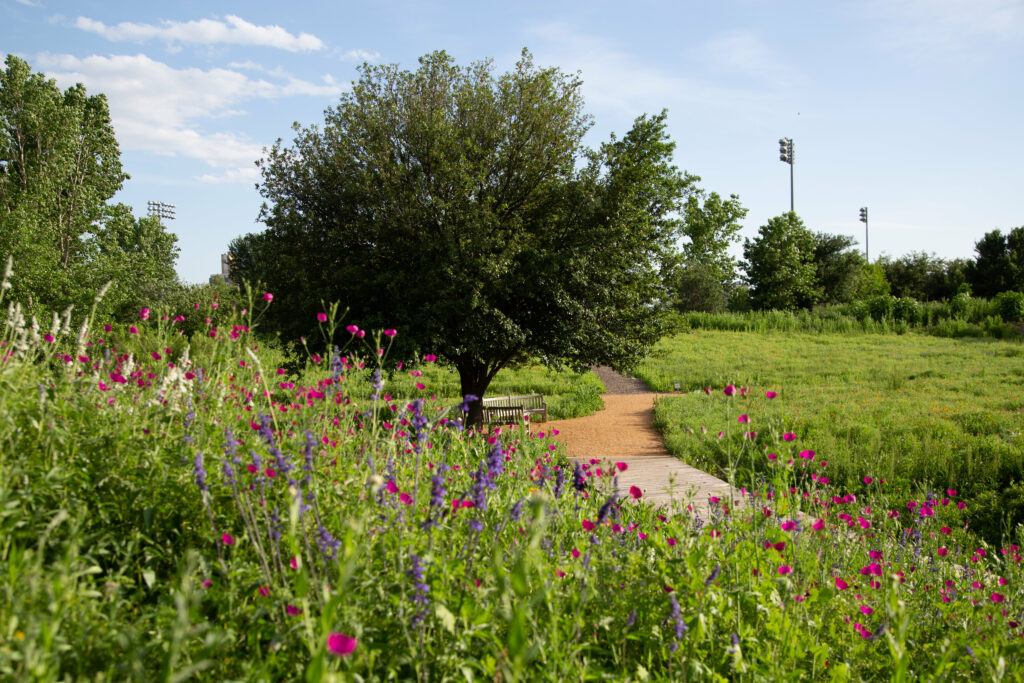
Before warm weather begins in earnest, the park wakes slowly: small, ornamental trees such as redbuds (Cercis canadensis var. ‘Texensis’), Mexican buckeyes (Ungnadia speciosa) and Eve’s necklace (Styphnolobium affine), plus low growers like prairie verbena, and scrambled eggs (Corydalis curvisiliqua) appear in March. In April, standing winecup (Callirhoe leiocarpa) and both white and blue mealy cup sage (Salvia farinacea) dominate in many of the park’s natural areas, with a multitude of other species playing supporting roles. Spring obedient plant (Physostegia intermedia) blooms for several weeks along the edge of a pond. Bluebonnets hug the borders of crushed granite pathways. Near the limestone seep, the pendulous clusters of Texas buckeye (Aesculus glabra var. arguta) flowers can be seen. Blue curls (Phacelia congesta), which rarely appeared in the park’s early years, is now common in dry shade.
In May, the park changes color from indigo and magenta to yellow and orange, as April bloomers give way to Indian blankets, which take center stage for several weeks. Finally, reliably around Memorial Day, the park reaches its zenith. Gaillardia remain in bloom while American basketflower, Mexican hat, spotting beebalm (Monarda punctata) and plains coreopsis (coreopsis tinctoria) peak. Within the context of that sequence, the floral color palette changes from year to year and evolves over time. The Master Naturalist volunteers and Bush Center management have learned to accept these annual fluctuations. Diggs says, “Don’t panic. As long as you are providing food and habitat and invasives aren’t taking over, you’re in good shape.”
Summer dormancy and fall bounty
Depending on the persistence of spring rains, the spring wildflower show lasts from mid- to late June, until the park goes into summer dormancy. During the heat of summer, annual wildflowers die and reseed, and certain perennials, grasses and ferns may turn brown or even disappear entirely. While plants such as Texas lantana (Lantana urticoides) or mealy cup sage may continue to bloom during drought, the park’s prairies largely turn brown until autumn rains arrive.
Gardens in the eastern U.S. and in England enjoy more rainfall and suffer less from drought than the typical Texas garden. Perhaps it is the historical influence of those gardens that has convinced so many Texans that we can irrigate our landscapes to health and happiness in August. Texas gardeners should consider adopting the seasonal rhythm of our native prairies in their own landscapes. These ecosystems have evolved to withstand periods of severe heat and drought, often without harming plants’ long-term health.
When fall rains arrive, typically in October or November, the park enters a second growing season. Goldenrod (Solidago altissima) spreads across open areas in mustard yellow waves. Turk’s cap (Malvaviscus arboreus var. drummondii) blooms red in dry, shady areas, and pink in a sunny dry creek. (The pink variety was not planted, but is likely a result of natural hybridization with plants in nearby neighborhoods.) Around the same time, poverty weed (Baccharis neglecta) and late boneset (Eupatorium serotinum) provide impressive flowering displays, while perennials such as mealy cup sage and Texas lantana reliably continue their full-season bloom periods. Before the park eases into winter dormancy, subtle fall color appears in persimmon (Diospyros virginiana), cedar elm (Ulmus crassifolia) and roughleaf dogwood (Cornus drummondii) foliage.
Collaboration and continuing education
After more than a decade, the Laura W. Bush Native Texas Park reflects both the promise and complexity of working with living systems. Maintenance is far from passive. Bermuda grass, bindweed (Convolvulus arvensis) and johnsongrass (Sorghum halepense) continually attempt to invade. Rabbits feed eagerly on new plantings. Some native species grow so aggressively they must be managed to protect diversity. Even so, the benefits continue to outweigh frustrations.
Visitors increasingly express interest in native landscaping and wildlife habitat. Children spot butterflies and birds where asphalt once dominated. Homeowners who visit the park leave inspired to plant wildflowers of their own.
The park does not function like a conventional garden. It changes with weather and time, responding to ecological forces rather than strict design intent. Its greatest lesson may be that thoughtful planning, paired with patience, can create landscapes that are both resilient and beautiful.
Jay Przyborski is an environmental lawyer and writer based in Dallas. To learn more about native Texas plants and landscapes, follow Jay on Instagram @NewTexasGardens. He is at work on a book featuring the state’s most beautiful native gardens, to be published by the University of Texas Press in 2027.