U.S. Secretary of State Marco Rubio was on Capitol Hill last week for several hearings to discuss the President’s Fiscal Year 2027 Budget Request for the department. Before the House and Senate Foreign Affairs/Relations and Appropriations committees, Secretary Rubio responded to a series of questions on the America First Global Health Strategy and the recent Ebola outbreak in the Democratic Republic of Congo.
The Secretary indicated that the U.S. would re-engage with Gavi, the Vaccine Alliance, and assign an individual to coordinate the U.S. response to Ebola, amid the recent outbreak. Members also asked about interagency cooperation with the Centers for Disease Control and Prevention (CDC) through the America First Global Health Strategy, emphasizing greater transparency, robust monitoring and oversight, and coordination.
These hearings support steps toward the success of the America First Global Health Strategy, containment of outbreaks like Ebola, and positive impact of American taxpayer dollars in ways that save lives. Thirty-two bilateral health agreements have been signed to date, and several countries have nearly finalized their implementation plans. Congress needs to continue to engage in a conversation with the Bureau of Global Health Security and Diplomacy and Secretary Rubio to ensure this new framework for U.S. global health engagement is transparent, accountable, data-driven, and patient-centric.
Outbreaks like Ebola remind us that global health is directly tied to American security. Infectious diseases do not respect borders, and delayed responses can threaten U.S. citizens, service members, supply chains, and economic stability. With the right response from Congress, U.S.-supported health systems can also continue to protect Americans and our allies.
Bush Institute Insights
As of June 2, the U.S Department of State has signed bilateral health agreements with 32 countries, bringing the total new health funding to $20.3 billion, including $12.8 billion in U.S. investment and $7.5 billion in partner-country co-investment. The latest bilateral health agreements were with Bolivia and Papua New Guinea. KFF is tracking each agreement with details on financial commitments and focus areas.
Recently, Dr. Ouma Oluga of Kenya’s Ministry of Health shared that Kenya has completed implementation planning for its $1.6 million health agreement with the U.S. and will transition to a full government-to-government mechanism by July 2026. On May 8, Uganda and the U.S. held the first meeting of the new Joint Health Steering Committee to oversee implementation of their five-year, $2.3 billion health agreement signed in December 2025.
However, negotiations have faced setbacks in other countries. Zimbabwe was the first country to reject a health agreement package with the U.S. that would have provided $325 million in health financing over data concerns. In Ghana, government officials rejected a proposed five-year bilateral health agreement that would have provided $109 million in U.S. support, raising similar concerns about provisions for sharing sensitive health data. In Zambia, officials pushed back on a pending $2 billion health agreement allegedly tied to preferential access for U.S. companies to the country’s critical mineral sector. Zambian officials also raised concerns about proposed data-sharing requirements.
The U.S. Department of State also announced a new partnership with SC Johnson and the Global Fund to deploy approximately 30 million Guardian spatial repellents, an American-made malaria prevention tool designed to protect more than 60 million people over the next three years. Through the America First Global Health Strategy, the initiative aims to accelerate malaria control in high-burden countries while supporting U.S. manufacturing and innovation.
Figure of the Week
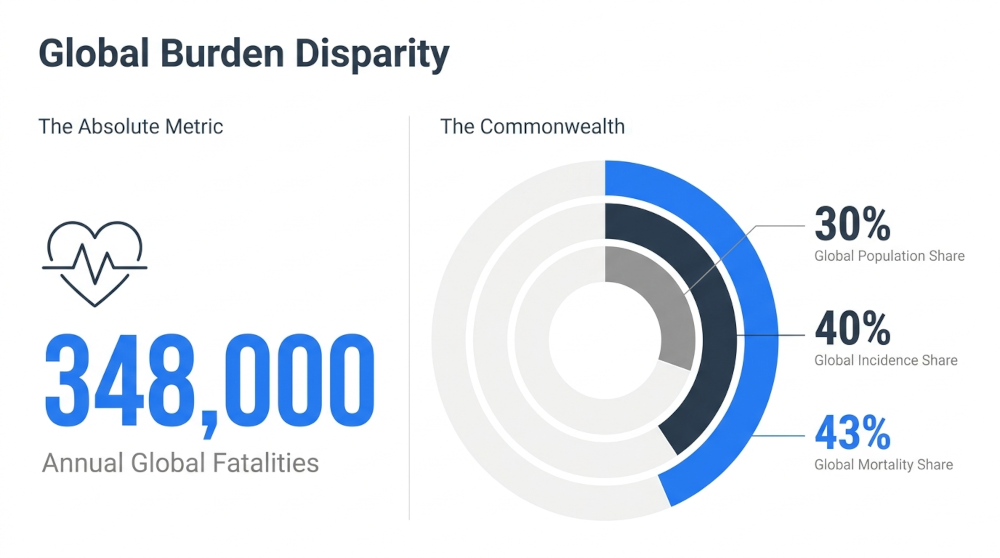
Approximately 348,000 women die annually from cervical cancer
Despite being almost entirely preventable and mostly treatable, cervical cancer kills approximately 348,000 women each year. During the 79th World Health Assembly convening last month, the Commonwealth, a global association of 56 countries that spans both advanced economies and low- and middle-income countries, met to discuss strategies to eliminate the disease. Commonwealth countries bear a disproportionate share of the burden, accounting for 40% of global cervical cancer incidence and 43% of mortality while representing only 30% of the world’s population, as illustrated in the infographic below.
Women living with HIV are up to six-times more likely to develop cervical cancer. Recognizing this, the George W. Bush Institute, UNAIDS, and PEPFAR launched the Go Further Partnership in 2018 to integrate cervical cancer care into pre-existing HIV services. This ensures that women who survive HIV don’t succumb to a preventable disease. To date, over 10 million screenings have been completed across Go Further’s 12 partner countries.
To achieve cervical cancer elimination by 2050, leaders of the Commonwealth also stress the need to embed cervical cancer care into primary health systems, integrate HPV vaccination into routine immunization, and link screening to existing maternal services.
Ally Updates: KFF resource for congressional reporting requirements for PEPFAR
KFF released a new resource outlining congressional reporting requirements tied to PEPFAR since the program’s launch in 2003. Ongoing requirements include annual reporting on U.S. global HIV efforts, women and girls programming, partnership frameworks, and progress toward country-led transitions under the America First Global Health Strategy.
Newer reporting requirements tied to the FY2026 appropriations package also require the State Department to submit transition strategies, bilateral health agreement details, and benchmarks for country ownership and co-investment.
According to the legislation, the State Department was required to submit the report no later than 90 days after the bill’s passage, by May 3. It is unclear whether Congress has received this report.
In the News
- Director of the Hoover Institution and 66th Secretary of State and National Security Advisor Condoleezza Rice addressed the fifth annual Rosenkranz Global Health Policy Symposium late last month at Stanford University. The keynote conversation included Dr. Jennifer Kates, senior vice president and director of the Global and Public Health Policy Program at KFF and focused on the future of U.S. global health engagement. During her remarks, Secretary Rice reflected on the genesis of PEPFAR and the program’s future. She also encouraged students to consider a career in public service, rooted in the fundamental American value of compassion.: “I would say that in public service you have the opportunity to be a part of a new [precedent]… and the fact that somehow there is still left, I think in the American public in particular, a view that America should not let other people suffer,” she said. “So if you want to have a role in taking that value and having it be a part of our foreign policy, part of our global engagement, we need new ideas as to how to do that. And you will come with those new ideas.” as to how to do that. And you will come with those new ideas.”
- In a piece published in USA Today, unexpected co-authors former Republican U.S. Senator of Tennessee Bill Frist, MD and rock legend Sir Elton John share the impact of U.S. investment in the HIV/AIDS pandemic and lessons learned to accelerate progress against the disease. Frist and John ask that funds dedicated to global health and the Global Fund be immediately released. Learning from lessons of the past, they recommend the reengagement of community health workers across the globe, the rabid scale and distribution of new HIV innovations, and greater implementation through faith-based and community-based partners. The piece showcases PEPFAR’s pluralism legacy and offers several valuable recommendations for the future.
- As of May 29, the U.S. Department of State has committed more than $162 million to the Ebola response in the DRC and Uganda. Working closely with the CDC, the Department has activated a dedicated Ebola Response Task Force, deployed a Disaster Assistance Response Team, and expanded enhanced screening for travelers who have been in the DRC, Uganda, or South Sudan. The Department also intends to commit $13.5 million to Kenya’s Ebola preparedness efforts. U.S.-funded partners are scaling up border screening, contact tracing, risk communications, diagnostic testing, and PPE delivery. In the DRC, partners have imported 100 tons of additional water, sanitation, hygiene, and infection prevention supplies, deployed 1,300 health workers, and supported Ebola treatment and transit centers to contain the outbreak at its source.
- Former Secretary of Health and Human Services Tommy Thompson and former Commissioner of the Food and Drug Administration Andrew C. Von Eschenbach published a piece on June 1 detailing considerations for the next Commissioner of the FDA. They include acting with transparency, consistency, and predictability, making decisions through a lawful process guided by science, and operate in a manner that puts the people’s wellbeing above politics.
- The Clinton Health Access Initiative (CHAI) and Wits RHI, with support from Unitaid, released a Flash Market Update on the progress of rolling out lenacapavir and long-acting HIV PrEP. Across ten early adopter countries, CHAI projects that more than 600,000 people will start lenacapavir this year.
- Gavi CEO Sania Nishtar and the Coalition for Epidemic Preparedness Innovations (CEPI) CEO Richard Hatchett outlined an urgent three-part response to the latest Ebola outbreak in the Democratic Republic of the Congo (DRC), caused by the rare Bundibugyo virus. With no approved vaccines or therapies for this strain, Gavi and CEPI are working with partners to assess whether the existing Ebola vaccine could offer any cross-protection, accelerate development of Bundibugyo-specific vaccine candidates, and ensure operational capacity for clinical trials and a potential rollout.
- NPR is releasing a multi-part series focused on the current state of HIV/AIDS treatment in light of U.S. foreign assistance changes. Journalists traveled to South Africa and Mozambique, interviewing beneficiaries and implementers. One beneficiary, Melda, a mother living with HIV whose child is also HIV positive, struggled to access care until a community health worker helped connect her family to treatment. To continue supporting patients, many health workers are now working without pay or with reduced salaries.
- A recent piece in DevEx investigates how underinvestment in tuberculosis (TB) outreach programs is potentially weakening Uganda’s ability to combat the disease, even as new AI-powered screening tools expand access to diagnosis. Uganda remains one of the world’s highest-burden TB countries, but U.S. government and Global Fund investments have helped raise its treatment success rate to 92% and reduce TB mortality by more than 50% since 2015. Sustaining those gains will require a gradual, well-supported transition as the country assumes more responsibility for health workers and TB services.