
Nicole Bibbins Sedaca:
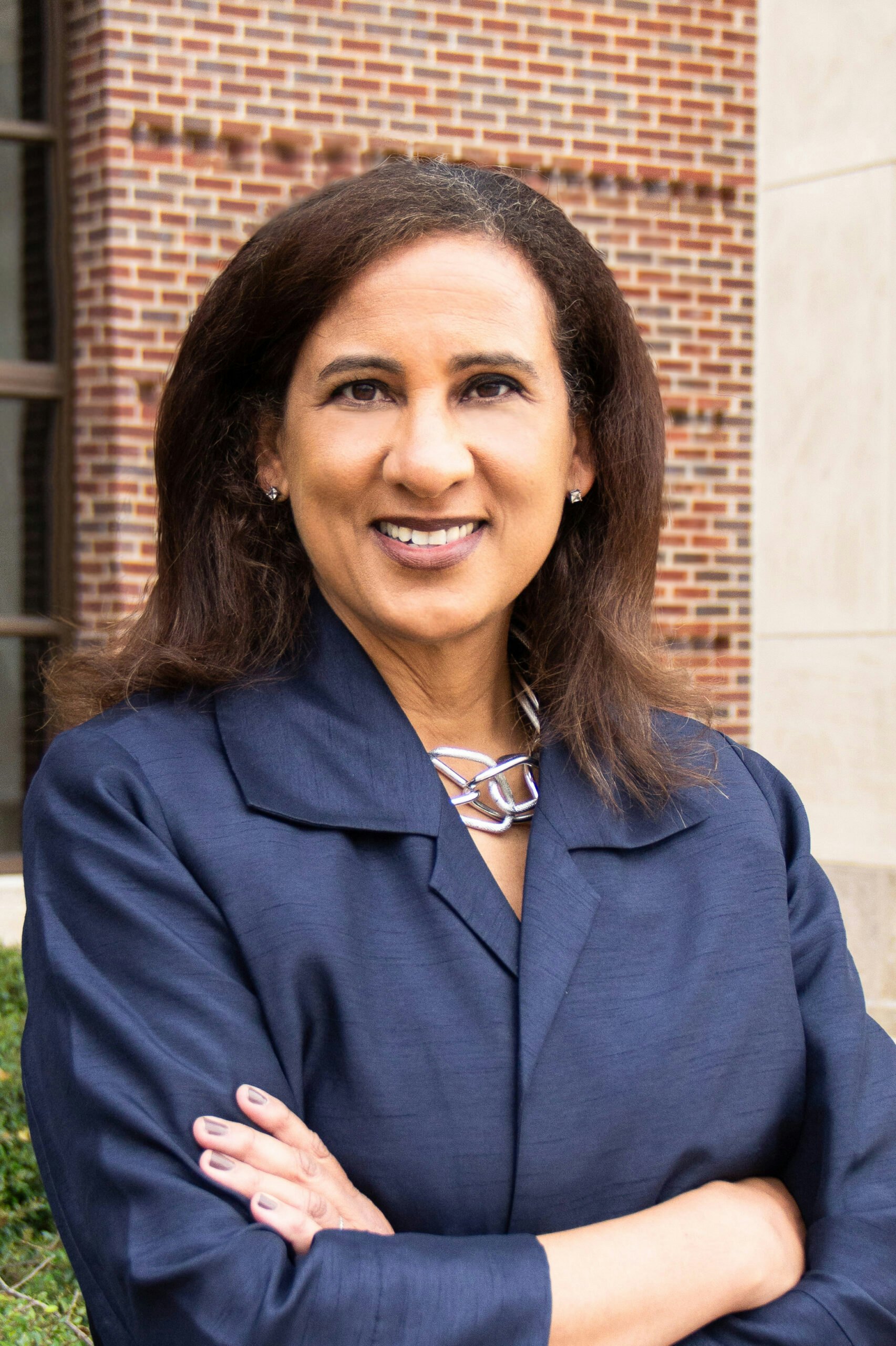
We are taking our series on the road, out of our Dallas studio and coming to California to talk to Dr. Kirsten Bibbins-Domingo. Dr. Bibbins-Domingo is a medical doctor, and also an epidemiologist, and currently serves as the Editor in Chief of JAMA, the Journal for the American Medical Association. And I have the good fortune that she is also my sister.
It’s wonderful to have you here. The Bush Institute is delighted to host you, and I wanted to start with, you have spent your career in public health, and you have served vulnerable communities in many different places and now are leading a research institution in editing their journal to think about these issues. What brought you into this line of work?
Kirsten Bibbins-Domingo:
I was always interested in science and the evidence, the facts that underlie everything we know about human health. That led me on my career from my Ph.D. into my M.D., having that science really serve the greater health of patients and the population.
But it turns out that’s only possible when we’re able to communicate that science, disseminate that science to the people who need it most, and that’s what journals do. They disseminate science so that other scientists can discuss a scientific finding. They disseminate science for clinicians or for policymakers or practitioners to think about how to implement, and to the general public.
And they do their part to help vet the quality of the science. All those things intrigued me, and that’s how I ended up here after many years being a scientist myself and still an active practicing clinician [to] being the head of this journal trying to take on that part of the work, which is essential to science.
Nicole Bibbins Sedaca:
Excellent. I know you have spent a lot of time serving vulnerable communities here in San Francisco and other places. Obviously, for those of us who believe we should be serving the vulnerable around us and those who have needs is the right thing to do. Tell me also, for our country and for many countries around the world, why is it the right thing to do in a society to think about the health and the well-being of those different communities?
Kirsten Bibbins-Domingo:
I guess I think about at first– it’s easiest to think of these things most local. I think we all understand that within our families, on our streets, in our neighborhood, there are people who are less well-off and people who are more well-off. And in general, I think people do their part to figure out how to help those people who are less well-off. It’s not hard to imagine why that’s just an important part of being human and being part of a community.
I think when you start to get into larger cities or states or the country, you start to realize, every way in which we function from day to day includes people who are less well-off than other people. People who might be working for lower wage jobs, but their jobs are just as important to the work of a company [or] to the work in a city.
Whether it’s that emotional– we understand why it is to do the right thing within our families. Whether within a larger community that you understand that our communities don’t function, or on a country or on a global scale. You start to realize that not only do we need to pay attention to those who have less because it’s the right thing to do, but it starts to interfere with things that other people do care a lot about: the economics of how we all live together, the functioning of how we all live together.
Because ultimately, the needs that other humans have are things that we address in other ways. And if we don’t do it in a way to pay attention to those needs up front, we’re going to pay on the other end in less efficient ways. There are many levels you can think about it. I like to think about it that it’s just the right thing to do.
But I think it has consequences even if that’s not your primary motivation for thinking about why it’s the right thing to do.
Nicole Bibbins Sedaca:
Excellent. You are the Editor in Chief of the Journal of the American Medical Association, one of the leading medical journals, and you are in charge of thinking through a lot of great, fact-based, top-notch research.
Talk to us a little bit about how you’re thinking about the importance of fact-based research right now and how it contributes to a healthy, thriving community and country, and just the importance of that type of research at this point.
Kirsten Bibbins-Domingo:
Sure. I can tell you, in the last three weeks we heard presentation of late-breaking science that really revolutionizes the treatment of pancreatic cancers. One of the worst cancers. Science that was developed here in the US, that is going to change the way patients and clinicians think about this really devastating disease.
We’ve had an incredible discovery that was announced just two weeks prior that is going to change the way we think about driving down cholesterol, which is at the root of a lot of heart disease and stroke, that we have also developed here in the US through academic discoveries as well as partnerships with important multinational companies.
I think we live in an extraordinary time. There’s a lot that’s broken in our healthcare system, but the pace of scientific discoveries that’s really changing how we think about devastating conditions like cancer, like heart disease, like obesity, and diabetes, like even rare diseases that now we can identify and figure out how to treat. It’s extraordinary.
And all of that, at its heart, comes through an attention that the US has had for decades in driving scientific discovery and investing in academic institutions and independent scientists in thinking about that translation to new drugs, new devices, new treatments. It’s hard to overstate how miraculous some of these discoveries are.
I think at their heart is the appreciation that we have to understand human biology. We have to understand the mechanisms by which disease works. We have to use that understanding to develop new therapies, to test hypotheses. Not all of this is going to be correct, so an essential part of science is actually putting ideas out there that others can challenge, can debate, can discuss, can then try their own experiments to test that idea, to prove it wrong or prove it right.
That essential process is what underlies all these fantastic breakthroughs that we’ve had just in the last few weeks. I think it’s an exciting time right now when I think about these discoveries. It’s also a time to reflect on what it takes to get there and what it means to keep those scientific institutions whole. To keep them doing the work that really has led to the incredible improvements we’ve seen in health, and not to take it for granted because it can very quickly, I think, go by the wayside.
We’ve come to take a lot of this for granted, that we’re just going to have these discoveries. And it would be very sad to take these for granted because there’s been a lot of investment over time in the US, a lot of investment of time of people who are engaged in this work, and we should not take it for granted.
Nicole Bibbins Sedaca:
And the diseases you’re talking about hit people all through our country.
Kirsten Bibbins-Domingo:
Absolutely.
Nicole Bibbins Sedaca:
In every corner of our country, in every socioeconomic group in our country.
Kirsten Bibbins-Domingo:
That’s exactly right…
Nicole Bibbins Sedaca:
And the science behind it has been what has saved lives. But you talked a bit about the debate and the rigorous discussions that you have among scientists who are desperate to get to those answers, and that the conversations are what really is iron sharpening iron. We talk a lot at the Bush Institute about pluralism, about how you have people with diverse ideas. They don’t have to agree with everything, but the whole idea that you make space for someone who thinks differently or approaches something differently.
How do you– how does that show up in your work?
Kirsten Bibbins-Domingo:
Oh, yeah. It’s really essential to the work. We think a lot about this. We’re a proudly independent journal. We’re the Journal of the American Medical Association, but we have editorial independence from our sponsoring organization. And there are hundreds of journals like ours that take on the work, that vet the science, that publish every day and put scientific content out.
The point of the work– and we pride ourselves [that] we are a peer-reviewed publication. That means other scientists are giving us the input on the science we publish, saying, “These are the things that seem right. These are the things that are problematic with that experiment.” And essential to science is to put your ideas out there for other scientists to say, “I’m not so sure about that,” or “Wow, that might be right, but I want to reproduce that in my own experiment.”
So, essential to science is not that everyone toes the line. Essential to science is in fact that you have the discussion and the debate. That we have not one government journal, but we have multiple journals that are publishing multiple experiments, the results of which people are continuing to discuss and debate. That is how we arrive closer to the evidence, the truth that underlies what are the basis for discoveries that really cure patients, that improve the health of the public.
I [had] never thought about science and pluralism or democracy as words that we put in the same sentence, but as I think about what’s essential to the scientific process, that is at its core is essential to it. That anybody who can put their idea out there, that idea can be challenged, and that part of arriving at the scientific process that we hope leads us closer to what is in a fact, what is evidence, is that we have an open process where there’s discussion and debate, and ultimately more experiments to figure out what is, in fact, correct.
Nicole Bibbins Sedaca:
It’s amazing that fact and challenge, debate, discussion, transparency are the things that lead us to the progress that at the end of the day is saving lives.
Our series is called Democracy Is a Verb. We do know that democracy is not a verb. We know that it’s a noun, so we always have to say that because people are unsure about that. But what we focus a lot on is that a healthy democracy is not just about elections or a government. It is about an active civil society where every single person is doing democracy as a verb. It means not just individual citizens, it means educational institutions, it means research institutions, civil society, government, media, all of it together.
As you’re thinking about the critical role, particularly from your perspective, what tips or what ideas do you have for citizens who are thinking, “I need to be part of my democracy. I need to be part of engaging this,” because it takes all of us to make our society as robust and resilient as possible, and our democracy as strong as possible.
Kirsten Bibbins-Domingo:
I think for me, the revelation was just thinking about it that democracy is not here, and then I’m doing my work over here. But as you suggest, that essentially every sector, and certainly I can speak for mine in science and medicine, relies on the fundamental principles of democracy. That without that, that the things that we view as important for discovery, for implementation, for improving the health of our patients, or for the population, rely on the core principles that that underlie a strong and healthy democracy.
But I also think about it in the way that I have come to understand the strength in democracy as being really something you have to appreciate very locally. It’s funny, I had this– the good fortune to give out some awards that Research America was giving out to scientists who’ve done their part in improving communication about science.
And we gave these awards to these wonderful graduate students who basically convinced their graduate students to go out and write op-eds in their local newspaper.
Nicole Bibbins Sedaca:
Oh, that’s great.
Kirsten Bibbins-Domingo:
Some of it is the science that we do sometimes sits behind closed doors, and people might become suspicious of science or not understand what is it that that group is doing, or why is it that we understand this to be evidence that underlies this disease?
I think the power that these graduate students had was to get other graduate students to just talk in their local communities about their work. I think when people understand why people are excited about science, why we’re excited about it in the doctor-patient relationship, I think people can come to understand what’s important about the structures that we risk taking for granted, but really are the things that are responsible, to a large measure, for why we know what is going to make us healthier. Why we know the medications we take or the advice we take in terms of our daily lives.
And I think that’s– I think at the end of the day, people have to experience it in conversation with other people. And that’s what we know about the doctor-patient relationship. It’s what we know from these graduate students to get their colleagues out there talking with their local communities is very powerful.
I think we do have to, as scientists and as physicians and medical practitioners, be more outspoken amongst our colleagues locally in order to get people excited but also to establish that type of trust and rapport, and sometimes debate and discussion as we’ve talked about, because not everybody is going to agree with everything right away.
But I think, at its core, it really is that local and personal interaction that really helps people to appreciate what makes the democracy strong.
Nicole Bibbins Sedaca:
I love how all of the elements of democracy are what it takes to have the rigorous research that it’s going to take to keep our communities and our individual citizens healthy and robust and resilient. And that it is those healthy communities that make our democracy strong.
And it is all of that together. That is great because democracy is a verb in the work that we’re doing, and it really is each citizen taking their part in it.
Dr. Bibbins-Domingo, I will call you Kirsten as my sister, thank you for all the work that you’re doing. But thanks for taking the time also to share your expertise with us.
Kirsten Bibbins-Domingo:
Thanks for having this discussion. Thanks for visiting California and thanks for having this discussion.
Nicole Bibbins Sedaca:
My pleasure.


