

Democracies are losing ground to authoritarian regimes. A majority of the world’s population lives in countries that are not fully free, where political rights and civil liberties are severely restricted, according to Freedom House’s 2026 report.
China, Russia, Iran, and North Korea, known together as CRINK, are working to undermine U.S. leadership by weakening the global rules-based system and eroding the effectiveness of international organizations.
CRINK’s actions threaten American national security by damaging U.S.-championed global norms, challenging democratic principles, violating citizens’ rights, and suppressing freedoms worldwide. Russia targets civilians in Ukraine, while North Korea, Iran, and China assault dissidents beyond their borders in what’s called transnational repression. All of these attacks on human rights are fundamental to the autocratic playbook.
CRINK’s Key Vulnerabilities:
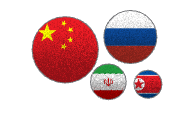 CRINK is a collection of unequal partners. China and Russia dominate in decision-making and agenda-setting due to their economic strength, nuclear capabilities, and veto power at the United Nations as permanent members of the Security Council. While North Korea has developed nuclear weapons and Iran continues to pursue them, their capabilities and global influence remain more limited compared with China and Russia. This uneven power balance fosters mistrust and resentment among CRINK members and can cause internal divisions when goals are mismatched.
The centralization of power in autocratic countries distorts decision-making.

- Elites often conceal their private beliefs out of fear, leading to a greater risk of policy miscalculation.
Autocrats use fear and coercion to stay in power, but these tactics often backfire.

- Research on freedom fighters shows that the use of brute force and torture strengthens dissidents’ resolve and deepens their commitment to justice.
CRINK can only loosely be considered an “alliance.”

- The grouping is driven by shared grievances and interests in weakening America but is built on a transactional-style international relationship. Because CRINK is based largely on interests and not beliefs and lacks accountability and enforcement, its long-term sustainability is inherently fragile.
Our Recommendation:
China, Russia, Iran, and North Korea (CRINK) are increasingly challenging the credibility of U.S. leadership and weakening democratic order, the source of decades of global peace and stability. To counter CRINK, the United States should adopt proactive strategies based on America’s founding ideals of freedom, opportunity, and democracy, and work closely with its allies.
The administration, Congress, the private sector, and our allies should expand “soft power.”

- The United States should showcase and advance American values of opportunity and accountability through partnerships, rather than transaction-style global relations. Soft power is a strategic necessity – a cost-effective and efficient national security tool.
- Supporting American broadcasters Voice of America, Radio Free Asia, Radio Free Europe/Radio Liberty is vital for information competition and narrative warfare. Support groups like The National Endowment for Democracy is also vital.
- Supporting civil society groups and oppressed citizens to disseminate credible and reliable information in closed societies is a cost-effective strategy to expose the flaws in propaganda and reveal dictators’ corruption, brute force, and injustice.
The administration should integrate human rights into the U.S. national security strategy.

- Human rights issues and national security are inseparable. Authoritarian regimes pose a threat because of how they treat both their neighbors and their own people.
- Democracy and human rights are not competing priorities; they mutually reinforce U.S. national security interests.
Congress should recalibrate sanctions legislation, and the administration should tighten its enforcement and implementation.

- Congress should reassess current sanctions and improve enforcement capacity.
- Congress should increase funding and staffing for the Office of Foreign Assets Control (OFAC) to improve the monitoring and investigation of sanctions evasion networks. The administration should also aggressively deploy existing tools such as the Global Magnitsky Act to target individuals and entities facilitating illicit transactions and sanction evasions.
Congress and the administration should empower democracy advocates from CRINK.

- Both Congress and the administration must recognize that robust and sustained investment in elevating democracy and human rights advocates advances U.S. national security interests by supportingindependent media, nongovernmental organizations, and dissidents whose voices can expose corruption and human rights abuses.
The administration should promote democratic and free market narratives.

- Diplomacy and soft power should be used to showcase that when freedom enables innovation and creativity, free-market principles encourage economic and technological competitiveness.