


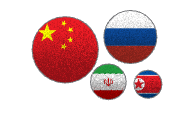
The United States, together with its democratic allies, is the counterweight to China, Russia, Iran, and North Korea, known together as the CRINK alliance. America’s innovation, emerging military technologies, existing alliances, and policy shifts are stronger than CRINK’s military and economic assets. CRINK is not invincible.
CRINK countries are strengthening coordination across economic and military cooperation, while increasing cooperation to evade U.S. sanctions. They seek to undermine American leadership, weaken the rules-based global economy, and threaten world peace and stability.
Russia’s full-scale invasion of Ukraine and the continuing conflict with Iran in the Middle East demonstrate how these countries contribute to instability and disruption of the international order.
CRINK’s Key Vulnerabilities:
 Unequal players, mismatched goals
CRINK countries have both military and economic goals that are misaligned and largely incompatible. China serves as the primary economic hub for Russia, Iran, and North Korea, creating an asymmetric power imbalance that gives Beijing a disproportionate advantage. Robust institutional mechanisms and enforcement frameworks could mitigate this imbalance. However, mistrust and a lack of shared values limit CRINK’s institutionalization and prevent deeper coordination.
CRINK largely operates based on sovereign interests, not as a part of a broader coalition.

- China continues to expand economically, with long-term growth driven by export-oriented manufacturing and technological advancements.
- Russia and Iran rely heavily on energy exports.
- North Korea’s struggling economy cannot afford to import expensive, industrial goods from its partners and offers little beyond limited natural resources such as iron, coal, herbs, and labor, making it a less attractive economic partner.
Coordination without cohesion: Not a NATO-structured alliance yet.

- CRINK’s military cooperation has expanded beyond information sharing to include North Korean troop deployment to Russia, Iran drone technology sharing, growing Russian support to Iran, and increased joint military exercises. Nonetheless, the cooperation remains far less integrated compared with NATO.
- While North Korea maintains defense treaties with China and Russia that should trigger automatic mutual defense, Iran is excluded.
- Despite some Russian backing in intelligence sharing, Iran has not received significant military or security guarantees from its so-called partners, as evidenced by the current war in the Middle East.
Our Recommendation:
China, Russia, Iran, and North Korea (CRINK) are increasingly challenging the credibility of U.S. leadership and weakening democratic order, the source of decades of global peace and stability. To counter CRINK, the United States should adopt proactive strategies based on America’s founding ideals of freedom, opportunity, and democracy, and work closely with its allies.
The administration should prioritize securing the semiconductor and critical mineral supply chain.
- Develop a resilient semiconductor supply chain and reinforce commitment to Taiwan – a democratic partner producing over 60% of global semiconductors and nearly 90% of advanced chips – by reducing U.S. reliance on critical mineral supply chains.
- Expand rare earth sourcing capacity through partnerships, joint ventures and cooperative agreements, and trade deals with partners and allies.
The administration should reform the Indo-Pacific alliance and rejoin the Trans-Pacific Partnership.

- Establish an Asian version of NATO to prepare for potential conflicts in the Taiwan Strait, Korean Peninsula, and South China Sea, while modernizing the Indo-Pacific alliances through increased burden sharing.
- The United States should reenter negotiations for the Trans-Pacific Partnership (TPP) agreement, which would provide economic as well as strategic benefits for the United States and its allies.
Congress should strengthen sanctions enforcement.

- Implement targeted sanctions on North Korean and Chinese entities supplying Russia with arms and dual-use technologies. To this end, expand the use of secondary sanctions to penalize third-party entities that facilitate transactions between CRINK members.
- Collaborate with allies to secure a decentralized online platform that shares information and data on sanctioned entities to reduce the enforcement burden.
The administration should increase military support for Ukraine to win the war Russia started.
- Helping Ukraine win the war against Russia that Russia started is the most effective means to deter/prevent another conflict that may require direct U.S. participation.
- Sustained support for Ukraine reinforces democratic solidarity and signals that territorial ambitions will trigger severe consequences, discouraging similar aggression in Taiwan or elsewhere.
- Ukraine has proven itself innovative fighters, providing its anti-drone technology to help defend against Iranian attacks on Gulf allies, and to protect U.S. military bases in the region.