On April 25, we recognize World Malaria Day, a moment to reflect on the progress made against one of the world’s most persistent infectious diseases and the work still ahead. In my latest piece, I highlight how gains in the fight against malaria were made possible through U.S. leadership to create sustained investment, strong partnerships, and a clear focus on results. The U.S. has helped save 14 million lives and prevent more than 2.3 billion cases globally through programming like the President’s Malaria Initiative (PMI).
The U.S. needs to maintain the same level of accountability and ambition through the America First Global Health Strategy, which will be critical in advancing the transition to country-led programs.
Ending malaria is within reach. We now have new tools like malaria vaccines and next-generation bed nets. Our collective success will depend on governments and partners sustaining the political will, investment, and coordination needed to protect hard-won progress and finish the job.
Bush Institute Insights
In 2005, President George W. Bush launched the President’s Malaria Initiative (PMI), and in 2006, President Bush and Mrs. Bush hosted the first White House Summit on Malaria, bringing together policymakers, experts, the private sector, civil society leaders, and faith-based organizations to raise awareness of the disease. For two decades, PMI has helped drive historic progress, with at least 35 countries now malaria-free and new tools like vaccines offering additional momentum.
In my latest explainer, “On World Malaria Day, look to the future while acknowledging the past,” I reflect on how sustained U.S. leadership has transformed the fight against malaria, and what it will take to finish the job. As countries assume greater ownership under the America First Global Health Strategy, success will depend on strengthening domestic capacity, unlocking sustainable financing, and maintaining strong accountability.
In another piece, Dr. Deborah L. Birx, Senior Fellow at the George W. Bush Institute, and I have further outlined how integrating malaria programs into broader health systems will also be essential to protect gains.
America First Global Health Strategy Update
As of April 7, the U.S. Department of State has signed bilateral health agreements with 30 countries, totaling $20.6 billion in new health funding, including $12.8 billion in U.S. assistance and $7.8 billion in partner country co-investment. The latest agreements are with the Philippines and Cambodia.
U.S. State Department Official Jeremy Lewin shed light on the progress made in completing bilateral health agreements during an event hosted by The Center for Strategic and International Studies (CSIS) on April 14. The event focused on the rollout of Lenacapavir in partnership with the Global Fund to Fight AIDS, Tuberculosis, and Malaria, and Gilead. Lewin outlined how the initiative fits into a broader overhaul of U.S. foreign assistance, including expanding access from 2 million to 3 million doses of the HIV prevention drug and advancing nearly 40 bilateral agreements.
Lewin noted that there would be 40 bilateral health agreements completed by the end of this fiscal year. There will be several informal agreements signed with countries that have smaller health budgets. He shared that 80% of PEPFAR funding is already obligated through the existing MOUs and that robust implementation planning is underway. He also defended the transition to country-led models, pushing back on concerns about capacity and supply chains.
He addressed a recent report from Reuters that the U.S. is moving to wind down its flagship Global Health Supply Chain Program, which delivered more than $5 billion in HIV and malaria commodities to 90 countries through private contractor Chemonics. “Nothing cancelled, nothing stopped,” Lewin said, noting plans to shift responsibilities thoughtfully while being committed to “no pipeline breaks.”
Finally, on Friday, the State Department released FY2025 Quarter 4 PEPFAR data. According to a press release, the data shows that as of September 30, 2025, PEPFAR supported lifesaving treatment to 20.6 million people living with HIV in more than 50 countries. However, policymakers should be aware that FY25 data prior to Q4 are not included in the release, making this a snapshot of the year, rather than a holistic analysis. The New York Times, NPR, and former PEPFAR officials have commented on the data’s release.
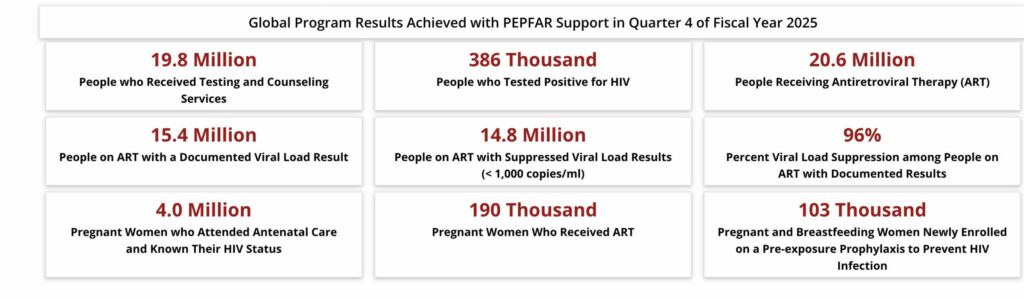
Figure of the Week
4.3 billion reduction in fiscal year 2027 global health financing
The President’s FY27 budget proposal would decrease global health funding by $4.3 billion and eliminate disease-specific budget lines, including those that have underpinned PEPFAR’s work. That includes $923 million less for HIV/AIDS, $561 million less for maternal and child health, a $576 million decrease of mental health funds, and a $872 million decrease to health workforce programs, Health Policy Watch reports. While the proposal retains the one-third matching requirement for the Global Fund to Fight AIDS, Tuberculosis, and Malaria, the broader reductions and restructuring could undermine continuity of care and accountability. Congress will ultimately determine FY27 appropriations while weighing the important role of U.S. leadership in the fight to end HIV/AIDS as a global health threat.
Ally Updates
A recent report from the American Foundation for AIDS Research (amfAR), Unmeasurable and Unaccountable, examines how metrics in these agreements are designed to track progress as PEPFAR transitions to country ownership. Reviewing seven publicly available Memoranda of Understanding (MOUs), the report highlights areas to strengthen accountability and offers several recommendations:
- The Bureau of Global Health Security and Diplomacy (GHSD) should develop new HIV metrics that focus on health system performance, including access, quality of care, and treatment continuity.
- Programs should establish accountability and oversight mechanisms, including patient feedback systems and routine assessments of care delivery.
- The President’s Emergency Plan for AIDS Relief (PEPFAR), PMI, and other global health programs should restore transparent, routine public reporting of budgets, expenditures, and performance data.
- Congress should enforce clear reporting requirements for all MOU-related data to strengthen oversight and accountability of U.S. global health investments.
In the News
- Bush Institute Senior Fellow and former U.S. Global AIDS Coordinator Dr. Deborah L. Birx joined NPR to discuss the legacy and impact of PEPFAR. During the interview, she emphasized the need for continued data-driven programming, political will, and monitoring, oversight, and reporting as the program transitions under the America First Global Health Strategy.
- As part of the World Bank and IMF Spring Meetings 2026, The ONE Campaign hosted discussions with African Ministers of Health and Finance and U.S. partners on the future of global health financing and bilateral health agreements.
- In Malawi, comprehensive training in integrated community case management (iCCM), supported by the PMI REACH Malaria project, equipped 90 Health Surveillance Assistants (HSAs) with the skills to diagnose and treat malaria, manage childhood illnesses, and properly coordinate care for severe cases. As a beneficiary of the program, John Chiona shared that when he first became an HSA, he received only basic, on-the-job training and lacked the skills needed to manage common childhood illnesses. Recognizing this gap, he sought additional training and certification to better serve his community. Now, as a certified iCCM provider, John’s newly acquired skills will improve access to quality healthcare for more than 3,000 people living in the remote Cheyo catchment, located 15 kilometers from the nearest health facility and the surrounding areas. For John, the training was “a dream come true” that will allow him to “serve [his] community with confidence.”
- Haiti’s HIV response is at risk of collapse as the U.S.-funded Global Health Supply Chain Program, Procurement and Supply Management (GHSC-PSM) winds down. Writing in a detailed Substack analysis, Alain Casseus, chief of the Infectious Diseases Division at Partners In Health, notes that GHSC-PSM currently handles everything from procurement to last-mile delivery for 272 facilities serving roughly 140,000 Haitians living with HIV. Without it, medicines may still arrive on the island but not reach patients. “Everyone can buy the drugs. No one can deliver them,” writes Casseus. His analysis highlights how breakdowns in logistics, not just financing, could quickly disrupt treatment and testing in Haiti, one of the world’s most fragile health systems.
- “What happens in Sudan will not stay in Sudan,” writes Sudanese-British businessman and philanthropist Mo Ibrahim in a Financial Times op-ed, arguing that Sudan’s civil war – now entering its fourth year with 150,000 dead and 12 million displaced – risks far broader consequences. Ibrahim warns that continued instability could “complete an arc of ungovernable lands across the Sahel.” The prolonged conflict, fueled by weapons flows and stalled diplomacy, could threaten regional health systems, humanitarian access, and long-term stability in the region.
- Malaria remains one of the most widespread infectious diseases, with roughly half of the global population at risk of infection. While the past two decades have seen major gains in prevention and treatment, progress has begun to stall in some countries due to persistent challenges like drug and insecticide resistance, climate pressures, and weak health systems. Through support for the PMI and the Global Fund, U.S. leadership has played a central role in expanding access to lifesaving tools such as insecticide-treated nets and malaria vaccines. Still, sustaining and accelerating progress will require continued investment, stronger surveillance systems, and country-led strategies that reach the most vulnerable populations, particularly children under five, who account for the majority of malaria deaths.