
On the ground
Voices from Iran


The Iranian regime continues to silence the Iranian people through an internet blackout, obstruction of satellite transmissions and cutting of cellular telephone communications. Despite this, the Bush Institute, using trusted interlocutors with limited communications into the country, offers some glimpses, translated into English, into daily life from ordinary Iranians in Iran. Names and locations are obscured for security reasons; some content has been compressed for brevity.
The first five accounts were collected from April 1 through April 10, 2026.
1
ACCOUNT 1: A MORNING LIKE ANY OTHER
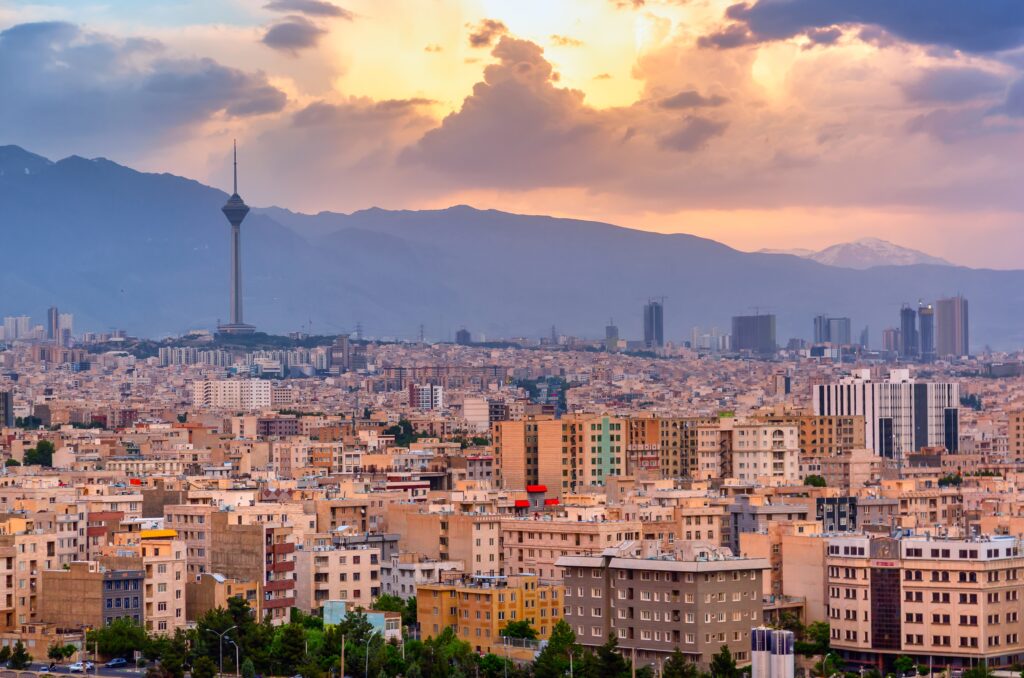
It began like any ordinary morning. My two young children had just been dropped off at preschool and school at 8 a.m.
Between 9 and 10 a.m., I heard the news live in the room: the United States and Israel had launched strikes on Iran. My only thought was to reach my children as quickly as possible. What normally takes half an hour turned into a desperate three-hour ordeal through gridlocked streets filled with panicked parents.
Within the first hour, the government shut down cellphone service and the internet. No official announcement was made. People learned of the attack only through word of mouth, smuggled signals, and satellite TV channels. The roads were choked with cars, eyes wide with fear.
The bombing continued across multiple cities, including Tehran. We waited anxiously for confirmation of one particular target: the residence of Ali Khamenei, the man many Iranians call the butcher of Iran. It took the regime nearly 24 hours to admit he was dead.
My six-year-old daughter turned to me and asked, “Mommy, Khamenei is dead?”
“Yes,” I replied.
“Hooray!” she said. “Now we will have unlimited access to the internet.”
Thirty-seven days later, she still cannot watch her cartoons on YouTube. She remains unconvinced, certain we are lying and that Khamenei is still alive.
Contrary to expectations, there were no immediate shortages of food or water, though prices rose sharply and frequently. The greater hardship was isolation.
Day 37. Panic has given way to a strange, tense calm. We celebrated Nowruz—the Persian New Year and first day of spring—amid a full-scale regional war. For the first time in decades, we were spared Khamenei’s hollow annual message. Nothing about him or the Islamic regime ever felt truly Iranian.
Iranians today are caught between worry and hope.
Almost everyone I speak with wishes for this spring to mark a true new beginning.
A year without Islamic extremism.
A year of equal rights for every Iranian—regardless of gender, religion, or sexual orientation.
A year to feel proud to be Iranian again.
A year to celebrate Iran: an ancient civilization that has endured for thousands of years.
2
ACCOUNT 2 : TO LIVE FOR THE HOPE OF IT ALL
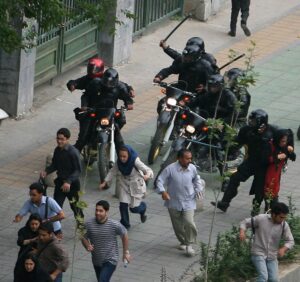
Ever since I can remember, I’ve been waiting. I’ve been waiting for the day I would see Iran without the Islamic Republic. As far back as my age allows me to remember, the first time I became familiar with the meaning of massacre was on 9th of July 1997 in the student protests which began in the University of Tehran and then spread to others. All the years of my life after that were spent with the hope that one day, at last, my Iran would be freed from the claws of a dictatorial regime.
But the massacres of 2009 (the green movement protests), 2019 (bloody November protests after the raise in the gas price), and 2022 (the woman-life-freedom uprising after the killing of Mahsa Amini in custody of Hijab police), along with the daily executions throughout these years, left me more devastated and more hopeless. So many years of working in a field directly tied to the internet, first turned me into a “fighter,” and then into an “exhausted” person. A fighter, because every time the global internet was shut down, it took my job away from me, I became unemployed, and then when it was restored, I had to fight much harder than before just to make up for it. Exhausted, because every time you fall and have to get back up again, it throws you back far behind where your strength once was. And I don’t know whether anyone reading this can even imagine what it means to be deprived of the right to use the internet, even for just a few days.
In January 2026, we went out into the streets empty-handed to practice our right to freedom and protest. The massacre on the 8th and 9th of January was a truly horrifying story.
Can you imagine the streets smelling of blood?
Can you imagine that when you leave your house, as you walk, you have to watch your step to make sure you do not step on your compatriot’s blood?
Or can you imagine that in such circumstances, even the phones and the internet were cut off, and you could not find out whether the people around you were still alive?
And can you believe that this is not a metaphor, but a reality that happened in my country? And that massacre happened not the way the media said, not over the course of two days. In eight hours out of those two days.
But for us Iranians, who for the past 47 years have been deprived of all human rights, the answer is this: if even war would cause us and our dreams to be destroyed but allow the children who come after us to live, then yes, absolutely.
Set aside the concussion, the injuries, the torn clothes, the serious damage to my eardrum, the bruises, and the shard of glass that was pulled from my eye, along with the horrifying scenes I witnessed that have now turned me into someone living with post-traumatic stress. Put all of that aside and ask me this: in those terrible moments, what exactly were you afraid of?
That the security forces arrived before the emergency responders, carrying guns as tall as themselves, shouting at us, the injured to disperse us from the scene. And they were forcing the women around me, covered in blood, to put on their headscarves; not to save our lives, but to hide what had been targeted there.
3
ACCOUNT 3: LIFE UNDER THE SHADOWS OF WAR
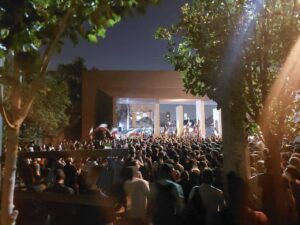
Today* marks exactly 82 days since the morning I woke up to the news that my friend had been killed by agents of the IRGC in the streets of Tehran, and 32 nights since I went to sleep hearing that the dictator of Tehran was dead.
We have lived through weeks of emotional turbulence. From shock and disbelief at a massive wave of killings, to moments of grim
satisfaction as, one by one, the oppressors of my people fell. From the fear of airstrikes, sometimes bringing what felt like good news, and other times carrying the deaths of my fellow citizens.
It feels as though we, the people of Iran, have been strapped into the world’s most extreme emotional roller coaster.
Life under the shadow of war turns the mind toward the future. The past, whatever it was, seems to lose its weight. Survival, and the question of what comes next, becomes the only thing illuminated in the restless mind. And what a bitter irony it is that the most uncertain and obscure stretch of time is now the most compelling subject of our thoughts.
This regional octopus may no longer possess the strength it had before the war, but when it comes to suppressing its own people, it still holds the upper hand, by far. And now that it has lost much of its power beyond its borders, we are certain it will turn inward, unleashing repression even more brutal and deadly than before, in an attempt to conceal its weakness.
If that dark future arrives, the writer of these words will likely be among the masses of refugees, forced to leave behind his beloved country. And that would mean the death of a nation, the death of a country.
[*NB: At the time this was written]
4
ACCOUNT 4: THE POWER OF THE PEOPLE
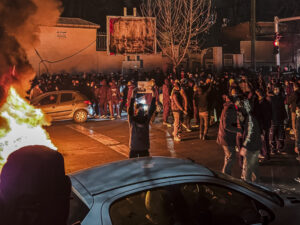
The only reason that has saved our country from being totally torn apart at the hands of this regime are the Iranian people. The people who from the very first day that this regime took control in Iran, fought empty-handed and stood against it to preserve the country. The last instance of this long fight is the nationwide protest that happened on January 8th and 9th 2026 in which, Iranians took over the streets in all 31 provinces of Iran, demanded the dismantling of the regime and for the return of the Crown Prince Reza Pahlavi (the son of Iran’s Shah before 1979), yet they have been massacred in the most gruesome ways within hours.
This massacre, which in some respects was unprecedented in world history, made the truth about the Islamic Republic clear even to the most hesitant people.
The sound of fighter jets and drones overhead, the sound of missiles in motion and exploding, the relentless and indiscriminate firing of anti-aircraft guns, and the sound of emergency vehicles and ambulances are all terrifying. But when you are forced to, you get used even to these. Our lives, in whatever form they can continue, still go on. Under this same condition, we still shop, we still cook, and we see our friends, especially these days, which coincide with Nowruz and the visits that come with it.
Nowruz (the Persian new year celebration that arrives with first day of the spring) is a tradition thousands of years old, and perhaps the deepest bond connecting all Iranians to one another. Throughout the darkest days of past centuries, Iranians have still honored these days, and we are doing the same now, under bombardment, repression, and killing.
As an Iranian citizen who has probably already lived more than half of their life, I have no particular wish other than the end of this regime of pure evil and decay, a regime that has sacrificed everything we have to its anti-West delusions and planted horror and fear in every single cell of our bodies.
Even now, as I write this text, I am anxious. I know I will remain anonymous and that no danger threatens me, yet my mind has been shaped by self-censorship. Every text I write, I think about it word by word, about what I would say in an interrogation if I were arrested for writing it, about how I would defend this or that passage in court, and so on.
I am finishing this note while, from not too far away, I can hear the sound of fighter jets moving and one explosion after another. I do not know where it is, but I would like to imagine that they have killed another one of the regime’s leaders, or bombed a group of repressive forces, or at the very least destroyed part of the regime’s military and security buildings. Of course, in moments like this, all of us also think that perhaps one of the regime’s leaders has taken up residence in our apartment building, and that in a few moments one of these very missiles may hit us too, and everything will be over.
But what choice is there? If, out of this war, a day comes when the Islamic Republic is no longer in power, I will endure every one of these fears and anxieties with all my being, and later I will remember them as the most riveting days of my life.
5
ACCOUNT 5: FREEDOM’S HOPE
As an Iranian, my fear is that this criminal regime will remain and carry out mass killings of people and political prisoners. I hope we are not left alone until we achieve victory.
In hope of freedom and victory.
6
ACCOUNT 6: A FAMILY MOURNS
As part of the Bush Institute’s “Voices from Iran” series, we are sharing a narrative from a family whose child was killed in the January 2026 protests in Iran.
The story was told by the family to a trusted interlocutor inside Iran, who then shared the story below, with the family’s permission, with the Bush Institute in May 2026.
Names have changed for security reasons.
From the very first moment that I’ve met this gentleman, the grief in his eyes was very obvious. Even though we met at a worksite, after the initial greetings he immediately started talking about his son and it was evident that his loss has fully haunted him.
“Kaveh was 16 at the time they killed him. Soon he would have turned 17,” his father says.
The family always had a financially challenging life, even with two full-time working parents. It was not easy for them to make the ends meet. The family was never that involved in social or political issues in the country, except for Kaveh. His mother said,
“He has always been the spirited one, the ambitious one, the one who wanted change. He was always following the news and yearning for a better future, for himself and especially for his sister.”
His mother described the events: “On the evening of January 8th, we departed from my workplace in the city center, and saw a huge, massive crowd. I was hesitant at first, but seeing him so ecstatic, thinking that finally the time has come, the time for the fall of the regime has arrived, I did let him go and join the protest. I begged him to take care of himself for me and his father – we could not bear anything happening to him. He told me to go home and wait for him there and after a short while, we lost each other in the crowd. I even asked him to not take his cellphone with him, but he was determined. He said I’m going to record history.” His mother added that Kaveh did take several pictures and videos, sharing them through channels so they could reach a global audience.
His father continued: “After an hour passed from the starting of the protest, I called him. A voice that I did not know answered his phone and told me that my son has been shot, that he is not in a good condition and I should go to the address they gave me and take him immediately to hospital.” Kaveh had been shot, and not quite conscious, had been in hiding in a house of one of the ordinary citizens who provided refuge to the wounded and fugitive protesters so that they won’t immediately get killed or get arrested by security forces. His father, unable to reach that address through the massive crowd, ongoing clashes and gunfire, asked his other child to travel from another direction to pick Kaveh up.
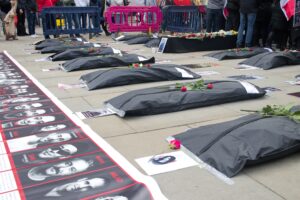
When his father arrived at the hospital, he said, “I was quite detached from this world. I had no idea what is going on around me and what is happening.” There were many wounded protesters being transferred to the hospital. Kaveh’s mother, desperately trying to identify her son amongst the mass of bodies, thought to herself, “Does this one’s hair look like my son’s? Does these muscles look like his?” She thought, “You know, my son was quite an athlete. He was an avid trainer and he was also interning at a mechanic shop to learn auto repairs. All of his teammates and colleagues loved him, they all say how dedicated and hardworking he was, how decent and kind he was.” She added, “When I was looking through the windows of the Intensive Care Unit and watching all those people, wounded, near death, and watching their families on this side, it suddenly hit me, a lot of these people have already families, they are married they have children. Maybe they are more beautiful than my son, more deserving than my son. I started praying and asked God if he is going to save somebody, save the ones who are more deserving than my son. Save the ones who are married, save the ones who have children. With all the love that I had and have for my son, I don’t know what granted me this power, to stay there and pray to God to save others over him.”
As Kaveh’s parents were waiting in the hospital while their son was in intensive care, they were told to go home and wait. They argued,
believing that if they left, security forces would remove life support. When they did head home, close to dawn, they received a phone call that their son had passed away.
When they returned, security forces denied them the body, trying to force them to bury their son in silence, without attention. Officials from the Supreme National Security Council arrived and start threatening them. Finally, they were forced to pay a ransom of 200 million Tomans (~1000 euros) to receive their son’s body. “To be honest, I am regretting that decision now,” Kaveh’s father said. “We should not have paid the extortion money to the murderers of our son and many others.” Despite warnings to keep the funeral small, massive crowds of people, people that they knew and a lot of people that they have never met, came to the ceremony in solidarity.
Kaveh’s father said, “This support really touched me. It made me feel that we are not alone. It really opened my eyes to what my son desired – that these people deserve much better. After the funeral, we have been receiving letters, gifts, fruit baskets, flowers from people that we do not even know, and they want to show us that we are not alone. So, I think I’m also going to visit other families who have lost their loved ones. We shall not be alone in this.”
Kaveh’s mom says, “After Khamenei got assassinated, I didn’t have it in me to face conversation. I turned off my phone and ran to the yard where my husband was smoking a cigarette. I tried to tell that he is dead, he died. I have never wished death for anybody, and at moment, I could not even bring myself to say his name.”
“To be honest, it did not ease my grief. I just wished for my son was here and was able to witness it, that finally the dictator of Tehran is dead.”
7
ACCOUNT 7: WOUNDS ON OUR SOULS
Content warning: The following material contains depictions of physical violence and death.
This account was collected by the Bush Institute in June of 2026.
I had many reasons to join the protests. Beyond my own personal circumstances, being present at the demonstrations felt like a mission and a duty as an Iranian. Government corruption, poverty increasing everywhere, unbelievable inflation crushing families, unemployment, and the absence of any hope for the future, especially among young people and the working class, weighed heavily on me and on every other Iranian psychologically. Taking to the streets and speaking our pain aloud was the smallest step we could take.
On the first night (Jan. 8), it was possible to guess which parts of the city would become gathering points for people, since you could predict which locations in each neighborhood could hold larger crowds. My son and I headed to one of these main points and found that many had arrived before us. The crowd wasn’t extraordinary at first, but as we began moving toward one of the largest squares of the city, near one of the city’s wide boulevards, people poured in from every alley we passed until our numbers became very large.
The chants were about economic pressure and inflation. The protesters’ behavior was entirely peaceful. Even the slogans were focused on people’s real grievances. As we approached the destination, the suppressive forces [the Islamic Republic’s security forces] were already stationed there, blocking the crowd from continuing. Gradually, warning shots into the air began, followed by physical attacks on people. Then both sides began throwing stones at each other.
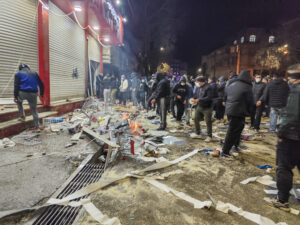
On the second night, the crowd was far larger. The number of people I saw had perhaps grown tenfold. The demographics were also more diverse. Many had come with their small children. I personally saw several infants in their parents’ arms. The route was the same as before. Before we even got close to one of the university complexes, the suppressive forces had attacked people with far greater violence. As we pushed forward, we suddenly realized that the warning shots into the air had turned into live ammunition fired directly into the crowd. Within a few minutes, many people were shot. In a short span of time, there were many bodies and pools of blood on the ground. When I saw that many of the dead and wounded had been shot without any provocation[or] holding any weapon whatsoever, I understood that we were being [targeted] at random. I had already become separated from my son and didn’t know where he was. I ran with all my strength and sprinted a few kilometers. A large portion of the crowd was fleeing. As I ran, I watched people drop to the ground like falling leaves. We didn’t even know which direction the gunfire was coming from.
I was still running when I was shot. I don’t know exactly when I realized that pellet shots had entered my ankle and my hip.
Even farther away, the suppressors continued coming at us in cars and on motorcycles, determined to disperse the crowd at any cost, not allowing even a few people to remain together. Along the way, I saw many residents opening their homes to shelter fleeing protesters.
When I got home, I found that my son had already made it back. I changed my clothes and saw the entry wounds from the pellet bullets on my body. Because of the several layers of clothing I had on, the bullets had not penetrated very deeply. My son’s anxiety and fear were overwhelming. He had never seen anything like this in his life. I tried to calm him, and, with the help of others, we were able to remove the bullets. I could still move. I decided to go back out on the third night.
On the third night, I again left the house to join a group of protesters, but the number of suppressive forces was far greater and the atmosphere far more brutal. Motorcycles attacked protesters the moment they spotted them, pursuing them as far as they could. I changed course and made my way to a new alley, but in that alley, a civilian car with two military motorcycles behind it came at me. I barely escaped, and, a few minutes later, in another alley, a resident opened their door and gave me shelter for several hours.
There I saw some residents were physicians and were trying to treat wounded protesters right there inside their homes.
Those days were deeply difficult for me. The terrifying images we witnessed inflicted grave wounds on our souls.
The image of defenseless people being killed by suppressive forces, without having even the simplest means to defend themselves, let alone any weapon to harm the soldiers, will never leave me. The vast majority of people I saw over those three nights did nothing more than walk and chant. Naturally, some of the younger ones pulled out nearby guardrails and barriers to slow the advance of the forces and smashed some bus shelter windows out of rage. But 95% of the people around me were simply walking and shouting slogans.
The most catastrophic and shocking thing was watching the suppressive forces open fire on unarmed civilians, their own compatriots, and carry out that widespread massacre.
The attacks on the second night were the most terrifying thing I have ever witnessed.
They killed people with ease.
Three of my own friends were arrested; one of them has still not been released. Those who went out early on the morning of the second day described horrifying things they had seen with their own eyes: municipal workers driving water trucks through the city, trying to wash the blood and human remains off the streets. Piles of blood-soaked shoes and clothing belonging to those who had been killed, scraps of their clothes left on the ground as the bodies were moved. Trails of blood splattered on walls, belonging to people who had been shot the night before while passing by those very same doors and walls.
No one can even begin to describe the depth of this catastrophe. People being riddled with bullets while having no shelter, cover, [or] equipment to protect themselves.
As I walked among the crowd, I watched the people around me. Most of them weren’t even dressed for running. They had come out in their everyday clothes.
On the second and third nights, I saw many small children who had gotten lost in the crowd. Or a parent had been wounded and their child, not knowing what to do, [was] crying over the parent’s body. I also saw children who had been shot.
At various moments, I witnessed people showing each other extraordinary empathy and solidarity. Some were moving through the crowd distributing water. When the attacks turned violent, others began handing out bandages and first-aid supplies.
What shattered me was witnessing the crime being committed by the Islamic Republic [regime] against its own civilian population.
In the days following the massacre, I read and heard horrifying accounts of many children going missing, most of whom were among the crowds with their families. Sexual abuse in detention centers, bodies stockpiled in cemeteries, the pressure and threats brought against the families of those killed.
I doubt there is a single person in Iran whose circle doesn’t include at least one person killed, wounded, or harmed in this atrocity.
We all lived this wound and this pain together. For those of us like me, who witnessed even a small part of this crime and slaughter with our own eyes, irreparable damage has been done to our souls. Even now, when I read the new reports, I can only cry, even though crying doesn’t even help me anymore. Revenge, too, will no longer be any salvation. I [don’t] know how this wound could be healed. Should it even be healed? Or should we let it stay raw?