In early August, the United States announced $2 billion in funding for partnerships with U.S. faith-based organizations to provide global health and humanitarian assistance across the globe.
The awards focus on strengthening local, faith-based health networks in countries that both have and have not signed formal agreements with the U.S. government under the America First Global Health Strategy, as Table 1 shows.
This funding is separate from the nearly $14.3 billion in U.S. funding already directed to countries through a series of memoranda of understanding (MOUs) signed under the Global Health Strategy.
The countries of focus for this additional $2 billion in funding have yet to be revealed. While some country beneficiaries may already have bilateral agreements with the United States, others will not.
Table 1: $2 billion awarded to faith-based and community organizations is broken down into three specific pots of funding.
| Amount | Dedication | Selection Criteria |
|---|---|---|
| $850 million | The Faith and Community Initiative Award | Awarded to World Vision and a consortium of other faith-based implementers to strengthen over 2,500 faith-based hospitals, clinics, and community hubs and train, pay, and supply resources to more than 30,000 community healthcare workers. This is an addition to U.S. bilateral investments outlined in country-level MOUs under the America First Global Health Strategy. |
| $570 million | Directly to faith-based and community hospitals and clinics | Funding in addition to U.S. bilateral investments outlined in country-level MOUs under the America First Global Health Strategy. |
| $538 million | Global humanitarian assistance awards | Humanitarian response funding for several international NGOs, including Samaritan’s Purse and a consortium of partners jointly led by World Vision and Compassion International, to respond to natural disasters and humanitarian crises. |
Source: U.S. Department of State
Funding will flow first to several large, American faith-based and community nongovernmental organizations (NGOs), according to a press release from the U.S. Department of State. Under the terms of the bilateral agreements, these coordinating organizations must ensure that at least 80% of resources from this new money go toward “frontline health services” rather than overhead and management costs. The State Department has not publicly disclosed how it will monitor these requirements or penalties if partners do not meet them.
It is essential and practical that most of the funding is directed locally. Many local faith-based organizations, such as national Church Health Associations, have been prime recipients of U.S. government funding and grants for many years, have demonstrated the highest level of accountability, and are capable of meeting federal U.S. funding requirements without the overhead costs of international support. They have been the bedrock of the President’s Emergency Plan for AIDS Relief (PEPFAR) and provide community-level prevention, care, and treatment interventions for malaria, tuberculosis, and maternal and child health.
We recommend the State Department return to direct funding of these local organizations to ensure maximum efficiency and effectiveness of U.S. taxpayer dollars.
What this means
For decades, local, faith-based organizations have been invaluable to the success of PEPFAR. At least 40% of clinical care in sub-Saharan Africa is faith-based and often serves the most vulnerable and difficult to reach populations. Faith-based organizations develop trust within communities and have a direct line for those in need of care.
The State Department’s announcement on funding, including the additional resources, is a welcome start to deepening partnerships through the America First Global Health Strategy and ensuring sustainability of local faith-based health services, a majority of which are often not funded or underfunded by local governments. Strengthening the capacity of faith-based organizations will also ensure that partner governments are held accountable and integrate longstanding implementing organizations into an interoperable, country-owned health network.
In 2023, the Bush Institute released PEFPAR and Communities, a policy brief outlining mechanisms for PEPFAR’s successful work with faith-based and community organizations.
PEPFAR recognized the value of these organizations in addressing the HIV/AIDS pandemic and strengthened their role. In 2016, PEPFAR set a goal for 70% of U.S. implementing agency portfolios to transition to local partners by the end of the 2020 implementation period. This collaborative approach paid off: By 2023, 60% of PEPFAR funding went to local partners.
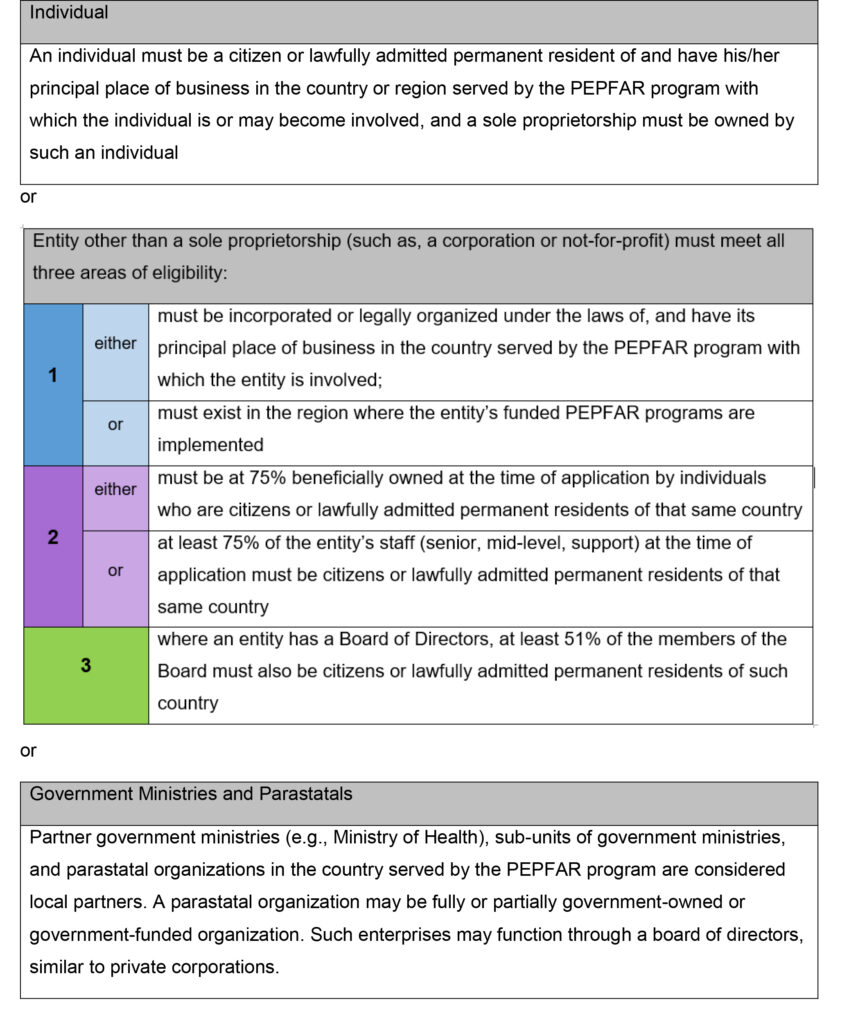
To achieve these results, PEPFAR developed a series of goals, metrics, and standards, including defining what a truly local organization is. In 2016, PEPFAR released standards to define a “local” individual or organization (as shown in the image below).
Source: PEPFAR
PEPFAR also created tools that allow clients, health workers, government officials, legislators, and advocates to assess programs, hold each other accountable, and prevent waste or abuse of funds. To ensure every one of its agreements for service delivery performed to expectations, PEPFAR adopted rigorous monitoring and oversight through a strategy of community-led monitoring. Several local, community organizations and civil society groups gathered qualitative and quantitative data about HIV services, reported on it, and informed programmatic and financial changes to ensure that funding yielded the greatest results.
What’s next?
Locally managed and implemented programming is at the heart of sustainable country ownership.
The U.S. Congress has a major role to play as faith-based and community organizations begin to plan and execute their programs. Lessons from PEPFAR’s success must be translated into the implementation of the America First Global Health Strategy. In addition to the Bush Institute’s recently released recommendations to ensure the success of the Strategy, Congress should ask the following of the State Department:
- Define what a “local” faith-based or community organization is and what “frontline health services” are while developing quantitative metrics to measure progress.
- Return to funding local faith-based organizations directly as soon as possible through awards at the country level.
- Ensure faith-based and community organizations have an official and directed role in implementation planning and the monitoring and oversight of programs, both under the bilateral MOUs and the new faith-based awards.
- Along with implementers under the bilateral MOUs and the new faith-based awards, use granular local data to ensure programs are reaching everyone in need of prevention and treatment services and only invest in data systems that are transparent and available in real time to local communities and governments. The State Department should also verify outcome data and progress through expanded case-finding, community-led monitoring, and independent surveys.
- Continue funding vehicles under the America First Global Health Strategy that recognize and support implementation science and technical advances and build local capacity through training under technical support agreements with universities, international organizations, and the private sector.
- Return to and require consistent, transparent reporting on bilateral global health funding directed toward local organizations to ensure sustainable programming. Metrics and outcomes to consider include:
-
- A list of, and methods for selecting, focus countries under the new awards and the faith-based and community organizations that are receiving U.S. funds.
-
- The amount of funds disbursed to each subaward under the prime awards, tracked quarterly against each subaward’s total estimated value (or “ceiling”).
-
- The percentage of aggregate funding in each award and subaward directed to the salaries, training, and technical support of local, frontline health workers.
-
- The percentage of aggregate funding in each award and subaward directed to overhead costs, including negotiated indirect cost rates and the salaries of U.S.-based technical teams.
-
- The percentage of aggregate funding in each award and subaward directed to the procurement of drugs and commodities, and testing and treatment resources.