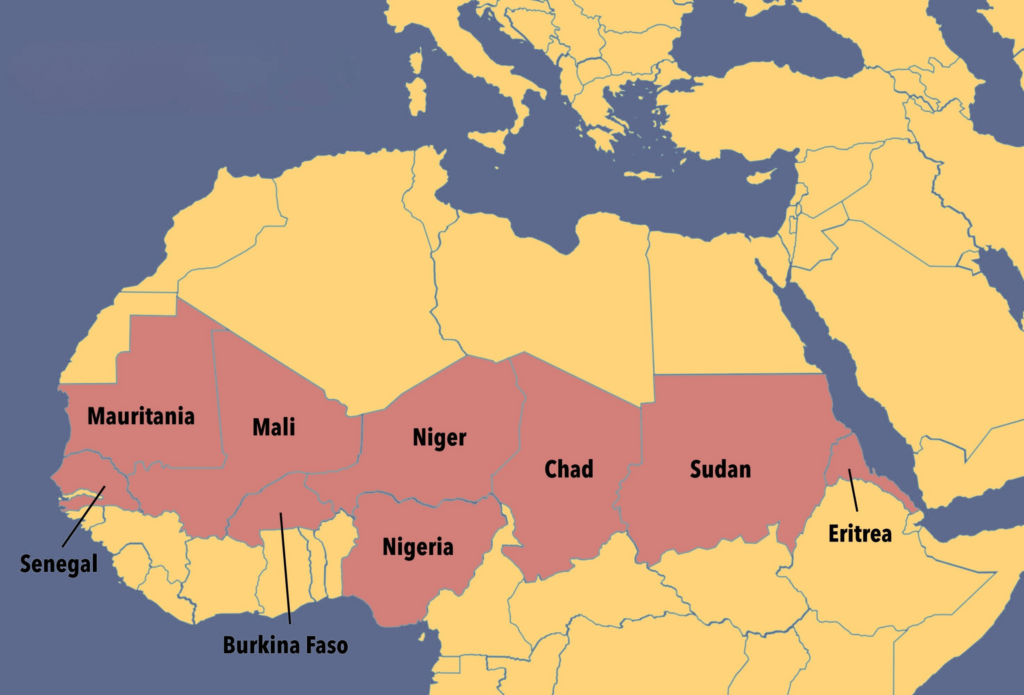
The Sahel, a vast arid region on the continent of Africa that stretches from Senegal on the Atlantic coast to Eritrea on the Red Sea, is emerging as one of the clearest illustrations of how China, Russia, Iran, and North Korea exploit both political instability and gaps in sustained U.S. and European engagement.
While not in a formal alliance or completely aligned on a common strategy, the geopolitical maneuvering of China, Russia, Iran, and North Korea – known collectively as CRINK –flourishes in the same conditions: countries desperate for economic investment, weak government institutions, nonelected military leaders seeking willing allies, and citizens’ frustration with the West.
CRINK zeroes in on venal governments willing to trade sovereignty and democracy for military support, security assistance and infrastructure investment.
It would be both foolhardy and shortsighted to demand these fragile states pick a side – democratic reform and the West versus the easy terms offered by CRINK. This dangerous dynamic would incorrectly treat sovereign and proud African countries as pawns on a geopolitical chessboard, rather than as partners with their own history and their own futures.
But make no mistake, the Sahel is fertile ground. The region was struck with a series of military coups that spread from Mali in August 2020 and May 2021 to Guinea in September 2021, Burkina Faso in January and September 2022, and Niger in July 2023. Because of these violent political acts and an increasing proliferation of terror groups, Western governments, including the United States, reduced their diplomatic and military presence in the region. Western businesses were quick to follow.
CRINK was watching. Russia, particularly, has been quick to exploit the West’s absence. And no action in response actually is an action.
Russian influence
Mali
Following the May 2021 military coup in Mali, the newly established ruling junta engaged with what was then known as the Wagner Group, a Russian government-financed and -backed private military company, to send roughly 1,000 mercenaries to ostensibly train the Malian military forces. They were also supposed to fight against local extremists, including organizations aligned with the Islamic State group which had gained footholds in stretches of rural territory across both Mali and Burkina Faso.
Although Wagner had operated in Africa before 2021 – mostly in Sudan, Libya and the Central African Republic – the rash of instability around the Sahel coups widened Russia’s window of opportunity. After Wagner founder Yevgeny Prigozhin’s death in August 2023, the Russian Ministry of Defense tightened its direct control over the company and rebranded it into a new entity called Africa Corps. Under Russian government direct control, Africa Corps expanded farther into neighboring Sahel states, deploying to Burkina Faso in January 2024 and then Niger in April of the same year.
Niger
Niger is a particularly striking example of Russia’s predatory behavior. For more than two decades, Niger was considered one of Washington’s most important counterterrorism partners in West Africa, anchoring U.S. efforts against the Islamic State group and al-Qaida. The United States had approximately 1,000 military forces in country conducting joint training and counterterror operations with the Niger military, along with significant reconnaissance assets.
After Niger’s July 2023 military coup, that relationship collapsed. The new military regime cancelled its agreement with the United States, forcing Washington to withdraw. In striking images captured broadly in media, Russian military personnel arrived at the same airbase in Niger while American forces were readying to leave the country.
Niger was just the toehold, though, and Russia continues to burrow in. Russian Foreign Minister Sergey Lavrov met with leaders of Niger, Mali, and Burkina Faso in Niger’s capital city this July under the umbrella title of the Alliance of Sahel States. A statement released after the meeting said it was to “strengthen military cooperation.”
Targeting independent media
And in September, with the support of the Russian government through its state-owned broadcaster, Russia Today (RT), these three governments launched what is essentially a propaganda channel to “inform” their citizens: Tafouk TV. It broadcasts in French and local languages Bambara, Hausa, and Moore, with livestreams across social media platforms, according to the Financial Times. It offers what the FT described as “high-octane patriotic celebrations, sterile interviews with officers and officials, and optimistic frontline reportage.”
Niger, Mali, and Burkina Faso have consistently limited impartial, independent media – blocking international broadcasters and targeting local journalists. The Russian ambassador, of course, visited Tafouk TV before its soft launch in June.
And just days ago, in October, Russian forces joined with the Malian military to move on the town of Kidal, seizing it back from the local Tuareg militia under a barrage of airstrikes.
Like other CRINK nations, Russia is offering something vulnerable governments want – military force and security assistance without demands and accountability for democratic reform. Russia’s eager engagement also reinforces the argument that countries can reject international pressure to support rule of law, democratic governance, and human rights without diplomatic and economic isolation. CRINK nations are poised, and willing, to fill diplomatic, economic and military gaps.
Chinese influence
China’s approach is lower key, but its long-term influence could be even more insidious than Russia’s.
Beijing has spent decades and billions slowly building binding economic webs across Africa through infrastructure projects, mining concessions and predatory lending. China now is also establishing a more visible – and active – security pillar into these relationships.
The country has recently expanded military training and arms sales across the continent, with Chinese defense companies more active in the Sahel. NORINCO, a major Chinese state-owned defense company, has now expanded its regional presence and is selling arms to Mali, Burkina Faso, and Niger.
This new security angle to China’s wraparound model of engagement – combining infrastructure deals, tech and diplomatic recognition – is heady stuff for fragile target governments, especially as China also doesn’t condition relationships on good governance, accountability, and fiscal transparency.
Iran and North Korea
While Iran and North Korea are smaller players, these two CRINK nations have also recognized opportunities created by gaps in Western engagement. Tehran is increasing diplomatic outreach across the continent as part of a broader effort to break its own diplomatic isolation, especially to mitigate the impact of Western sanctions. Pyongyang has long leveraged relationships with African governments to earn hard currency and circumvent sanctions isolation. This includes through military training.
Again, even as these CRINK nations increasingly cooperate bilaterally, there remains – for now – no known or public coordinated CRINK strategy for Africa or beyond.
Beijing, Moscow, Tehran, and Pyongyang have different priorities and national interests, and to be clear, sometimes they are in competition. For example, while Russia and Iran may benefit from political instability in the Sahel, China has significantly more at stake economically across Africa and may not share their appreciation (or actions) in fomenting instability.
However, in the Sahel, across the continent of Africa, and elsewhere around the world, formal CRINK coordination is not necessary for these countries’ actions to be reinforcing.
Inertia rewards CRINK
Each new or stronger relationship with a CRINK power provides the Sahel’s fragile governments with more leeway to ignore Western pressure for reform and the reinstatement of democracy.
American and Western inertia rewards CRINK.
Washington should invest time and resources in commerce, education, civil society, media, local government, and culture, both within capitals but also broadly out into rural areas. The United States, together with allies and partners, must stay engaged.
The swift termination of decades of partnership with Niger demonstrates how quickly deep security relationships can disappear when the broader political context evaporates. With countries in the Sahel, as elsewhere, the United States must broaden engagement across all segments of society as a matter of institutional, systemic action. Interactions must go beyond transactionally targeting counterterrorism or mining concessions.
The United States should also stay at the table, showing up consistently to engage as partners with African governments and civil society, across U.S. administrations.
CRINK steps through an open door when African leaders see that the United States only seems interested when we need counterterror help and critical minerals or if there is a crisis or a multilateral vote at the United Nations. Consistency matters.
Finally, democratic institutions should be at the center of U.S. policy.
While the Sahel does continue to suffer from violent extremism and ungoverned spaces, military-to-military partnerships alone simply don’t produce stability. For governments in the Sahel, and elsewhere, weak governance, corruption, economic deprivation and unemployment, poor health systems, and educational opportunities create openings for homegrown authoritarians to seize power.
The path of the Sahel won’t be decided by arms sales from China or military bases with Russian troops, but by whether governments in the region can build stability and be accountable to citizens. That long-term stability rests on credible elections, independent and strong institutions, independent media, and civilian-military relations. The United States has traditionally played a key role in helping foster these pillars of stability, economic prosperity, and healthy democracy. The U.S. and democracies in the region and around the world, need to invest, engage as partners, and support these countries, and their citizens, towards that better tomorrow.