
Chapter 1:
Paving the way for impact
The following timeline is the first chapter in the three-part series, "Imagining a world without PEPFAR." This chapter provides a foundation for understanding how PEPFAR came to be and the impact it has today.


What if the United States had looked at the HIV/AIDS catastrophe unfolding across Africa and had decided it was someone else’s problem? Surely, the United States had enough of its own challenges to handle, some thought.
What if there had not been support from leaders like President George W. Bush and members of Congress from the right and left to launch this new model in foreign assistance, rooted in science and data, but also true partnership? What if the United States had decided it was too big, too difficult, too much of a problem?
As we approach World AIDS Day on Dec. 1, 23 years after President Bush created the President’s Emergency Plan for AIDS Relief (PEPFAR), it’s important to reflect. The following three-part series explores the evolution and impact of PEPFAR.
As the world roils with crises and conflicts, weathering pandemics and division, there’s danger in forgetting exactly what PEPFAR accomplished. The scale of what was at stake in 2003, and what has been achieved, can be difficult to remember.
And it can be arduous, too, to recall an important component of what made PEPFAR work: bipartisan American leadership rooted not only in compassion, but with a hard eye on accountability. Leaders across political ideologies quickly identified a national security threat and built a new model of assistance that redefined how America is seen in the world.
“I believe that every life has dignity and value. I also believe that of those to whom much is given, much is required. So, we developed a plan with clear objectives and accountability, and we got to work.”
– President George W. Bush reflecting on the genesis of PEPFAR for the Washington Post in 2023.
Bipartisanship that continued over time, far exceeding any expectations for collaboration and compromise. Genuine partners on the ground in countries ready to not only receive assistance, but to use it to build better futures for their people.
PEPFAR was designed to solve one issue. Years later, we understand it solved many.
1
PAVING THE WAY FOR IMPACT
The President’s Emergency Plan for AIDS Relief was announced during President George W. Bush’s 2003 State of the Union address. But the HIV/AIDS pandemic started long before that. President Bush, advocates, policymakers, members of Congress, the American people, and leaders across the globe made the courageous decision to act against a disease that had taken millions of lives.
The following timeline is the first chapter in the three-part series, Imagining a world without PEPFAR, and provides a foundation for understanding how PEPFAR came to be and the impact it has today.
2
1981-2000S – PATIENT ZERO AND A FIRESTORM OF FEAR
In 1981, President Ronald Reagan was in his first year in office, the United Kingdom hosted the royal wedding, Raiders of the Lost Ark was in movie theaters across the country, and the Centers for Disease Control and Prevention (CDC) released its first report on an unknown disease that would become HIV/AIDS.
Over the next two decades, with the strong advocacy of the gay community and Ryan White, an American child diagnosed with HIV through blood transfusion, the United States and other wealthy nations worked to develop treatments and interventions to help mitigate the impact of this deadly disease. However, those advances were profoundly unequal. Across Africa and in other parts of the world, HIV was raging, and an alarming number of people were dying from AIDS.
During the 1990s, the United States began to develop a coordinated effort to address AIDS, including the establishment of the White House Office of National AIDS Policy (ONAP), the Presidential Advisory Council on HIV/AIDS (PACHA), and the first White House Conference on HIV and AIDS. In 2000, the Congress passed the Global AIDS and Tuberculosis Relief Act, designating $600 million for U.S. global efforts
But there was still much work to be done. By 2001, an estimated 28.5 million people in sub-Saharan Africa were living with HIV/AIDS. Although sub-Saharan Africa was home to about only 10% of the global population, 70% of those with HIV/AIDS lived in this region and did not have ready access to the pharmaceutical and medical interventions that were saving lives across the U.S. and Europe.
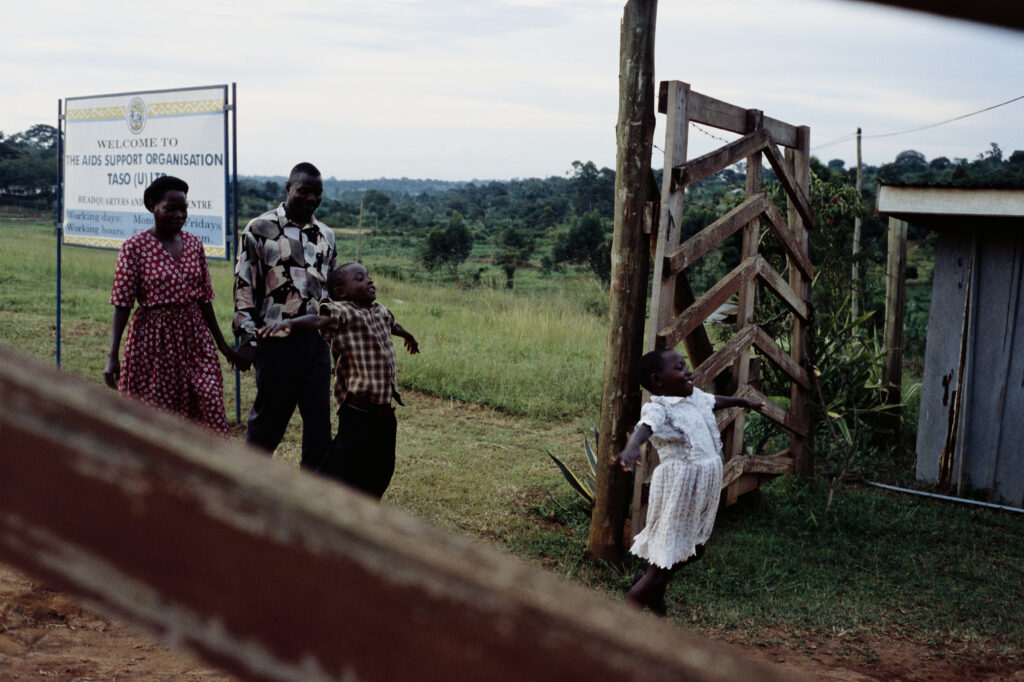
As this wildfire spread, impacting men, women, and children in the most vulnerable communities, it became clear this was not just a health emergency. HIV/AIDS threatened the security, economic engines, and community fabric that underpinned the stability of nations and the entire region.
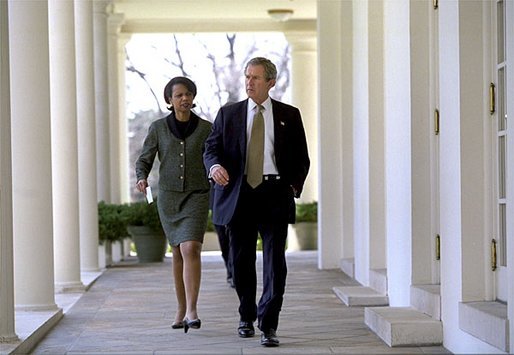
“At one of my first meetings with then-Governor Bush in 1999, we agreed that our agenda in Africa would go nowhere if we did not address the scourge of AIDS.… There were estimates of up to 100 million deaths over the next 20 years if something was not done to arrest the plague.”
– Dr. Condoleezza Rice, former U.S. National Security Advisor (2001-2005) and former U.S. Secretary of State (2005-2009)
(Source: The Bush Institute’s An Oral History of PEPFAR)
3
2000 – MILLENNIUM OF CHANGE
On Jan. 10, 2000, the United Nations Security Council convened an extraordinary session on HIV/AIDS in Africa, presenting the shattering reality that the disease was threatening to collapse entire countries. In sobering remarks, U.N. Secretary-General Kofi Annan warned, “The impact of AIDS in that region is no less destructive than that of warfare itself. Indeed, by some measures it is far worse. Last year, AIDS killed about 10 times more people in Africa than did armed conflict.”
He continued, “By overwhelming the continent’s health services, by creating millions of orphans and by decimating health workers and teachers, AIDS is causing social and economic crises which in turn threaten political stability. It also threatens good governance, through high death rates among the elites, both public and private.”
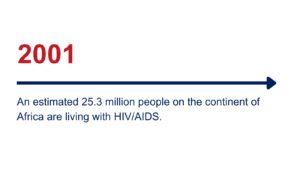
Critically, the secretary-general highlighted the brutal cycle of conflict, economic instability, and the pandemic. The highest HIV rates were among people between 25 and 39 years old, who were in the throes of their careers, building families and communities and putting food on the table. Children born into HIV-positive families faced the harsh reality that they would soon be orphaned. Soon, entire villages would be run by children who lost their parents, making them vulnerable to nefarious actors. Fragile institutions ravaged by armed conflict, famine, and economic downturns were made even more vulnerable by an epidemic. And societies desperately needed these same institutions to address the disease and remain stable.
Recognizing these calls for action, President Bush stood next to the Secretary General on May 11, 2001, and announced that the United States would assist in the establishment of and provide a $200 million founding pledge to the new Global Fund to Fight AIDS, Tuberculosis and Malaria. Less than a year later, the Global Fund officially launched and began providing access to life saving resources to those in greatest need.
“The statistics were horrifying. Some 10 million people in sub-Saharan Africa had died. In some countries, one out of every four adults carried HIV … the United Nations projected that AIDS could be the worst epidemic since the bubonic plague of the Middle Ages.”
– President George W. Bush
(Source: The Bush Institute’s An Oral History of PEPFAR)
4
2003 – ANSWERING THE CALL
But by 2003, HIV/AIDS was no longer just a public health emergency. It was a security crisis as countries were on the verge of becoming unstable and their populations desperate, making them prime recruiting targets for extremists. The United States knew that much more needed to be done to save lives. Recognizing the potential impact that could be made, President Bush and his administration decided that the global AIDS policy needed to change significantly to meet the challenge. Thinking big, with a focus on results, scientists, academics, HIV practitioners, and experts worked together to turn a moonshot idea into a reality.
That year, during his State of the Union address, President Bush announced the creation of the President’s Emergency Plan for AIDS Relief, or PEPFAR, a program that would dedicate a total of $15 billion over five years. Just a year earlier, U.S. spending on the global HIV pandemic was approximately $1 billion thanks to the American taxpayers.
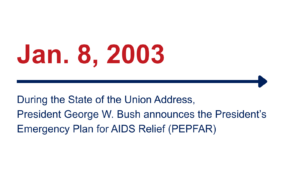
It’s worth revisiting his words in full:
“A doctor in rural South Africa describes his frustration. He says, `We have no medicines’ … many hospitals tell people, `You’ve got AIDS. We can’t help you. Go home and die.’
“In an age of miraculous medicines, no person should have to hear those words. AIDS can be prevented. Antiretroviral drugs can extend life for many years. And the cost of those drugs has dropped from $12,000 a year to under $300 a year – which places a tremendous possibility within our grasp.
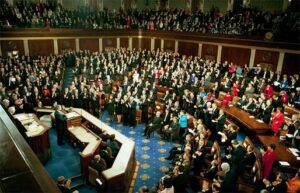
“Ladies and gentlemen, seldom has history offered a greater opportunity to do so much for so many. We have confronted, and will continue to confront, HIV/AIDS in our own country. And to meet a severe and urgent crisis abroad, tonight I propose the Emergency Plan for AIDS Relief – a work of mercy beyond all current international efforts to help the people of Africa. This comprehensive plan will prevent 7 million new AIDS infections … treat at least 2 million people with life-extending drugs … and provide humane care for millions of people suffering from AIDS, and for children orphaned by AIDS. I ask the Congress to commit $15 billion over the next five years, including nearly $10 billion in new money, to turn the tide against AIDS in the most afflicted nations of Africa and the Caribbean. This nation can lead the world in sparing innocent people from a plague of nature.“
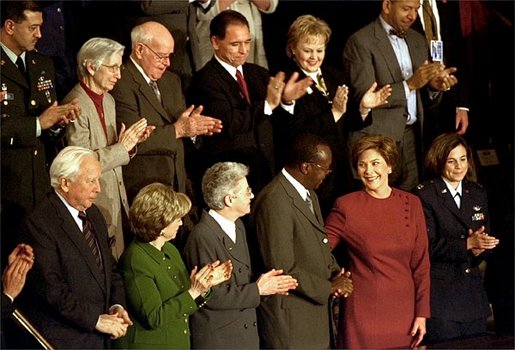
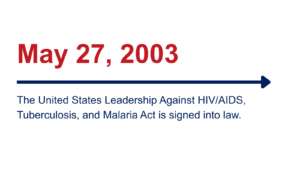
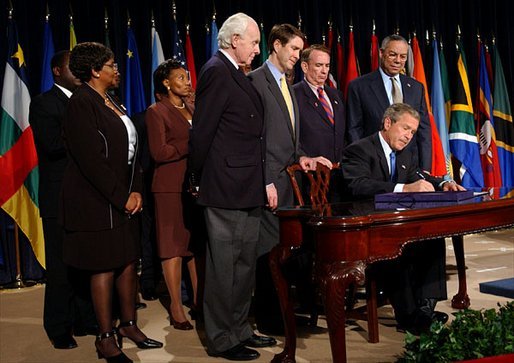
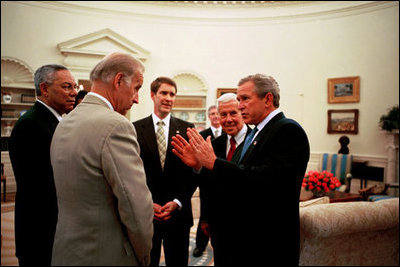
Congress responded. With overwhelming bipartisan support, the United States Leadership Against HIV/AIDS, Tuberculosis, and Malaria Act became law on May 27, 2003, establishing PEPFAR and the Office of the Global AIDS Coordinator at the State Department.
Bono, Lead Singer for U2 and Co-Founder of ONE and (RED), reflects on the creation of PEPFAR.
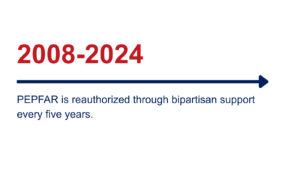
That steadfast promise to answer the call coming from across an ocean continued beyond 2003. Programs launched under the executive branch seldom live beyond the president’s term. PEFPAR is the outlier: It was reauthorized by Congress in 2008, 2013, 2018, and 2024, showing that the mission and vision of the program, as well as its results, far exceeded its political capital.
5
PEPFAR TODAY
But PEPFAR was never just about the funding. PEPFAR developed structures, prioritized science, data, and accountability; built lasting partnerships; evolved to address the greatest challenges and innovations at the time; and supported the development of in-country institutions. Most notably, PEPFAR fundamentally changed what American foreign assistance could accomplish.

Through the careful and methodical work led by teams of dedicated Americans on the ground in impacted countries, the United States crafted long-term partnerships with governments, local organizations, faith-based groups, clinicians, advocates, and entire communities. PEPFAR prioritized what came to be called “country ownership,” the idea that planning, measurement and accountability were interlinked to gradually move programs to locally led and locally delivered implementation.
This reinvention of the very concept of “foreign aid” was the blueprint for a transformation across development assistance, including in the creation of the Millennium Challenge Corporation, in which country ownership served as a central pillar of the model.

“You know the work of PEPFAR in Africa has made such a tremendous difference, has saved so many lives, has given thousands and thousands of people, particularly women, hope for the first time in their lives that they can pursue their dreams, that they can become normal again. The importance of this continuing can make a big difference in a country achieving its development goals, particularly as they relate to the improvement of health in the nation. … This particular program touched the lives of the ordinary people and made a difference.”
– Ellen Johnson Sirleaf, President of Liberia (2006-2018)
(Source: The Bush Institute’s An Oral History of PEPFAR)
“Thanks to American support and partnership, thousands of Rwandan children and mothers are alive and have hope because of the President’s Emergency Plan for AIDS Relief program.”
– Paul Kagame, President of Rwanda (2000-present)
(Source: The Bush Institute’s An Oral History of PEPFAR)
“We note with great admiration your commitment to the respect of human rights, democracy, and good governance, as well as your humanitarian support for the drive towards poverty alleviation. We recognize also your exemplary dedication to the fight against diseases, like malaria and the HIV/AIDS pandemic.”
– John Kufuor, President of Ghana (2001-2009)
(Source: The Bush Institute’s An Oral History of PEPFAR)
“PEPFAR is helping us tackle the HIV/AIDS scourge. Many lives – many, many children who would have been orphaned are no longer orphaned because of that.”
– Jakaya Kikwete, President of Tanzania (2005-2015)
(Source: The Bush Institute’s An Oral History of PEPFAR)
The Bush Institute would like to thank Alec Clark, Southern Methodist University Tower Scholar (Class of 2027) for his assistance in completing this project.