Insights from Bush Institute immigration expert Laura Collins
As we close 2025, I’ve been thinking a lot about the culture of compassion and welcome that continues to live in the American people. This year has seen many unwelcoming immigration policies that target not just people without legal immigration status in the U.S. but also lawful foreign-born workers and others who have waited in line and done what the law requires.
Ordinary Americans are demanding due process for their immigrant neighbors and raising their voices to insist on better immigration policies – ones that benefit America and treat our immigrant neighbors with humanity. It is human to worry about our immigrant neighbors this year.
But the American people still believe that we benefit from immigration, and we continue to show the world that we remain a beacon of freedom and opportunity.
Figure of the Month
2,000%
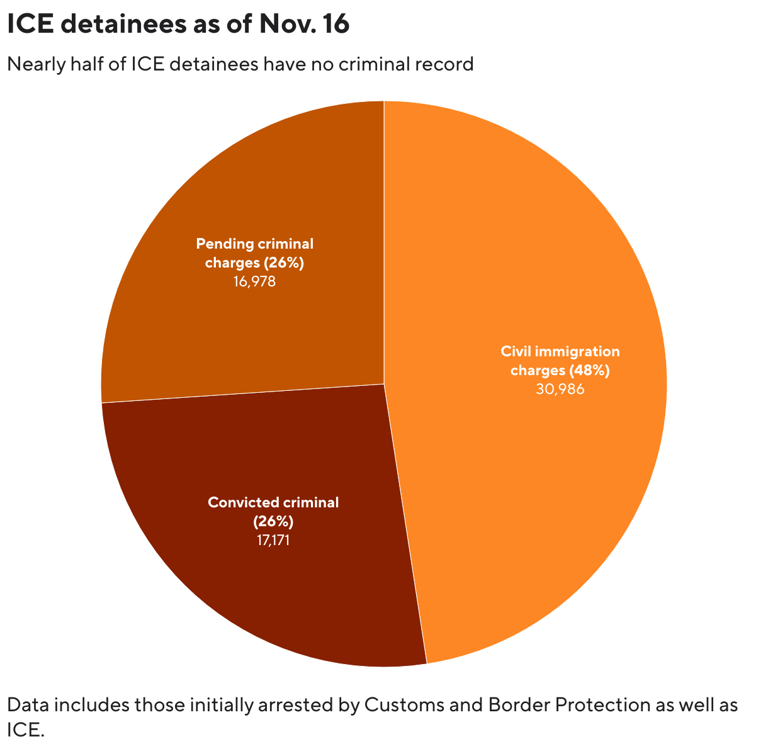
Chart: Julia Ingram / CBS News
Source: Immigration and Customs Enforcement
There is a 2000% increase in non-criminal detainees arrested by Immigration and Customs Enforcement (ICE) since the start of the second Trump Administration in January, as reported by CBS News. As of Nov. 16, about 31,000 people — or 48% of those in ICE custody — had no criminal charges or convictions.
Data Dive
- Immigration detention funding has increased by more than 400%, rising from roughly $3 billion in FY2019 to over $14 billion in FY2025, with projections for next year surpassing $15 billion, according to a recent paper from the National Immigration Forum. The One Big Beautiful Act (OBBA) commits taxpayers to an additional $11.25 billion in annual detention spending through FY2029, regardless of enforcement needs.
- Almost one in five healthcare workers in the United States are foreign born, according to the latest study published by the National Foundation for American Policy. This share has been rapidly increasing over the years, emphasizing the vital role that immigrants play in an industry that cannot be outsourced or automated.
- The Trump Administration has expanded the original travel ban to include 5 additional countries and partial restrictions on 15 new countries.
- Up to 61,000 truck drivers in California could soon lose their licenses, as Secretary of Transportation Sean Duffy began restricting refugees, asylum seekers, and Deferred Action for Child Arrivals (DACA) recipients from holding commercial trucking licenses. CalMatters reports that those drivers represent about 8% of all licenses in the state.
- The number of new foreign students enrolled in U.S. colleges this fall dropped by 17 percent compared to last year, according to new survey data released by the Institute of International Education. The Washington Post analyzed the findings and illustrated the trend in six charts.
What I’m Reading
- In a lengthy piece worth your time, CNN detailed the administration’s efforts to restrict both legal and illegal immigration, noting that many have been slowed or blocked in court. The legal pushback underscores the limits of executive power in immigration policy. “You can make drastic changes in policy, but you can’t wholesale change the system itself without Congress enacting legislation,” said Andrew Selee, president of the Migration Policy Institute.
- The 19th reports on more questionable immigration enforcement tactics. In Chicago, a young mother on her way to the hospital to see her newborn daughter in the neonatal intenstive care unit (NICU) was surrounded by ICE agents and taken into custody. Despite no criminal record and a pending asylum application, the mother was detained for 34 hours in allegedly unsanitary conditions, with little food and water, all while managing the pain of her C-section recovery and her Type 1 diabetes.
- A Chinese man risked his personal safety to film human rights abuses in China. He entered the U.S. illegally to request asylum. He’s now in immigration detention and may be removed to his persecutors.
- The Trump Administration recently announced that work permits issued to immigrants seeking asylum and other humanitarian protections will now be valid for just 18 months rather than five years, a change that will affect hundreds of thousands of people. The administration argues this will allow it to run additional security screenings. The Biden Administration had originally extended employment authorization to help the U.S. government with timely processing.
- In a piece notable for its humanity, Los Angeles Times reporter Brittny Mejia wrote about harvesting watermelons and cantaloupes with an immigrant crew in California, detailing their struggles and fears.
- NBC News reports on military spouses being detained while appearing at their immigration appointments. Samuel Shasteen, who served 20 years with the Marines, said his wife was arrested and detained at her final U.S. Citizenship and Immigration Services interview. “We do everything that we can to protect and serve our country,” commented Shasteen, “and then they betray us by treating us like we’ve never done anything.”
- Despite a record backlog in immigration courts, the Trump Administration has been firing dozens of experienced immigration judges. The Free Press editor Joe Nocera spoke with one of the recently terminated judges, Olivia Cassin, who described escalating interference, pressure to move cases quickly, and increasingly hostile working conditions. “They want to dismantle the system,” she told him.
- New York Magazine has a fascinating piece on the complexities of immigration law and policy. Bhutanese Nepali refugee and convicted felon Aasis Subedi was deported to Bhutan — a country he left at age 4 and that refuses to recognize him as a citizen because of his ethnicity — only to be expelled again. Left without documents, legal status, or any country willing to claim him, Subedi fled to Nepal, where he was soon arrested for entering illegally. As a convicted criminal, the U.S. can remove him. As a stateless person who suffered persecution, where is it appropriate to remove him to? Where do you send someone when no country is willing to claim him?
- Cultural anthropologist Thomas Dichter writes in The Dispatch that migration is humanity’s oldest engine of progress — and a defining strength of the United States.
Bush Institute Insights
- This Thanksgiving season, I joined Strategerist host Andrew Kaufmann for a new After Hours episode on gratitude, together with my Bush Institute colleagues Anne Wicks and Chris Walsh. We talked about what makes Thanksgiving a uniquely American holiday – its history, its family traditions, and its ability to bring people together.
- My colleague Natalie Gonnella-Platts and I wrote about how the U.S. government should judge Afghans on the individual merits of their immigration cases, not the horrific actions of one person.
Upcoming Events:
- January 22, 2026 – Hoover Institution: Immigration Policy and the Economics of Innovation