


Welcome back to the George W. Bush Institute’s education newsletter.
Science of reading policies continue to gain momentum across the country, but passing laws is only the first step. New research highlights persistent implementation with many teacher preparation programs and classrooms still relying on instructional practices that leave students guessing rather than knowing how to read. If our nation is going to improve student outcomes, state leaders must focus not only on smart policy design but also on the hard work of implementation.
If you’re new to the Bush Institute, welcome. We are a nonpartisan organization committed to promoting freedom, opportunity, accountability, and compassion. If this newsletter was forwarded to you and you’d like to receive future editions, reply to this email, and we’d be glad to add you to our list.
Thank you for reading.
Monthly snapshot
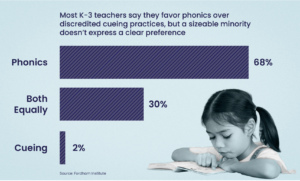
Nearly one-third of K-3 teachers still report using three-cueing, a discredited practice that encourages students to rely on pictures and context to identify words rather than using phonics and decoding skills.
Nearly one-third of K-3 teachers still use balanced literacy approaches that place three-cueing – an instructional practice banned in some states – on equal footing with phonics, according to a recent report from the Thomas B. Fordham Institute. The gaps are especially pronounced in high-poverty schools, where teachers are less likely to demonstrate strong knowledge of and commitment to the science-of-reading.
Fordham Institute/Eamonn Fitzmaurice
Similarly, the National Council on Teacher Quality’s 2026 Teacher Prep Review found that one in five teacher preparation programs still teaches debunked methods that encourage students to guess words using pictures, patterns, or context rather than decode them through letter-sound relationships.
Closing these gaps will require states to strengthen teacher preparation, prohibit ineffective reading practices, and ensure teacher training, instructional materials, and classroom instruction are aligned with the science of reading through strong implementation and oversight.
State spotlight
Oklahoma strengthens early literacy policy
Oklahoma strengthened and expanded its Strong Readers Act with new legislation designed to ensure students can read proficiently by the end of third grade. The law requires early screening for reading difficulties, evidence-based reading instruction and interventions, individualized reading plans for struggling students, parent notification and engagement, and targeted support for teachers and schools to improve reading outcomes. It also prohibits educator training in three-cueing and makes the state’s Literacy Instructional Team permanent and expands expert support for schools statewide.
Bush Institute insights
- Education, Workforce, and Opportunity: A toolkit for state leaders. Young people face a rapidly evolving world – the rise of AI, geopolitical shifts, the emergence of new enterprises, the contraction in some existing sectors – all of which are causing real-time churn in the job market. At the same time, America’s strength continues to be the people who build, innovate, and contribute at work and in their communities. The George W. Bush Institute recently released a toolkit to help state leaders develop smart opportunity policy agendas that will renew the American dream by better aligning education and training with workforce demands, creating more access to opportunity for young Americans. The toolkit includes recommendations, a decision guide, and case studies on Alabama, Arkansas, Colorado, Kentucky, and Texas, along with a resource guide.
- Texas improves student success with partnerships and accountability. Anne Wicks, the George W. Bush Institute’s Don Evans Family Managing Director of Opportunity and Democracy, moderated a discussion at the annual ASU-GSV Summit on how Texas is using policy, data, partnerships, and incentives to improve student outcomes. In Houston ISD, the number of campuses earning an F fell to zero in 2025 from 56 in 2023, aided by place-based partnerships with Ballmer Group. In Dallas County, the Commit Partnership has increased the share of young adults earning a living wage to 33% from 22% from 2012-2024 by focusing on reading, math, college readiness, and postsecondary completion.
- The Education Scorecard is sobering and encouraging. In my recent piece on the latest Education Scorecard. I highlight a troubling reality: students remain nearly half a grade level behind in reading compared with pre-pandemic levels. The encouraging news is that recovery is possible. Five states and Washington, D.C., posted meaningful reading gains between 2022 and 2025 by pairing evidence-based literacy policies with strong implementation, teacher training, high-quality instructional materials, and targeted interventions. Sustaining progress will require clear expectations, transparent reporting, and effective systems for monitoring student performance.
Science of reading
- Tennessee is a national model. Karen Vaites, founder of the Curriculum Insight Project, argues that Tennessee deserves more attention for its reading and math gains. She points to the state’s rapid adoption of high-quality instructional materials and its practical Reading360 training as models for other states. Tennessee Education Commissioner Lizzette Reynolds credits Tennessee’s progress on student outcomes to science-of-reading instruction, knowledge-building materials, regional implementation support, educator preparation oversight, and accountability data. She also notes that Tennessee is expanding its focus into pre-K and adolescent literacy to support the full continuum of reading development.
- States play a critical role in teacher preparation. NCTQ President Heather Peske urges states to ensure teacher preparation programs are equipping new teachers for success. Fewer than half of states maintain full authority over their program review processes, and even states with strong reviews often hesitate to enforce consequences when programs fall short. Preparation programs need clear, evidence-based standards, strong internal use of data, and rigorous state oversight to ensure aspiring teachers are set up for success. Peske emphasizes that “standards without enforcement are just suggestions.”
Measurement matters
- In response to a recent New York Times essay by Ross Weiner questioning the value of test-based accountability, Chad Aldeman, independent education analyst and frequent contributor at the Fordham Institute, argues that when Congress replaced No Child Left Behind with the Every Student Succeeds Act in 2015, it significantly reduced federal accountability requirements. After that shift, achievement gains stalled and then declined, especially among lower-performing students. While accountability systems can and should improve over time, Aldeman argues that objective measures of student learning remain essential for understanding how well all children are being educated and whether schools are preparing students for the future.
At the Bush Institute, we share Aldeman’s view that meaningful assessments and transparent accountability are not ends in themselves, but critical tools for improving instruction, informing parents, and defending against the soft bigotry of low expectations. Strong reading and math skills are fundamental to learning across all subjects and provide the foundation for broader educational goals, from civic engagement to career readiness.
- Mississippi raises the bar on school accountability. Mississippi is increasing the rigor of its A-F school grading system after reaching a state benchmark that requires higher expectations as student performance improves, according to an article by ExcelinEd’s Christy Hovanetz for the Magnolia Tribune. As a result, some schools may receive lower letter grades even as student achievement continues to rise – an indicator of a tougher standard, not declining performance. The change builds on more than a decade of academic gains that have helped move Mississippi from near the bottom of national rankings to ninth in the nation in fourth-grade reading on NAEP. Hovanetz argues that maintaining high expectations is critical to sustaining progress, writing that, “The goal isn’t to protect the appearance of success. It’s to persist and build upon it.”
- Indiana’s accountability waiver spurs optimism and caution. The U.S. Department of Education approved Indiana’s “Returning Education to the States” waiver, making Indiana the third state – after Iowa and Louisiana – to receive flexibility. The waiver allows Indiana to consolidate $50 million in federal funds across five federal funding streams. It also aligns Indiana’s state and federal accountability systems, which the state will leverage to place greater emphasis on college and career readiness measures. Critics worry that combining funding programs could make it easier for money intended for specific groups of students – such as English learners and other students who need extra support – to be used for other purposes. They also worry that changes to the accountability system could make it harder for parents and the public to see how well students are doing academically and whether schools are helping all students succeed. As implementation gets underway, policymakers and stakeholders will be watching closely to see how the changes affect student outcomes and transparency.
- The case for high-impact tutoring. Writing in The 74, former Washington, D.C., Superintendent of Education Christina Grant and former Tennessee Commissioner of Education Kevin Huffman argue that educators shouldn’t give up on high-impact tutoring initiatives. The District of Columbia‘s high-impact tutoring initiative offers a strong example of why measurement matters. Students who participated exceeded expected academic growth by 44% compared with peers who did not receive tutoring. The program paired investment with rigorous evaluation, demonstrating the importance of tracking results and refining programs over time.


