To celebrate America’s 250th birthday, I will publish a series of 12 essays exploring milestone events that shaped the American economy into what it is today – from the adoption of the Declaration of Independence to the Marshall Plan. I’ll pay particular attention to the country’s formative decades and tell the stories of ideas, policies, and innovations that helped build the world’s strongest economy.
It’s all too easy to take the many freedoms that Americans enjoy today for granted.
An example most people don’t think about much is the right to go into business – a vital element of the extraordinary economic freedom Americans have enjoyed since early in the nation’s history. The nation’s decision to create this right was a radical, contested, and richly consequential choice, neither a part of the legal system America inherited from the British Empire nor an inevitable feature of the early republic.
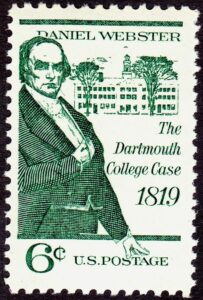
Between 1810 and 1824, America’s leaders made a series of pivotal decisions that enshrined the freedom to start a company: In a momentous break from European legal traditions of the time, New York adopted a revolutionary law on business incorporation in 1811. Most other states soon followed. Three historic U.S. Supreme Court rulings further facilitated entrepreneurship – Fletcher v. Peck (1810), the Dartmouth College case (1819), and Gibbons v. Ogden (1824).
America’s decision to establish a more expansive right to go into business than any other country had ever done gave rise to explosive growth in business formation in the early to mid 1800s. Together with other key pillars of the U.S. economy like sound property rights, an innovative patent system, and strong financial institutions established under the leadership of Treasury Secretary Alexander Hamilton, it set the stage for America’s rise to become the world’s wealthiest nation by the early 20th century.
Bedrock principles
The freedom to go into business rests on three vital principles:
- Individuals must have the freedom to enter into any trade without interference from would-be competitors or anyone else, provided they satisfy basic regulations.
- Individuals must have the freedom to join with other like-minded people to establish firms that can operate more efficiently and at larger scale than any one individual could achieve on their own. Incorporated firms – that is, firms that assume a distinct legal identity separate from their employees or shareholders – must have the legal standing to do almost anything a person can do, such as entering into contracts, suing, and being sued. They should also have the right to operate as joint-stock companies, meaning they can raise capital by selling stock to investors who are then free to sell their shares to other investors. Shareholders risk the money they’ve investing but should not bear additional responsibility for the liabilities of the firm.
- Firms must have confidence that the government will not capriciously seize their property, undo business contracts, exclude them from the marketplace for the benefit of favored competitors, or force them out of business.
None of these principles was well established in Europe at the time of American independence. But within half a century, all three had become bedrock principles of the U.S. legal system.
The British approach to business formation before 1776
In pre-1776 Britain, laws sharply restricted individuals from going into business for themselves in most industries. Britain regulated industry through the guild system, established in medieval times in England as in other European countries and formalized during the reign of Queen Elizabeth I by a statute in 1563.
For centuries, the medieval guild system served important functions – setting quality standards, training young people, and providing a safety net for members and their families – but by the 18th century, one of its main purposes was to protect incumbent guild members from upstart competitors. Adam Smith heavily criticized the system for its anticompetitive effects in his 1776 treatise, The Wealth of Nations.
The modern joint-stock company was invented in Britain and the Netherlands in the late 16th century. Early joint-stock companies – like the British and Dutch East India Companies, founded in 1600 and 1602 – made it possible to scale up oceangoing merchant trade as never before.
But crucially, both these companies came into existence because their respective governments granted charters to groups of well-connected businessmen, giving them state-sanctioned monopolies in specified businesses like Asian spices and the Atlantic slave trade. And what the government gave, it could arbitrarily take away. Even today, governments in China and many other countries have the power to grant or revoke the privilege of operating a business as they see fit.
In 1720, Britain’s Parliament responded to a financial crisis sparked by the failure of the government-chartered South Sea Company by banning the establishment of joint-stock companies, with exemptions for existing firms like the East India Company. The early stages of Britain’s industrial revolution took place despite the obstacles imposed by this legislation.
A heated debate in post-independence America
The guild system never became entrenched in the American colonies before independence, so the United States fortuitously came into being with much greater freedom for individuals to start small businesses than British people enjoyed.
The new republic, however, inherited British law and customs regarding corporations. America’s 13 state governments took up where Britain had left off, granting just over 300 charters that allowed new entities to incorporate and pursue activities specified by their charter. But joint-stock companies mostly remained illegal and each charter required an act by a state legislature, often passing only after frenetic lobbying and debate. Most chartered entities had religious or educational missions. Very few engaged in commerce, as legal restrictions made it difficult to raise capital or operate at scale.
The question of whether America should create easier paths to incorporation and stronger protection for businesses was one of many points of fiery contention during the 1790s between Hamilton and Secretary of State Thomas Jefferson. Hamilton viewed joint-stock companies with secure legal rights as a force for economic and social progress and led the way in creating one of the nation’s first large-scale manufacturing firms, the Society for Establishing Useful Manufactures.
Jefferson, meanwhile, opposed the growth of incorporated firms as he associated them with Britain’s system of state-sanctioned privileges and generally disdained modern industry and finance. Southern Jeffersonians also staunchly resisted federal engagement in regulating commerce since they thought it might lead to federal interference with slavery – a possibility they were determined to prevent.
By the 1810s and 1820s, however, America had entered a new age that was at once more democratic and more commercially minded than the founding generation had known. The changing tenor of the times created growing pressure to allow new forms of business organization and to weaken the ability of state legislatures to control who could go into business and who could not.
Four landmark decisions
- In 1811, the New York State Legislature passed a law that for the first time established a well-defined path to incorporation, opened it to everyone, and eliminated the need for legislative action on each application. The legislation allowed firms to issue stock to an unlimited number of investors and automatically granted shareholders limited liability, meaning investors were on the hook only for the amount of their investment. Most other northern states followed with similar laws over the next three decades. Southern states viewed the legislation as antithetical to their slavery-based plantation system and largely declined to follow New York’s lead, but the right to incorporate as a joint-stock firm became a core provision of every southern state constitution after the Civil War.
- In 1810, the Supreme Court ruled in Fletcher v. Peck that state governments could not legislate away contracts entered into by private individuals and firms.
- In the Dartmouth College case of 1819, the court overturned an act of the New Hampshire legislature that would have declared Dartmouth to be a public institution, removed the college’s board of trustees, and allowed the governor to appoint a new board filled with political allies. One memorable moment: The statesman Daniel Webster – then a U.S. congressman but also the lead lawyer arguing against the state and a Dartmouth alumnus – famously brought the court’s justices to tears with his climactic line, “It is, sir, a small college; and yet there are those that love it.” The court’s decision enshrined the principle that governments may not seize control of an incorporated entity, even when the organization came into being through a government charter.
- In 1824, the Supreme Court ruled in Gibbons v. Ogden that a state could not arbitrarily grant a monopoly to a favored firm and exclude would-be competitors from any industry subjectto federal regulation under the Constitution’s commerce clause, which gives Congress regulatory power over interstate and foreign trade.
- The Gibbons case, which considered a New York monopoly grant on steamboat service along the state’s rivers to inventor Robert Fulton and his partners, represented a landmark vindication of federal authority over commerce. Congress wanted to allow newentrants into the waterborne transportation market and New York wanted to preserve Fulton’s monopoly, so the decision effectively limited the public sector’s power to exclude firms from a market they wish to enter.
All these decisions were controversial. Jefferson responded to the Dartmouth decision by blasting Chief Justice John Marshall – who was Jefferson’s cousin but had Hamiltonian policy inclinations – as a “crafty judge” engaged in “twistifications” of the law.
Business booms – and America becomes transformed
But these decisions stood the test of time and established a right to go into business that no other nation would match for more than a century.
The number of steamboats on New York’s waters rose from six in early 1824, before the Court’s Gibbons decision, to 43 by the end of the year.

More than 1,900 incorporated firms came into being just in the New England states by 1830, with more than half engaged in manufacturing.
By the late 19th century, the United States ranked far ahead of any other country for the size and number of its corporations – though the power of America’s largest enterprises became a controversial issue in its own right. The nation’s extraordinarily commerce-friendly policies and the prosperity they created helped knit the country together and built the United States into the world’s preeminent economy.
And for individual Americans, the freedom to go into business became an uncontroversial, underappreciated aspect of being an American.