
George W. Bush Institute
Education, workforce, and opportunity: a toolkit for state leaders

As our labor force becomes more educated and more skilled for the jobs of the 21st century, we’ll stay the leading country in the world. And that’s what we want. We want to be the leader in the world, because when you’re the leader of the world, the standard of living for your people rises. We want the American dream to shine brightly.
President George W. Bush
April 5, 2004
1
TOOLKIT
a. THE PROMISE OF OPPORTUNITY POLICY
The future of our republic today rests on the collective shoulders of the 105 million young Americans under the age of 25. Their readiness to shape and drive this future, however, is far from guaranteed. Since World War II, the growth of the U.S. economy has been closely tied to the population’s educational attainment and workforce engagement, but the world as we know it is changing.
High school graduates are launching into a profoundly and rapidly evolving world. The ascent of AI is causing real-time churn in the job market; some sectors are contracting while others are opening new frontiers. Nearly a quarter of all jobs will be affected by AI and other new technologies by 2030, according to one projection by the World Economic Forum (WEF). An estimated 170 million new roles will be created, while 92 million others will be eliminated. Gallup reports that more American workers say they are struggling in their lives than thriving.
Young people need clear guidance and reliable data to navigate an increasingly complex set of choices – many of which look very different from those faced by previous generations. At the same time, states need strong policies, targeted initiatives, and committed champions to improve education, employment, and wage outcomes for their young people.
Opportunity policy – the powerful alignment of education, workforce, and economic strategies – offers a path forward, enabling individuals and state economies alike to thrive.
Governors and state leaders, with their ability to shape and implement policy agendas tailored to their individual state’s needs, can be the orchestrators of a strong opportunity policy agenda. The voices of governors are powerful. They can create a vision, set clear priorities, align resources, enforce accountability for change, and organize stakeholders to execute. Governors can define what needs to change – and then create the conditions for action.
The opportunity pipeline spans education, training, and career pathways that connect individuals from early learning through the workforce, shaping their access to skills, credentials, and economic mobility. Ideally, young people develop skills and knowledge over time, ultimately building toward choices about college, careers, or military service. But cracks in the pipeline are leaving too many young people behind.
American student achievement is in steep decline. Results from the 2024 National Assessment of Educational Progress (NAEP) showed that only a third of students are reading at grade level. On the International Mathematics and Science Study (TIMSS), an international assessment of math skills in 64 countries, American math achievement between 2019 and 2024 dropped 18 points for fourth graders and 27 points for eighth graders. In both grades, American students were outperformed by peers in China, Japan, Singapore, South Korea, and many European nations.
At the same time, higher education is facing an unprecedented transition. The value of a college degree is being debated by industry and students alike. According to a recent Gallup report based on a 2025 survey, those with an undergraduate or advanced degree are now more pessimistic about the job market than those without college degrees, marking a big shift. The report notes that “just 19% of college-educated workers said now is a good time to find a quality job, compared with 35% of workers without a college degree, a 16-point gap.”
Recent federal policy changes impact both funding and accreditation in higher education. Pell Grants, traditionally used for degree programs, can now be applied to short-term credentials tied to high-demand jobs. In addition, a new federal accountability framework requires institutions to demonstrate that graduates’ earnings justify the cost of their degrees to remain eligible for federal financial aid. Together, these changes represent a fundamental challenge to the traditional higher education model and signal a shift toward outcomes-driven accountability.
Today’s labor market is tightening, with the gap between available jobs and job seekers narrowing – though conditions vary widely by state and sector. In response, some employers are rethinking hiring requirements, including dropping degree prerequisites for certain roles across industries such as technology, aviation, and state government.
While individuals with a bachelor’s degree or higher generally earn more than those with only a high school diploma, outcomes vary significantly by field of study and occupation. At the same time, the unemployment rate for recent college graduates has risen to nearly 6% – an increase of 2 points from 2023 to 2025– underscoring the growing complexity of the education-to-workforce pathway.
That news is striking.
While the business sector is the primary destination for most young people educated in our pre-K through postsecondary systems, education has historically focused on broad goals, such as civic engagement and meeting academic benchmarks, rather than explicitly aligning outcomes with workforce needs. As a result, education systems and industry often operate at different speeds and with different incentives, and that misalignment is reflected in policy, funding, and outcomes.
Of course, the purpose of education is not simply to train workers. But the sector cannot lose sight of its central responsibility: ensuring that young people are prepared for a range of pathways as they enter adulthood, whether pursuing a degree or credential, serving in the military, or entering the workforce. Especially in a time of rapid change, young people must be equipped not only to support themselves and their families, but also to engage meaningfully as citizens and members of their communities.
b. THE OPPORTUNITY TOOLKIT
There are too many people lingering on the fringes of opportunity in this country. At the same time, there is unmet demand for trained and qualified people to join the changing American workforce. Governors and state leaders have significant power to change both.
This toolkit is intended to be a pragmatic resource to assist governors and state leaders in breaking through the noise as they navigate this complex – yet promising – landscape. It is designed to help state leaders consider their state’s particular needs, resources, and opportunities, along with providing promising resources and examples from the field to help them build and execute their state’s policy agenda.
This document includes four sections:
- Six high-level recommendations for state leaders.
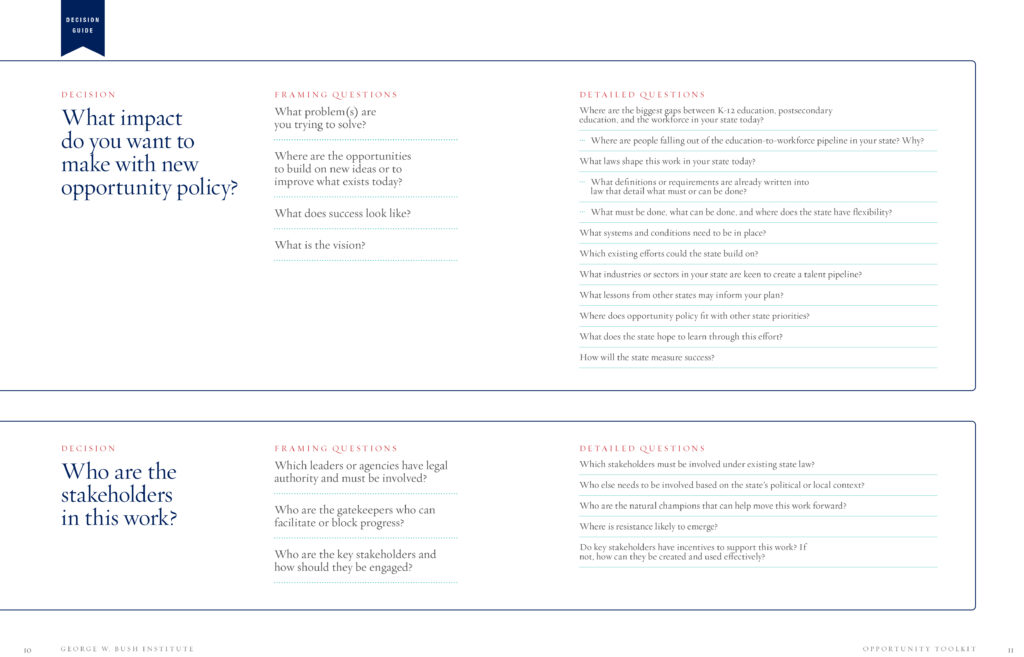
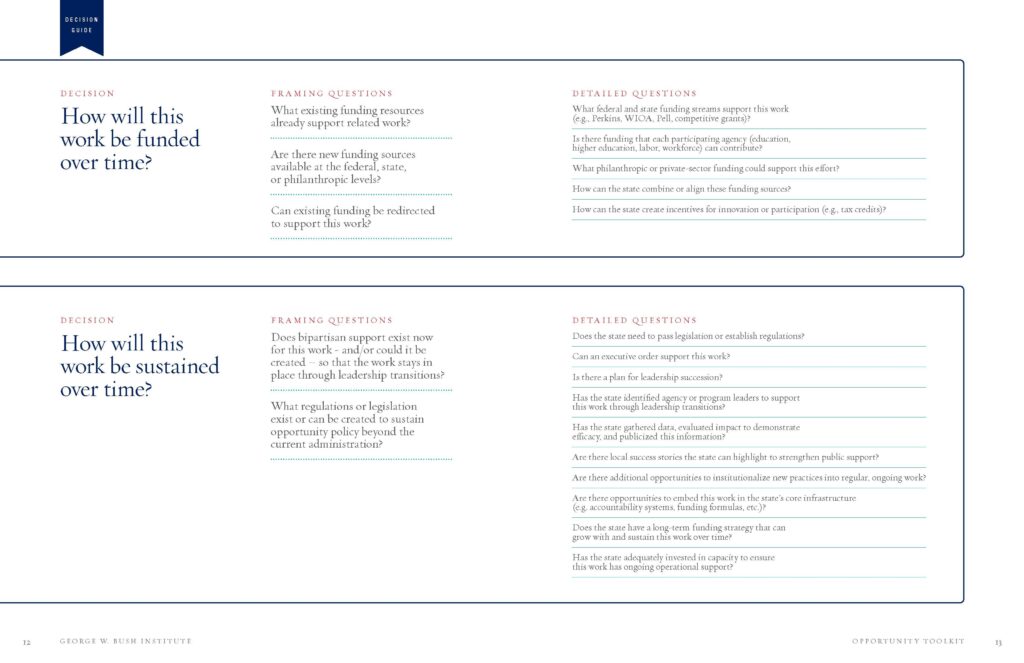
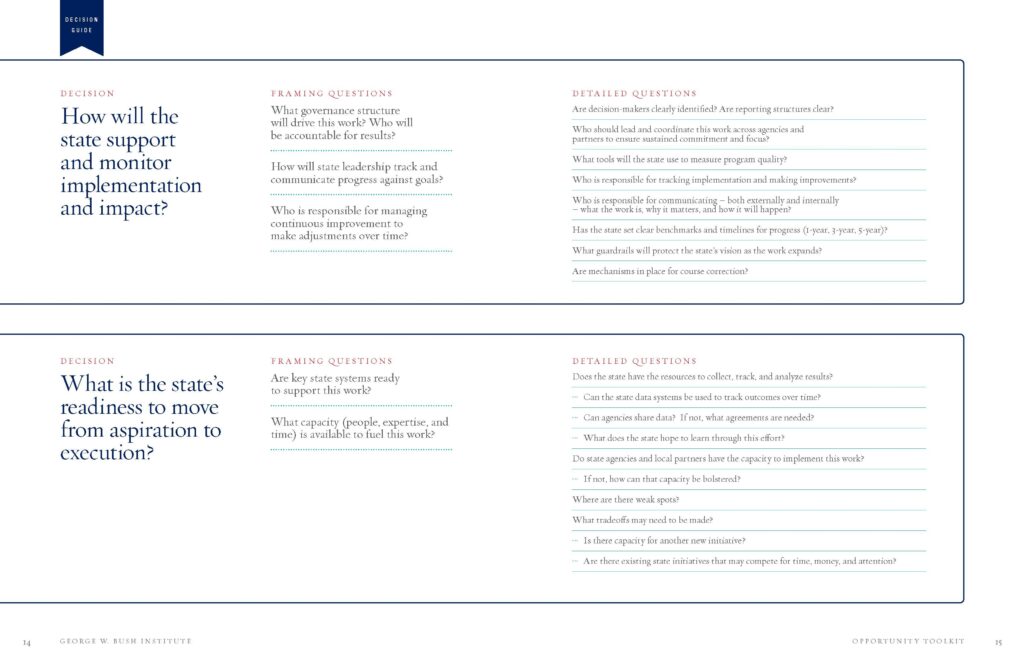
- A detailed decision guide to support specific policy planning and implementation.
- Brief examples of promising and innovative state policy.
- A robust resource guide detailing strong model policy, reports, and guidance from expert organizations around the country.
2
RECOMMENDATIONS
As governors and state leaders build their specific opportunity policy agendas, we suggest that they consider these six recommendations:
a. MARSHAL YOUR STAKEHOLDERS
Most people would agree that it is important to prepare young people for their professional and civic futures, but it is a governor who can compellingly describe how his or her state, and its people, will be better off and more successful with strong opportunity policy in place. The bully pulpit remains one of the most powerful tools available to a governor. Through speeches, state-of-the-state addresses, budget priorities, and convenings, governors can set the tone for what their state needs and how to get there.
A clear and consistent vision from the top also helps to align the purposes of systems that often operate independently, a common challenge given the disparate agencies and funding streams involved in education and the workforce. When governors articulate a shared goal – ensuring every young person has access to meaningful work experience before graduating from high school, for example – they create direction for government agencies, educators, employers, funders, and community leaders alike.
Governors can also convene the people responsible for executing this work. Education leaders, workforce agencies, industry partners, higher education institutions, philanthropy, and community organizations all play essential roles in opportunity policy. Bringing these stakeholders together around a shared strategy helps break down silos and accelerates progress. Ongoing efforts – like a commission or working group with deliverables – build important momentum over time that can outlast the tenure of one leader or champion.
b. USE OUTCOME DATA EARLY AND OFTEN
Clear measurable goals help everyone understand what is working – and for whom. Dashboards that are easy to access and understand help stakeholders understand both the need to act and progress over time. Disaggregating outcome data by common demographic categories (like race, gender, and socioeconomic status) helps everyone involved see what is changing – and who is being left behind.
That clarity helps to prioritize and continuously improve interventions, programs, and resource allocation over time. And it keeps all stakeholders informed about which young people are ready for their next step and who is falling out of the opportunity pipeline.
State Longitudinal Data Systems (SLDS) – integrated, state-managed databases that track individuals’ education and workforce outcomes over time – are a critical tool for advancing state opportunity policy. By connecting data across K-12 education, higher education, and workforce systems, they provide state leaders with a more complete picture of how individuals move through the opportunity pipeline. When intentionally designed and effectively governed, SLDS function as essential infrastructure for aligning systems, measuring outcomes, and informing decisions. However, many states have yet to fully leverage these systems to realize their full potential.
c. KEEP THE FOCUS ON THE BASICS
Beware of the breathless predictions that AI will render reading and math skills irrelevant. While the world is changing rapidly and significantly, the ability to read, write, and do math remains the crucial building block for students to become critical thinkers, idea generators, and builders.
This reality becomes even more important in an economy increasingly shaped by AI. Using AI effectively requires strong background knowledge, discernment, and the ability to interpret and evaluate information. Without foundational skills, new technologies can widen opportunity gaps rather than close them.
While it is not new, state opportunity policy should prioritize high standards and high expectations for student learning in K-12 education. Reading, writing, and math are the table stakes for future readiness. State leaders should champion investments in research-based reading and math instruction as the bedrock of opportunity policy.
d. BUILD IN THE PROFESSIONAL REPS THAT YOUNG PEOPLE NEED
Young people need meaningful on-ramps to professional life – it won’t just happen.
They develop confidence and competence through repeated exposure to real-world work experience. First jobs are rarely glamorous, but they are often essential for both practical and interpersonal skill-building. Everyone is a beginner at some point, and there is no skirting the learning process even as traditional entry-level jobs diminish.
The traditional pathways that reliably served many adults before are changing or fading. AI tools are driving swift automation, reshaping tasks and workflows, and reducing some entry-level jobs. The resulting increased efficiency is often good for companies and organizations, but it is creating a new opportunity gap for young people who may find it increasingly difficult to get a foothold in the workforce.
State opportunity policy should prioritize integrating professional experiences directly into education settings, rather than waiting until a young person has a diploma in hand. Work-based learning programs, internships, entrepreneurship opportunities, and apprenticeships allow students to explore careers, build professional habits, develop skills, and form meaningful connections. Service opportunities can also play a valuable role by connecting young people to community needs, creating pathways to earn and learn while contributing to critical needs across the country.
e. GO WITH THE GOERS
The gravitational pull of the status quo is strong. While our education and workforce systems are often large and slow-moving, they are also filled with entrepreneurial leaders who are testing and building new approaches to improve outcomes for young people. These “goers” are willing to try new ideas, see how systems can work together differently, creatively navigate funding and resources, and are motivated by change to act, adapt, and drive progress.
That group is the horsepower governors and state leaders need to turn an opportunity agenda from idea to impact. Identifying and supporting the goers – from within education, industry, and the nonprofit sector – creates both innovation and momentum. Governors can accelerate their opportunity policy impact by aligning incentives and funding streams with innovation. Competitive grants, pilot programs, and public-private partnerships can encourage experimentation while still maintaining accountability for results.
f. PRIORITIZE IMPLEMENTATION
Passing legislation or launching a new initiative is, of course, only the beginning. The spirit of that legislation becomes hollow if implementation is not prioritized. Innovation is most valuable when it leads to durable improvements. And good governance, necessary capacity, and the right incentives allow impactful ideas to scale.
A strong governance structure, which clearly states who is responsible for decision-making, who is accountable for change, and who is responsible for transparently sharing information, provides governors and state leaders with a clear line of sight into the work that comes after a bill is passed. Ensuring that a new effort or initiative can meet its promise also requires ensuring that enough capacity – people, money, and time – are available to fuel the change. It also requires ending programs that are not working or aligned, even when one is politically popular. Finally, providing the right kinds of incentives – like special funding or early access to new programs – helps keep the right stakeholders engaged.
Any significant policy effort requires ongoing adjustments as new ideas are tested in a rapidly changing environment. Smart policymakers anticipate that by ensuring that continuous improvement is baked into governance, capacity, and incentives. By prioritizing execution alongside policy design, governors can ensure that well-intentioned reforms translate into meaningful outcomes for young people and for the state’s economy.
3
DECISION GUIDE
4
STATE CASE STUDIES
a. TEXAS: USING DATA FOR OUTCOMES-BASED FUNDING
Opportunity policy in action
The Texas Legislature in 2023 unanimously passed House Bill 8 (HB 8) into law, creating outcome-based funding for the state’s 50 community college districts. The law incentivizes community colleges to align credentials with Texas workforce needs by tying funding to the following:
- The number of credentials of value
- Credentials awarded in high-demand fields, with added weight for those yielding faster returns.
- Students who transfer to four-year universities in state.
- High school students who complete 15 semester credit hours of dual credit.
One of Texas’ strengths is the use of commissions and working groups to convene stakeholders and experts to develop a report then used to inform legislation and regulations by investigating gaps in the system, rigor of credentials, and barriers for students.
The Texas Legislature in 2021 called for the creation of the Texas Community College Finance Commission to rethink the way community colleges are funded with state dollars, with the goal of better using community colleges to reduce Texas’ skilled-workforce shortage. That commission, whose members included a range of stakeholders, delivered a final report in 2022 that provided important analysis and recommendations for the legislators who developed HB 8 during the 2023 legislative session.
Governor Greg Abbott in 2024 called for the creation of the Governor’s Task Force on Healthcare Workforce Shortages to address the gap between credentialed health care workers and rising demand for care, to seek to expand opportunities for students, and to remove barriers that exist for health care programs at institutions. The task force’s final report offers a robust set of recommendations for sector leaders and public officials to solve for this particular industry.
The Certificate Programs Task Force is a working group of community college leaders and practitioners within the Texas Association of Community Colleges focused on strengthening short-term credential programs statewide. It will further refine the credential-of-value methodology for short-term credentials and develop recommendations by Sept. 1, 2027. This builds upon the Legislature’s work in 2025 with Senate Bill 1786 (SB 1786), which incorporated a shorter return-on-investment timeline and aligns credentials with the state’s self-sustaining wage benchmark.
Why it matters
HB 8 and SB 1786 move away from traditional community college funding formulas – typically based on inputs like enrollment, courses, and credit hours, along with local taxes and tuition – toward a model that prioritizes outcomes. It directs most state funding to reward measurable results, with additional support for institutions serving students who are academically disadvantaged (based on a Texas assessment of college readiness), economically disadvantaged (Pell Grant recipients), or adult learners (25 years and older). The law maintains a base funding safeguard for community colleges that are unable to cover core costs through taxes and tuition alone. It also established the Financial Aid for Swift Transfer (FAST) program, which pays colleges to provide dual credit courses at no cost to high school students who are eligible for free and reduced-price lunches.
What to watch for
Early indicators suggest the bill is working, with a growing pipeline of Texans eligible to earn credentials of value and transfer to four-year institutions. Dual credit enrollment at community colleges increased by 12.5% by fall 2024 from fall 2023, and the number of students completing at least 15 semester-credit hours of dual credit increased by 15% in FY24 from FY23. As results improve, policymakers will need to put clear safeguards in place to ensure that the outcome-based funding remains available, continues to reward student success, and is transparently reported.
b. COLORADO: LEVERAGING THE WORKFORCE DEVELOPMENT ECOSYSTEM
Opportunity policy in action
Colorado built a high-functioning postsecondary and workforce development ecosystem over 15 years of deliberate, bipartisan policy work – layering infrastructure and aligning incentives while refusing to let election cycles reset the agenda.
The state’s durable policy architecture has three load-bearing elements:
- A policy environment that treats education and workforce as a unified system rather than competing bureaucracies.
- A philanthropic community that aims to fund coordination rather than isolated programs.
- An employer community building toward a more formal, structured role in shaping what credentials get offered and what skills get taught.
Why it matters
Colorado’s strength is alignment instead of silos.
The Colorado Community College System (CCCS) serves as one of the critical connective tissues. By housing Career and Technical Education (CTE) within the community college system rather than a separate state agency, Colorado has reduced fragmentation, increased consistency across regions, and positioned community colleges as flexible on-ramps for both recent high school graduates and adult learners reentering the workforce.
The Colorado Commission on Higher Education’s (CCHE) 2023 strategic plan, Building Skills in an Evolving Economy, set a clear standard: Credentials must pay off. Paired with House Bill 22-1349 (HB 22-1349), which directed the Colorado Department of Higher Education (CDHE) and CCHE to develop a “minimum economic viability threshold,” the state established that, at a minimum, a postsecondary credential must generate lifetime earnings that exceed the full cost of attendance. That is a materially different accountability standard than completion rates – and it reoriented how Colorado assesses the value of individual credentials and programs, not just whether students finish. Colorado Senate Bill 14-205, signed into law in 2014, established industry-led regional sector partnerships that bring together employers, education providers, workforce boards, and economic development agencies. By 2025, those partnerships engaged more than 900 employers across 27 active partnerships – creating a feedback loop between labor market demand and program design that most states lack.
Governor Jared Polis issued an executive order in 2025 directing state agencies to operate Colorado’s postsecondary education and workforce development programs as a unified talent system rather than parallel bureaucracies, ensuring the state approaches postsecondary and workforce as a single portfolio, not two.
Opportunity Now, a grant program that requires cross-sector collaboration as a condition of award, is pushing community colleges, employers, and workforce boards to build shared infrastructure, like CoorsTek, an earn-and-learn model that includes youth apprenticeships, rather than parallel programs. Business leads; education follows.
The Colorado Department of Education’s (CDE) 2025-2028 strategic plan sets a big goal for the K-12 education system: By the class of 2029, 100% of Colorado graduates will have attained at least one of the “Big Three”: an in-demand industry credential, 12 college credits as part of a defined postsecondary and workforce readiness pathway, or a high-quality work-based learning experience. This plan redefined the expectations for Colorado high school graduates. It was championed by the Homegrown Talent Coalition, led by Colorado Education Initiative and Colorado Succeeds.
Finally, in 2026, the Colorado Department of Higher Education (CDHE) announced an expansion of its Accelerated Study in Academic Programs (ASAP), a model designed to move more students from enrollment to completion by addressing the full set of barriers they face. ASAP provides a comprehensive package of financial, academic, and personal supports, from tuition assistance to advising and wraparound services, tied explicitly to degree attainment. The program is backed by a blend of public and philanthropic investment, including support from partners like Arnold Ventures, signaling a growing emphasis on scaling evidence-based models that prioritize completion, not just access.
What to watch for
Three things made Colorado’s ecosystem durable enough to survive leadership transitions and budget cycles:
- Bipartisan framing around economic outcomes. Workforce development does not have to be a culture-war casualty. Colorado has consistently framed postsecondary investment in terms of earnings, employer competitiveness, and regional economic growth – language that holds across party lines.
- Philanthropy as a systems actor, not a project funder. Colorado’s philanthropic community has invested in coordination, data infrastructure, and policy capacity, rather than only stand-alone programs. That orientation amplifies public investment rather than substituting for it.
- Codified employer voice. Sector partnerships are not advisory committees that meet twice a year. They are legally established, regionally grounded, and tied to program decisions. Employers have skin in the game.
The result is a state where postsecondary education and workforce development are not parallel systems that occasionally collaborate. They operate as a single ecosystem oriented toward one question: Does this effort lead to a good job?
c. ARKANSAS: MARSHALING STAKEHOLDERS FOR A COMPREHENSIVE APPROACH
Opportunity policy in action
Rather than relying on program reform, Governor Sarah Huckabee Sanders elevated workforce pathways as a priority by aligning agencies around a single objective: preparing Arkansans for high-wage, high-growth careers.
Sanders issued an executive order in 2023 creating the Governor’s Workforce Cabinet and the position of chief workforce officer (CWO). The executive order creates a “single entity to coordinate and to assist in career and technical education,” ensuring young adults enter the labor market prepared for high-skilled jobs.
The Workforce Cabinet is a cross‑agency body for coordinating workforce policy and aligning education, workforce, and economic development efforts statewide. It’s chaired by the CWO, who is charged with coordinating, managing, and directing the governor’s workforce development policies and career education strategy, centralizing authority, accountability, and coordination.
Why it matters
The creation of a CWO sends a clear signal about gubernatorial priorities, but what makes Arkansas’ approach particularly impactful is Sanders’ appointee – Mike Rogers, a nontraditional choice that reflects a focus on workforce needs over credentials alone. With experience in both industry and education –including leadership at Tyson Foods and teaching skilled trades – Rogers brings a practical understanding of employer needs, how skills are taught, and the barriers learners face.
Like the CWO, the Workforce Cabinet’s composition is a core strength. Spanning the full workforce continuum, it brings together senior leaders from the Departments of Commerce, Corrections, Education, Human Services, Labor and Licensing, and Veterans Affairs. This structure ensures that the needs of employers, students, job seekers, justice-involved individuals, veterans, and those facing social service barriers are represented within a single, coordinated decision-making body. One of the cabinet’s first major actions was developing the Arkansas Workforce Strategy to serve as a clear roadmap for aligning state efforts. Reflecting a holistic approach, the plan was shaped by broad stakeholder input, including more than 500 employers, national experts, and cross-sector working groups.
The state’s strategy centers on four priorities:
- Aligning business and industry needs through the Department of Commerce.
- Strengthening education and career pathways through the Department of Education.
- Delivering coordinated services for job seekers and employers.
- Investing in regional workforce strategies tied to economic demand.
Since its launch, Arkansas has advanced several initiatives aligned with the strategy. The Arkansas ACCESS legislation is a comprehensive higher education reform package designed to better align education with workforce needs and reduce barriers for students. Additionally, the LAUNCH platform connects students, job seekers, and employers through a single, skills-based system linked to public services. The state has also expanded work-based learning through a State Apprenticeship Agency and created the My AR Dashboard, a transparent data hub to inform decisions. Together, these efforts are strengthened by clear metrics, governance, and accountability to guide implementation.
What to watch for
Sanders has transformed workforce development from a set of disconnected programs into a coordinated opportunity policy strategy linking education, employment, and economic mobility. Because the Workforce Cabinet is rooted in executive authority, its long-term sustainability will depend on whether responsibilities and cross-agency coordination are codified in statute or remain tied to Sanders’ leadership. Similarly, while the state has built a strong data infrastructure, accountability will hinge on how that data is used, including whether underperforming programs are redesigned.
Ultimately, these factors will determine whether Arkansas’s efforts lead to a lasting impact.
d. KENTUCKY: MAKING EDUCATION AND WORKFORCE DATA TRANSPARENT AND MEANINGFUL
Opportunity policy in action
The Kentucky Center for Statistics (KYSTATS) works to make education and workforce data readily accessible to policymakers, practitioners, and the public. Established in 2012, KYSTATS collects and analyzes comprehensive data through the Kentucky Longitudinal Data System (KLDS) and integrates information from multiple state agencies, including the Kentucky Higher Education Assistance Authority, Education Professional Standards Board, Higher Education Matters, the Kentucky Education and Labor Cabinet, and the Kentucky Cabinet for Health and Family Services.
Why it matters
State longitudinal data systems that connect early childhood, K-12, higher education, and workforce data across agencies over time are foundational to informed decision-making. In Kentucky, policymakers regularly use KYSTATS data to inform legislation. This includes updates to postsecondary performance funding under Senate Bill 191, which incorporated student outcomes and earnings data to better match funding with workforce and economic priorities. KLDS data on teacher supply, workforce trends, and regional economic needs have also informed policy responses to issues like teacher shortages and how to best align credential programs to workforce needs. Tools such as district dashboards and career exploration platforms further ensure that policies – like financial literacy requirements – are grounded in real-world data about wages and opportunity, strengthening the state’s ability to better connect education with economic opportunity.
Kentucky codified the KYSTATS, including KLDS and its governance structure in legislation, ensuring sustainability through leadership transitions. Governor Andy Beshear has consistently framed education and workforce data as the “key to breaking generational cycles of poverty.” He and other state leaders have utilized the KYSTATS dashboard to illustrate how pre-K enrollment leads to increased college graduation and directly impacts the state’s economic stability.
What to watch for
KYSTATS’s roadmap for 2026 through 2028 outlined the state’s ongoing commitment to expanding data transparency. The research agenda reflects a shift to tracking how people move through school and into jobs over time, with a focus on key moments like graduating high school and starting college or a career, rather than static reporting. The plan prioritizes examining differences in outcomes across regions and student populations to better understand gaps in access and success.
Just as importantly, the roadmap emphasizes expanding KYSTATS users beyond policymakers and researchers so that any Kentucky citizen can come to the site and understand the data. The plan focuses on making all reports, graphs, and features of KYSTATS easy to interpret and visually appealing to a wide range of users. To achieve that goal, Kentucky plans to continuously assess how well all stakeholders can access and use the data, to better understand the data’s clarity and relevance. Together, these efforts can create a feedback loop on how insights are produced, evaluated, and refined, so the system increasingly delivers decision-ready information that meets policymakers’ needs and helps to tell the story of economic opportunity in Kentucky.
e. ALABAMA: FOCUSING ON ACADEMIC RIGOR AND PROFESSIONAL EXPERIENCES FOR STUDENTS
Opportunity policy in action
Beginning with the class of 2026, Alabama will require all high school graduates to meet more rigorous college, career, and military readiness standards to earn a diploma.
Alabama’s updated high school graduation policy requires students to complete standard course requirements and demonstrate college and career readiness by meeting at least one approved indicator. These include:
- earning benchmark ACT scores
- achieving qualifying scores on Advanced Placement (AP) or International Baccalaureate (IB exams)
- earning college credit in high school
- attaining a silver or gold ACT WorkKeys score
- completing a youth apprenticeship
- earning an approved industry credential
- achieving Career and Technical Education (CTE) completer status
- finishing an approved computer science course
- enlisting in the military prior to graduation
Previous classes only needed to meet course requirements and submit the Free Application for Federal Student Aid (FAFSA) to receive a diploma. The changes for 2026 are designed to ensure Alabama graduates are more rigorously prepared for college and career readiness.
Why it matters
By making college and career readiness a graduation requirement – rather than an aspiration – Alabama is strengthening its pipeline to opportunity. This shift has been championed by Governor Kay Ivey, bipartisan representation in the state Legislature, and advocacy from organizations such as the Business Education Alliance of Alabama and A+ Education Partnership.
Recognizing that many of its readiness measures require significant collaboration with employers in the private sector, Alabama partnered with community colleges and institutes of higher education to support implementation and to provide clear, user-friendly resources to help students navigate their options. The Alabama Community College System provides robust guidance on dual enrollment, including centralized information and links to local programs. The Alabama Office of Apprenticeships has expanded employer partnerships to establish apprenticeships for thousands of occupations. They also have dedicated staff who help businesses design training programs and offset costs through wage reimbursements for student apprentices.
Alabama’s policy on new graduation requirements is designed to be an ongoing performance system, not a one-time mandate. The state’s longitudinal data system tracks credential attainment and postsecondary and workforce outcomes to ensure these policies translate into meaningful results for students. Additionally, Alabama will attain rates and the gap between graduation and readiness, using these data to guide adjustments, funding decisions, and continuous improvement of program implementation. This process creates a feedback loop for future policy and establishes broader accountability and alignment across the state.
What to watch for
The class of 2026 will be the first to graduate under Alabama’s new requirements. This shift creates clear accountability for student outcomes, with an important caveat: Alabama must maintain rigorous benchmark scores for the ACT and ACT WorkKeys indicators. Setting the bar too low risks diluting the intent of this policy, which is to ensure more students are truly prepared for what comes next.
It will also be important for the state to track the pathways students use to meet the readiness standard. This level of transparency will help identify whether certain groups of students are disproportionately steered into specific pathways and inform any needed adjustments.
5
RESOURCE GUIDE
The following resources – a wide-ranging collection of reports, tools, podcasts, model policies, and relevant executive orders – provide key context and insights that may be useful to state teams building opportunity policy strategy. This list should be considered a snapshot of key resources rather than a definitive list.
Building a Resilient Modern Workforce – AEI
This report provides a framework for thinking about—and mapping a strategy for—an uncertain future by outlining the three main factors that will shape the future of the workforce: (1) the slowing growth in the number of available workers, (2) the rise of artificial intelligence, and (3) the growing importance of noncognitive or soft skills in enabling workers to adapt to technological change.
Holding New Credentials Accountable for Outcomes: We Need Evidence Based Funding Models – AEI and The Burning Glass Institute
This report examines the value of credential programs amid a crowded marketplace of over 1.1 million options, arguing that public funding for credential programs should be conditional on demonstrated economic benefits.
Portrait to Practice: How States Turn Vision into Infrastructure for Student Success – America Succeeds
This report presents the findings of a 50-state policy scan conducted between late 2025 and early 2026 to examine the policy and leadership conditions that help translate portraits of learners into meaningful experiences for students.
Breaking the Gridlock: An Action Plan to Strengthen Education-to-Workforce
Pathways – Bellwether and The U.S. Chamber of Commerce Foundation
This report describes the current education-to-workforce pipeline, the barriers students encounter along the way, and policy solutions to help in both red and blue states.
From Policy to Impact – Bellwether
This series highlights how SEA leaders can strengthen six distinct phases of implementation.
Making It Work: Ten Stories of Promise and Progress in High School Work-based Learning – Bellwether
This report builds on a 2021 analysis of all 50 states and D.C., which assessed work-based learning policies against 15 criteria in six categories. By revisiting 10 states with planned or in-progress initiatives, the report highlights strategies that strengthen work-based learning and showcase promising progress.
Pathways to Implementation: Building and Sustaining Effective Career Pathways – Bellwether
This seven-part series provides state leaders with a practical framework for designing, implementing, and sustaining career pathway programs that align with workforce needs.
Sharing the Cost: Insights from States Funding Dual Enrollment to Expand Access – Bellwether
This report examines six dual enrollment programs across four states — California, Idaho, Minnesota, and Texas. It analyzes each program’s funding structures — including how costs are shared across states, community colleges, K-12 districts, and students — as well as student participation and attainment outcomes.
A Nation at Risk to a Nation at Work: The Case for a National Talent Strategy – Bipartisan Policy Center
This report lays out bold but achievable actions that modernize the federal role in education and the workforce while relying on state and local leaders across sectors to do the work closest to their communities.
AI and Workforce Navigator – Bipartisan Policy Center
This tool includes a skills data dashboard that shows AI’s impact on in-demand skills across industries and geographies, along with reports and case studies.
Measurement for MOBILITY – Britebound and Education Strategy Group
This report examines how states can measure and support students’ long-term success through their reporting, accountability, and incentive systems.
Credential Value Index – The Burning Glass Institute
The Credential Value Index (CVI)—a first-of-its-kind index and navigation tool that sheds light on the real-world outcomes of virtually every certification in America, as well as more than 20,000 other non-degree credentials.
The Jobs That Mobilize Framework – The Burning Glass Institute
Using real-time labor market data and employer insights, this report demonstrates how skills-based hiring and targeted upskilling can transform workforce systems, ensuring that economic growth benefits workers, businesses, and communities alike.
When Degrees Aren’t Enough: The Case for Work-Based Learning – CECU Career Education Report
This podcast episode features former Massachusetts governor and current Education at Work CEO Jane Swift in a discussion around the importance of professional experience, internships, work-based learning, and competency-based models.
Data and the P-20W Continuum – DQC
These roadmaps explore how state leaders can develop secure, high-quality linkages between early childhood, K-12, higher education, and workforce data systems that allow for information to be available to students and families as a tool for decision-making.
State Financial Incentives for Work-Based Learning – Education Commission of the States
Informed by a 50-state policy scan, this Policy Brief highlights key elements of financial incentives in state policy for each group: students, employers, and education institutions and intermediaries.
Bridging the Gap: How States Are Aligning High School with Postsecondary Success – ExcelinEd
Highlighting innovative policies in Indiana, Utah, and Georgia, the report shows how states are aligning graduation requirements with college, career, and military pathways while simplifying access to higher education.
Florida Pathways: College and Career Dashboards and Student Experiences – ExcelinEd
State policymakers in Florida have dedicated significant effort to aligning K-12, postsecondary and workforce systems. This report includes a review of current data dashboards in Florida that relate to post-high school success as well as a comprehensive survey of students, parents and recent graduates.
Leveling Up the High School Experience: Credentials of Value in College and Career Pathways Policy – ExcelinEd
This report highlights the critical role of industry-valued credentials in bridging the gap between education and employment.
Maximizing Return on Investment: How States Can Analyze Pathways to Improve Student Success – ExcelinEd
This report is designed to help state policymakers conduct a meaningful ROI analysis of pathways policies.
Pathways Matter – ExcelinEd
This tool creates a framework of twenty policies, organized into six focus areas, to help states build a skilled and educated workforce.
Pivots Without Pathways – Career Navigation in a Fragmented Labor Market – Harvard University / The Project on Workforce
This report details findings from a study examining how low-wage workers and community college students navigate their careers, including how they access, interpret, and use education and career information.
An Education Reform Self-Assessment | A Nation At Risk +40 – Hoover Institution
This tool helps policymakers apply the lessons learned from four decades of reform efforts to help inform their next education policy priorities.
CEMETS iLAB Indiana – Indiana Career Apprenticeship Pathway
CEMETS iLab Indiana is a coalition of over 300 Hoosier leaders representing a variety of sectors including business, K-12 education, higher education, and government. The coalition’s members joined forces in 2023 to design a new statewide professional education and training system rooted in a youth apprenticeship experience starting in high school.
Effective Pathways: Assessing the Readiness of State K-12 Career and Technical Education Programs – Insightful Education Solutions
This report presents a national assessment of K-12 CTE program readiness. Rather than evaluating individual schools or programs, this analysis examines whether state CTE programs are sufficiently structured, measured, and transparent to understand student pathway activity, assess alignment with workforce priorities, and support ongoing improvement.
Policy Blueprint to Modernize & Expand Apprenticeship Nationwide – Jobs for the Future
This report recommends a comprehensive set of federal policies to modernize and scale apprenticeships to meet the needs of today’s workers and the demands of today’s economy.
What Works: Expanding high-quality career pathways in Texas – JPMorganChase
This report examines how strategic alignment, strong collaboration with intermediaries, data-informed decision-making, and targeted investments can support communities in building high-quality career pathways.
A Stronger Nation – Credentials of Value – Lumina Foundation
This tool, built around Lumina’s new credentials of value framework, connects post-high school education attainment with economic value.
10 Steps to Building Talent Locally – Lumina Foundation
The Local Talent Handbook from Lumina Foundation is a practical guide for community leaders that lays out 10 steps to build stronger local workforces.
Actualizing the Promise of Youth Apprenticeship: Lessons Learned from NGA’s Policy Academy to Advance Youth Apprenticeship – National Governors Association
This publication highlights key themes from the Policy Academy, governor-led policy change on youth apprenticeship, and future of youth apprenticeship policy at the state and federal levels.
Governors Working on Workforce Development – National Governors Association
This article highlights efforts that Governors in eight states have taken to support workforce development.
Reigniting the American Dream – National Governors Association
This framework calls U.S. governors to
- Step out of partisan corners and into a shared vision
- Examine the obstacles and confront the challenges that limit individual and collective opportunity
- Leverage our resources and relationships (domestic & global) to learn, compare and innovate
- Move beyond rhetoric and develop transformative practices and policies
- Clear a path for millions more Americans to dream — and achieve
Thinking Differently About Career-Connected Learning – NCEE
This series presents global policies and practices that improve student success, including goals for future-ready students, scaffolding for career-connected learning, and student-informed decision-making.
Quality Skills and Education Pathways – The Pew Charitable Trusts
This research focuses on how state policymakers can strengthen nondegree credentials ecosystems by building consensus around quality standards, improving data collection and transparency, and enhancing regulatory capacity.
Apprenticeship Should be a Centerpiece of Workforce Pell – Progressive Policy Institute/Bruno Manno
This article provides recommendations for state and federal leaders regarding maximizing Workforce Pell Grants to increase apprenticeship opportunities.
Apprentice Nation – Ryan Craig
This book explores how a modern apprenticeship system will allow students and job seekers to jump-start their careers by learning while they earn—ultimately leading to greater workforce diversity and geographic mobility.
State Opportunity Index – Strada Education Foundation
The State Opportunity Index helps states assess how they are leveraging education after high school — including degrees, certificates, and other credentials — to strengthen workforce competitiveness.
Building Pathways to Success: Work-Based Learning in Tennessee High Schools – TN SCORE
This series on work-based learning in Tennessee high schools is designed to inform leaders about how work-based learning can propel students toward a high-demand, high-wage career and a life of economic independence.
Connecting Education and Opportunity: A Framework for Credential Impact in Tennessee – TN SCORE
This framework provides a data-informed lens through which state leaders can identify which postsecondary pursuits are also matched to high-demand, high-wage jobs.
The Opportunity of Stackable Credentials – TN SCORE
This memo highlights how stackable credentials can expand opportunity and strengthen the state’s workforce.
American Public Schools and the Great Opportunity – TNTP
This strategy provides a roadmap for redesigning public education, so that 50 million young people are prepared for meaningful work and a meaningful life by 2035.
Most Career Pathway Programs Aren’t Preparing Students for Good Jobs. Here’s How States Can Change That – TNTP
This article explains how states can conduct an annual return on investment analysis for high school career-connected learning programs, including three actionable steps, pointing to specific state examples as models to follow.
Let’s Measure Ready: A 50-State Analysis of College, Career, Military, and Civic Readiness Indicators – Urban Institute
This report provides an updated 50-state landscape scan of CCR indicators, focused on variations in CCR indicators’ design, components, benchmarks, and transparency.
The Future is High School | XQ: 10 State Policy Actions – XQ Institute
This resource outlines ten policy actions grounded in clear goals, learning experiences, and meaningful measurements. It also included tailored reports for each state and D.C.
Executive Orders Issued by President Trump that Impact Opportunity Policy:
Preparing Americans For High-Paying Skilled Trade Jobs Of The Future
Description: This Executive Order directs the federal government to streamline and strengthen workforce development programs so they better align with America’s reindustrialization and the growing demand for skilled workers. It calls for a comprehensive review of existing programs, expansion of Registered Apprenticeships (with a goal of 1 million new apprentices), investment in upskilling (including AI-related skills), and promotion of alternatives to four-year degrees.
Reforming Accreditation to Strengthen Higher Education
Description: This Executive Order targets the higher education accreditation system, directing federal agencies to increase competition among accreditors, reduce barriers to innovation, and make it easier for institutions to switch agencies. It aims to better align accreditation and federal funding with positive student outcomes as well as to eliminate a reliance on diversity, equity, and inclusion.