


News deserts are expanding nationwide as journalism organizations shutter their operations. Almost 40% of America’s newspapers have gone out of business over the last two decades. The Northwestern/Medill Local News Initiative reports the collapse has left 50 million Americans with limited to no access to local news. The problem is acute in rural communities, where a newspaper often is the only journalism operation.
The deserts have arisen over the last two decades largely because the digital revolution upended the financial model of newspapers. At the same time, some traditional news operations, as well as new digital and nonprofit models, are bucking the trend. That includes in parts of rural America.
Their progress is crucial for the country. A reliable flow of information strengthens local communities. Independent reporting helps citizens make informed decisions, holds local officials accountable for serving communities, and keeps people abreast of neighborhood activities.
The news operations in this case study show how rural news organizations are empowering citizens from the Texas Panhandle to the Midwest to Central Appalachia.
TEXAS PANHANDLE
Clarendon Enterprise and Greenbelt Intrepid
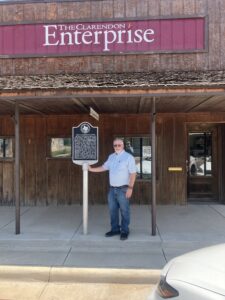
Roger Estlack’s family started publishing newspapers in the Texas Panhandle in 1929, when they owned the Donley County Leader. Today, the Texas Tech University graduate owns the Clarendon Enterprise, which serves an agricultural community about 60 miles southeast of Amarillo. In 1995, he purchased the paper, whose origins trace back to 1878.
In 2025, the West Texan bought a paper that served the nearby Panhandle cities of Childress, Memphis, and Wellington. He renamed it the Greenbelt Intrepid, which now serves those three communities.
The Clarendon paper reaches 1,000 people a week through its print and digital editions. Save for a few subscribers on both the East and West coasts, the weekly Enterprise circulates among the town’s 1,800 residents. Some may read it online. Others may receive the eight-page paper through the mail, buy it at the newspaper’s offices, or, most likely, purchase copies for $2 at Clarendon grocery and convenience stores. Penetration of roughly 50% in a community shows a strong reach. By comparison, some major metropolitan papers only reach 10% to 15% of their communities.
Still, the revenues are not sufficient to sustain the Enterprise’s operations. As a result, the newspaper publishes two glossy welcome guides a year for Donley County, in which Clarendon sits. The Enterprise works with the Clarendon Chamber of Commerce in publishing the guides in the spring and fall.
The publications contain lists of events over a six-month period, historical features about such novelties as Route 66’s path through the county, and Clarendon College’s Lady Bulldogs’ rise to the final four of a national junior college basketball tournament. Advertisements for restaurants, businesses, and ranch land are spread throughout the 55-page guide. (Estlack also publishes guides for Hall County, where the Intrepid circulates.)
Sitting at lunch in a Clarendon restaurant this summer, Estlack, who serves as first vice president of the Texas Press Association, explained that the Enterprise has had to think differently about income. The newspaper no longer counts on ads from grocery stores and car dealerships.
Rethinking revenue led to the guides as a source of income, along with the Enterprise producing a high school football poster each fall and a graduating senior edition each spring. These revenue sources allow Estlack to keep ad rates affordable for the Enterprise, which still runs help-wanted ads, public notices, business advertising, and a worship directory. Classified advertising, he says, brings in about 15% of revenues.
The July 2 edition naturally focused on America’s 250th anniversary. A front-page story detailed parades and other celebrations that were scheduled for July 3 and July 4 in the West Texas community. Estlack wrote an insightful column on America at 250 versus America at 200. And a full-page ad heralded rodeos, music and dancing, and arts and craft shows during the week. The July 9th edition included four pages of pictures from those festivities. Both editions contained local news items, including obituaries.
The Enterprise costs $2 per issue. The paper has two full-time staff members, plus two part-time staffers and a few freelancers. Estlack’s wife works as a volunteer.
Together, they report on the City Council, community events, Clarendon College, school activities, and local sports. Estlack writes occasional editorials while a community columnist chronicles life in Clarendon.
The Enterprise launched a website in 2000, has a following of about 6,000 people on Facebook, and even saw one of its social media stories about a resigning school superintendent go viral. The Enterprise also hosts occasional Facebook Live events. And Estlack is intent on selling ads based upon the Enterprise’s total audience, not just its circulation.
“We are making it by giving people information about their community,” Estlack says of the Enterprise.
The publisher acknowledges he occasionally absorbs vitriol from officeholders. “But we are out in the community and will always be a cheerleader for Clarendon. We just want our elected officials to follow the rules and people to do right. We are willing to tell what’s good and what’s bad.”
“Mr. Clarendon,” is how Austin Lewter, director of the Texas Center for Community Journalism, describes Estlack. “He is invested in his town.”
Estlack sees room for growth with his other newspaper, the weekly Intrepid. It reaches only 1,300 people in its three communities of about 9,000 residents. Estlack travels the half-hour or so to Childress, Memphis, or Wellington a few times a month to work with the editor on growth and revenue initiatives.
One plan involves simply collecting subscription revenues. The prior owner had given up collecting money from local stores after the latter sold weekly editions for two dollars. Estlack also plans on increasing advertising rates, which he did for the Clarendon Enterprise by first meeting with local advertisers. The Childress paper had not increased its ad rates since 2014.
The Intrepid and Enterprise are fortunate that both papers are printed in the Panhandle. The lack of available printing presses is a problem for rural papers. Estlack and his brother retrieve theirs from a printer each week, about an hour’s drive away.
“You still can make a living, if you’re willing to work at it,” he emphasizes.
Hansford County Reporter-Statesman and Sherman County Gazette
About 115 miles farther north in the Texas Panhandle, Suzanne Bellsnyder owns and operates two newspapers: the Hansford County Reporter-Statesman and the Sherman County Gazette. Bellsnyder grew up in Hansford County, later worked in Austin as an aide for a Texas state senator, and eventually returned to this part of rural Texas to be closer to her parents and raise her daughter there.
The lifelong Republican had no journalism background and didn’t expect to become a journalist, much less own newspapers. But after serving as national director for the Hispanic Alliance for Prosperity Institute, working in city government, and consulting about economic development, she bought her papers at a low cost to keep them alive.
Now, the West Texan runs them in one combined edition. The joint publication contains banners for the Hansford County Reporter-Statesman and the Sherman County Gazette and provides unique reporting for each county. She is based in Hansford County and reports stories there and has hired a correspondent in Sherman County to help cover that county.
Combining the two operations has helped her operations financially.
“We are breaking even,” Bellsnyder reports.
The revenue model for the combined edition breaks down equally among subscriptions, public notices, and sponsorships. Public notices entail alerts in the papers and online about school board meetings and other events. Sponsors purchase banners that run across the print and digital editions. Or the sponsors might be included in the newspapers’ publication of local residents’ business cards. Bellsnyder even hired her mother to solicit sponsors, which include churches that advertise their local congregations.
She acknowledges that charging more for a yearly subscription would help. Subscribers now pay $50 annually. Doubling to $100 would put the operation in the black.
Each week, she prints 500 copies for both papers combined. At first, Bellsnyder encountered the lack of accessible printing presses that afflict rural newspapers. Her papers were printed two states away in Liberal, Kansas, then shipped to her Panhandle offices. Now, the papers are printed about 70 miles away in Pampa, Texas.
The entrepreneur uses social media to get reporting and analysis to the communities her papers serve. Facebook is popular with older readers, while TikTok connects with younger, more visual news consumers. She uses that latter platform to go beyond the headlines and explain the processes of government. Last year, an explainer about the county budget drew 10,000 views.
Publishing online is a big part of sustaining Bellsnyder’s local operations.
The combined papers appear digitally each week thanks to work with the Community Journalism Project. And Bellsnyder uses the platform to engage readers. This summer, for example, the Hansford County Reporter-Statesman conducted an online survey about whether residents in Spearman, the county’s largest town, wanted a food truck park. (The vast majority did.)
People pay attention to the paper’s reporting. Pieces can become the talk of the town, and radio soon follows up on them. Naturally, families want to see their children in the paper. Sports reporting is part of the strategy, along with ample coverage of graduation ceremonies and other school events.
Bellsnyder’s commitment to sustaining rural communities extends beyond these papers. She writes a Substack column about rural Texas that Austin policymakers read and syndicates her column to 28 rural Texas papers.
“I want to give voice to rural Texans,” the former College Republican state chair said in an interview.
She also is launching the Grama Institute to provide news content to other small-town papers, bring together rural editors to work on common challenges, and develop policies that support rural life.
THE MIDWEST
Teri Finneman not only researches the plight of rural journalism and lectures about its challenges through her role as a professor at the William Allen White School of Journalism and Mass Communications at the University of Kansas (KU). The North Dakotan also works with KU students in publishing a digital newspaper in nearby Eudora, Kansas. And she is consulting this year with 14 small-town papers in Kansas. She has done likewise with rural papers in Nebraska, North Dakota, Tennessee, and Wyoming. The work led her to co-author the book, Reviving Rural News.
Finneman contends that rural newspapers need to change their revenue model.
That includes offering more advertising options. But it also means charging readers more for subscriptions. As she explains in the accompanying video, many papers have not kept their pricing model aligned with a rise in the cost of other goods, such as the increase in soft drink prices.
Finneman also advocates for papers becoming very engaged with their communities.
“Joseph Pulitzer and William Randolph Hearst did community engagement big time,” she says about the famously competitive publishers’ promotion of their New York papers in the early 20th century.
In the Eudora Times’ case, Finneman and students are present in the community every day, except for perhaps Sundays. Relationships develop through covering city council and school board meetings, reporting on football and basketball games, and writing feature stories.
“We are the local news outlet for this community,” she explains.
Finneman and the student-reporters are active in the community in other ways as well. They work with the local coffee shop and bakers in hosting a well-attended December cookie contest, which results in the publication of a cookbook. They host a March Madness for pets, in which residents vote throughout a week on the pets that residents enter in the contest. These activities are not about journalism per se, but they are about building trust in the Eudora Times through engaging the community.
Elsewhere in Kansas, Harvey County Now hosts a blues-and-brews festival, featuring bands, beer, and food trucks. The paper likewise hosts a monthly mingling session, sometimes in the newsroom, sometimes at another business.
A paper that Finneman consults with in North Dakota partners with a local pasta factory and businesses in the town of 2,000. Together, they host an October “Pasta Fest.” People come downtown, peruse the various stores, and vote on their favorite dish.
Events like those can be revenue streams for some rural newspapers. Benjy Hamm, director of the Institute for Rural Journalism and Community Issues at the University of Kentucky, contends that events can be part of a diverse revenue stream. They could range from bridal events to home and garden shows to healthcare gatherings for seniors.
Events, however, ultimately are about building social cohesion and strengthening trust in the media. Finneman says her research finds that people are more likely to support their newspaper when they know a journalist.
CENTRAL APPALACHIA
The philanthropic funding that propels nonprofit news sites in urban and suburban communities is harder to find in rural journalism. An exception is the funding that Press Forward/Central Appalachia and the Rural News Fund are investing in eight places in West Virginia, Ohio, Kentucky, Tennessee, Virginia, and North Carolina.
Grants of $50,000 were extended earlier this year to the first cohort of recipients. They consisted of nonprofit and for-profit news organizations as well as public media operations. Each recipient reaches underserved communities across Central Appalachia. The grantmaking involves a partnership among several Central Appalachian organizations and Press Forward, a national effort to engage funders to sustain local news operations.
Eli Flournoy, who advises Press Forward/Central Appalachia, says the goal is to expand coverage in Appalachian news deserts. This year’s recipients had to show that they had been operating and growing and that they had plans to expand coverage near them.
The money is not forever. Rather, it provides “bridge capital” over a two-year period. During that time, the news operations can seek other funding to further sustain themselves. At the end of those two years, the Press Forward/Central Appalachia initiative will fund another cohort.
The recipients for the first round of grants to nonprofit or for-profit news organizations are the Southeast Ohio Independent News; Enlace Latino in North Carolina; Mountain Top Media in Eastern Kentucky; and Black by God in West Virginia.
The first four public media awardees are West Virginia Public Broadcasting; Allegheny Mountain Radio in West Virginia and Virginia; Appalshop/WMMT in Kentucky; and Appalachia + Mid-South Newsroom in Kentucky, Tennessee, and West Virginia.
Each organization informs its communities through various means. The Southeast Ohio Independent News, for instance, draws strongly upon local investigative reporting. One piece this summer dug into the rift between the mayor of Athens, Ohio, and a local recreation council.
The biggest challenge for these organizations, Flournoy reports, is the capacity of their business side. The entrepreneurs running these organizations are experts in “the mission.” Where they need help is managing business operations.
That’s why Flournoy and a team of advisors like Benjy Hamm work with the recipients on issues such as reducing non-news expenses. Business coaches work with the recipients in assessing their financial model.
“We are squarely focused on rural marketplaces,” Flournoy says. “Having accurate news and information is vital to the health of local communities.”
Supportive organizations are essential to the success of rural news operations.
Press Forward/Central Appalachia. Hamm’s Institute for Rural Journalism and Community Issues. The Texas Center for Community Journalism. They provide opportunities for those who run and/or own small-town news organizations to consult on business strategies, learn from a network of peers, and receive training in managing their operations.
CONCLUSION
The work and strategies of the news organizations in this essay matter for this simple reason: We need to think of reliable information the way we do clean water or clean air. That’s how the Poynter Institute’s Megan Griffith-Greene describes the necessity of reliable information. We need it to sustain ourselves as we live together in community.
As this case study shows, some rural news organizations continue to provide local reporting for their communities. In doing so, they empower citizens from the Texas Panhandle to the Midwest to Central Appalachia to make informed decisions. In the end, that strengthens our democracy.
LESSONS LEARNED
- Update and diversify revenue streams.
- Be transparent about the costs of running a paper.
- Don’t be shy in hiking subscription rates.
- Provide more than traditional print advertising options.
- Give people information about their local communities.
- Publish county welcome guides.
- Be creative in engaging readers.
- Have an active online presence.
- Show commitment to the community.
- Feature high school sports.
- Train students as reporters.
- Partner with funders and supportive journalism organizations.
- Work with outside coaches on business and management matters.
- Accept the fact that vitriol will come.


