To celebrate America’s 250th birthday, I will publish a series of 12 essays exploring milestone events that shaped the American economy into what it is today – from the adoption of the Declaration of Independence to the Marshall Plan. I’ll pay particular attention to the country’s formative decades and tell the stories of ideas, policies, and innovations that helped build the world’s strongest economy.
If you want to understand the rise of America’s economic power and prosperity over the last 250 years, a good place to start is the American Revolution. No other event, before or since, has had such profound economic consequences for the people of what became the United States and for the world – even if economic change wasn’t the Revolution’s chief aim.
Before the Revolution, the American colonies were locked in a premodern imperial system aimed at restricting their economic activities to provide raw materials for the British Empire’s industrial hub in England. The colonies’ connection with Britain also had the effect of preserving old-world social and economic structures. By the 1770s, the colonies faced increasing constraints on their growth.
After the Revolution, independence unleashed economic forces that led over several decades to stunning industrial and commercial expansion, radical new ideas on freedom for workers and entrepreneurs, and economic opportunities unmatched in human history to that time.
The Revolution’s transformative effects became visible almost immediately following the Continental Congress’ decision for independence in July 1776. In the words of the great American historian Gordon Wood, “Americans had become, almost overnight, the most liberal, the most democratic, the most commercially minded, and the most modern people in the world.”
Critics of the early American republic rightly note that the Revolution’s ideas regarding political and economic freedom initially extended only to White males and were starkly inconsistent with slavery and other injustices that continued long after the nation’s founding. But as Dr. Martin Luther King said in his 1963 “I Have a Dream” speech, the “magnificent words” of the Declaration of Independence established a “promissory note” to every future American – a promise that has inspired successful efforts throughout history to extend the nation’s foundational freedoms to all Americans.
America’s colonial economy before independence
Although individuals from England and elsewhere migrated to Britain’s North American colonies for a wide range of religious and political as well as economic reasons, the colonies themselves fit squarely into an imperial economic system developed by British leaders with great steadiness of purpose throughout the 17th and 18th centuries.
Britain’s imperial system was rooted in mercantilism – the idea, widely accepted in that era, that nations should aim to export manufactured goods, import raw materials, and build national wealth and power by running as large a trade surplus with respect to other countries as possible. By the late 1600s, leaders in Britain as well as France, Britain’s chief rival, embraced the further theory that powerful nations should advance their mercantilist objectives by building global empires and forcing their colonies to serve as raw materials suppliers and markets for manufactured goods for the benefit of the imperial metropole.
From the start, the British government viewed its colonies as cogs in a wider imperial machine. The colonies would provide foodstuffs and tobacco for people in Britain and timber for Britain’s Royal Navy and merchant fleet. They would serve also as markets for woolen textiles, metal equipment, and other goods made in England as well as sugar from Britain’s Caribbean colonies and tea from its Asian territories. And Britain’s North American and Caribbean colonies, chronically short of workers for their tobacco and sugar fields, would become a market for enslaved Black people transported by British merchant companies from West Africa.
As early as the late 1600s, rapid population growth and economic progress in Britain’s North American colonies caused British leaders to worry that their colonists would challenge the imperial system by developing manufacturing industries of their own. They also worried that opportunities presented by an American manufacturing sector would “drain this Kingdom of great Numbers of our People,” as author Joshua Gee put it in the 1740s.
These concerns led to a long series of measures aimed at keeping the colonists in their economic and demographic place, historian Theodore Draper recounts in his book, A Struggle for Power: The American Revolution. Britain’s restrictive policies included the following:
- A series of “navigation” acts requiring that all goods moving to or from the colonies – even from one American colony to another – pass through Britain and travel on British ships (enacted between the 1650s and the 1690s).
- Laws prohibiting the colonies from manufacturing wool textiles (starting in 1699).
- A ban on manufacturing hats in the colonies (1732).
- Stepped up enforcement of an old ban on importing molasses – semiprocessed sugar used mostly to distill rum, then a large American industry – from French and Dutch-controlled Caribbean islands (1733).
- A ban on manufacturing goods made from iron (1750).
After Britain’s victory over France in the Seven Years’ War of 1756-1763, the empire tightened its screws further. The expulsion of French forces from what became Canada and the American Midwest, coupled with massive migration into the American colonies, raised the possibility of rapid westward expansion of the colonies. This would impose additional military costs on an indebted British government as a result of conflict with Native populations, enable further population growth, and increase incentives for homegrown manufacturing.
The British government responded with the Proclamation of 1763, temporarily prohibiting settlement of areas beyond the Appalachians, and then with a series of tax measures in 1765 and 1767. Authorities in London also made clear that they intended to enforce existing restrictions on colonial manufacturing and commerce far more vigorously.
Even though actual taxes imposed under measures like the 1765 Stamp Act were modest relative to income levels in the colonies, most colonists reacted to these measures with vitriolic rage.
To understand why, consider two additional realities of the time. First, the colonists were well aware of the age-old British political principle that the Crown could not impose taxes without the consent of its subjects as expressed through an elected Parliament. The empire had no prior record of taxing the colonies directly, and the colonists had no representation in Parliament.
Second, Britain announced its tax measures at a time when colonial frustration with British policies to constrain the colonies’ growth was approaching a boiling point. New Englanders in particular suffered from poor conditions for large-scale agriculture and believed that a still-stricter mercantilist regime would undermine their nascent manufacturing sector, which had emerged amidst relatively lax enforcement of the laws prohibiting it before the Seven Years’ War.
Complaints against the Empire’s economic restrictions figured prominently in pamphlets written by colonial leaders protesting the new policy program. Boston leader James Otis wrote in 1765, “Can anyone tell me why trade, commerce, arts, sciences, and manufactures should not be as free for an American as for a European?” The widely respected lawyer John Dickinson, in his famous 1768 pamphlet Letters From a Farmer in Pennsylvania, blasted imperial authorities for prohibiting the colonists from manufacturing their own goods or buying them from anyone else besides British suppliers. “We are exactly in a position of a city besieged,” he declared.
In addition to restricting trade and manufacturing, Britain imposed legislation blocking the emergence of a modern financial system in the colonies. The colonies inevitably ran persistent trade deficits with Britain’s home islands – a necessary part of London’s imperial design – so they were chronically short of gold and silver, the Empire’s main forms of money. British policies ruled out a homegrown banking system that might have helped finance the colonists’ trade. After 1751, Britain banned colonial governments from issuing paper currency as well.
The colonies, therefore, had no way to pay for necessities other than by borrowing, mostly from British merchants. These credit constraints added further obstacles to the development of American manufacturing and intra-America trade, on top of the Empire’s other regulations.
Another constraint: Imported attitudes and customs regarding work and enterprise
Gordon Wood, who died just last month, earned his reputation as the preeminent historian of our time focused on the American Revolution by documenting the enormous social, political, and economic changes wrought by U.S. independence. In his Pulitzer Prize-winning 1991 book The Radicalism of the American Revolution, he richly illustrates the antiquated state of prerevolutionary attitudes and customs respecting work and enterprise, both in Britain and America.
Britain in the mid-18th century, Wood shows, was a “hierarchy-ridden” society defined by steep status distinctions separating aristocrats from common people. Colonial America largely imported British-style social hierarchies, though in truncated form because the colonies never became home to titled aristocrats like the ones who occupied the highest rungs of Britain’s social ladder.
As in Britain, colonial society largely reflected the view, as expressed by religious leader Jonathan Edwards, that “all have their appointed office, place, and station, and everyone [should] keep in his place.” Elite families closely imitated the customs of the British aristocracy, especially in the South. This included lavish consumption – lowland South Carolina was especially known for the “magnificence” of its elite consumption patterns, as one visitor described them – plus an obsession with “honor” and the conviction that most forms of work were below the station of “gentlemen.”
Such attitudes took hold despite the fact that much of America’s social elite was only one or two generations removed from self-made forebears, as was the case with George Washington, Thomas Jefferson, and John Adams. American elites largely thought of social rank as something one inherits, though none of the colonies ever legally defined it this way.
As for the common people who constituted most of the population in the colonies, elite opinion largely held that it was good for them to remain relatively poor, as poverty was the only reliable device to make them work, and that consumption of luxury goods by common people was a dangerous vice that society should actively suppress. Tens of thousands of White working-class people lived in various forms of indentured servitude under colonial laws that restricted their movement and returned them if they ran away. Tenant farmers comprised a growing share of agricultural workers across the colonies by the 1770s, as wealthy elites acquired more and more of the country’s available farmland.
Another pervasive feature of the colonial economy was borrowing by working-class people from relatively idle elites. In a credit-constrained and cash-starved economy, going ever further into debt was often the only way many people could make ends meet. It was also a growing source of income for prominent figures including Benjamin Franklin and John Hancock of Massachusetts.
Small farmers hoping to export crops to Britain typically had to sell their produce at below-market prices to the largest plantation owners, who controlled access to British importers and lenders. All these arrangements tended to reinforce tight, personalized, and highly unequal relationships between wealthy patrons and dependent working people and to prevent the spread of market-oriented practices.
And at the bottom of the social ladder in the mid-1700s were half a million enslaved Black people. Slavery remained legal in every colony, though there were far fewer enslaved people in the North than the South.
The colonial economic system, in sum, was not especially conducive to innovation, rising labor productivity, or upward mobility – though many Americans achieved substantial upward mobility anyway thanks to hard work and America’s abundant cheap land.
The radicalism of the American Revolution
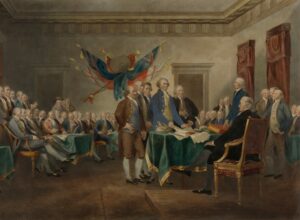
Before and during the war for American independence, leading patriot leaders largely defined their cause by what they were fighting against rather than what they aspired to replace it with. This – together with the fact that the American Revolution produced no fanatical leaders like French revolutionary Maximilien Robespierre, no dictators like Napoleon Bonaparte, and no mass bloodletting like the French Terror of 1793-1794 – has led many people to conclude mistakenly that America’s revolution was not at all radical.
It’s true that organized opposition to British policies after 1763 arose as a defense of the status quo in colonies that were doing well economically by late 18th century standards. Some historians, noting that revolutionary leaders cast their struggle for independence as a defense of long-existing rights and that most pre-Revolution property owners emerged from the period with their property intact, have labeled the Revolution as conservative or even reactionary.
The Declaration of Independence made just three references to economic issues, not counting its objections to taxation without representation:
- A criticism of British policies aimed at preventing population growth in the colonies in Jefferson’s list of “injuries and usurpations” by King George III.
- A reference to policies aimed at “cutting off our Trade with all parts of the world.”
- A claim that “establish[ing] commerce” would be among the powers rightly possessed by the newly independent United States in the Declaration’s concluding paragraph.
All true, but hardly radical at first glance. Jefferson’s list of the king’s abuses reads far more as a critique of Britain’s crackdown on Massachusetts after the Boston Tea Party of 1773 than as a call for overturing the American economic order of his time.
Once the revolutionaries declared the nation’s independence, however, they swiftly developed radical goals for the society they aimed to create during and after the Revolutionary War. To start with, they began their Declaration of Independence by asserting a “self-evident” truth that “all men are created equal” – an altogether radical and unprecedented proposition in the late 18th century.
Wood argues convincingly that the Revolution’s leaders arrived at a “breathtaking” and “utopian” vision for a new social order. They imagined a republic of virtue led by selfless leaders and offering a greater degree of economic freedom than any society had ever before achieved. Opportunities would be available to all – or at least all White men – without regard for “rank or position,” as the South Carolina revolutionary leader David Ramsay said in a Fourth of July speech in 1778. John Adams said America would redefine the term “gentleman” to refer not to “the rich or poor” but to education, accomplishment, and productive participation in public affairs.
If the intentions of the revolutionaries were radical by the standards of their time, the results of the American Revolution were far more so.
The Revolution had several immediate consequences with radical long-term economic consequences. First, it dramatically changed people’s cultural attitudes. As Adams wrote to his wife Abigail in July 1776, “Idolatry to Monarchs and servility to Aristocratical Pride was never so totally eradicated from so many Minds in so short a time.” Over a handful of years, most Americans came to believe, according to Wood, that “no one was really better than anyone else.”
Attitudes towards work and enterprise, in particular, underwent a sea change within a generation. The Revolution affirmed the radical new view, espoused by Adam Smith in his 1776 treatise The Wealth of Nations and endorsed by Benjamin Franklin, that hard work, business-building, and innovation were the chief engines of prosperity in society. Most Americans quickly came to believe that menial work was respectable and dignified, that entrepreneurship was praiseworthy, and that it was dishonorable for wealthy men to remain idle and live off the toil of others – all views virtually unheard of before 1776.
Second, the Revolution directly changed the composition of society by causing the departure of about 80,000 loyalists, meaning Americans who remained loyal to Britain and opposed the Revolution. Though a seemingly small number, this amounted to six times the number of émigrés who fled France during the French Revolution as a share of population. It also mostly included aristocratic families who had been at the top of the prerevolutionary social ladder.
Third, the Revolutionary War itself transformed America’s economy. Countless farmers engaged in modern commercial life for the first time as food suppliers and even small-scale manufacturers for the Continental Army. Tens of thousands of Americans, from top political and military leaders to junior officers and foot soldiers, traveled widely around the country and got to know people from other states. Paying for the war gave rise to tremendous ad hoc financial innovation which, though chaotic at the time, helped lay the foundations for a modern financial system within a decade of the war’s end.
Lasting consequences
Over the longer term, the Revolution put America’s economy on a dramatically different trajectory than it had been on before 1776.
Removing the shackles imposed by Britain’s imperial economic system set the stage for enormous growth in manufacturing for the domestic market and, before long, for markets around the world. Small-scale manufacturing in rural areas grew explosively following independence and for several decades thereafter. Commercial activity transformed America’s countryside, where four-fifths of Americans still lived in the 1790s, and significantly raised income levels. America’s industrial revolution, as defined by the emergence of large-scale mechanized production, lagged Britain’s industrial takeoff by several decades, but once it got going, American industrialists rapidly caught up with their British rivals.
Notably, the new U.S. government did not try to catch up with Britain by imitating British imperial policies, though Treasury Secretary Alexander Hamilton did borrow heavily from British experience in constructing the nation’s financial system during the 1790s, as I show in the first of my Milestone Moments essays. Rather than restricting what entrepreneurs could manufacture in any given location, America’s federal and state governments largely allowed businessmen to operate any kind of firm anywhere. By the 1810s, America had established much better protections for the right to go into business than Britain or any other nation offered at the time, the subject of another Milestone Moments essay.
It has become fashionable to argue that America achieved its post-Revolution industrial takeoff because the United States imposed sky-high tariff rates on imports, substituting tariffs for the direct trade restrictions imposed by imperial Britain. This claim doesn’t stand up to scrutiny.
Average tariff rates in Hamilton’s time amounted to less than 25%, even though tariffs were the federal government’s most important means of raising much-needed revenue. While helpful to domestic goods makers, rates were too low to make small manufacturers competitive in themselves – as American industrialists showed by demanding far higher rates in the 1820s and 1830s, after U.S. industrialization was already well underway. Hamilton insisted that high tariffs would undermine industrial growth by making domestic manufacturers lazy and inefficient and called for setting tariffs at levels high enough to raise needed revenues, but no higher. Neither Hamilton nor any other leading founder was a mercantilist.
The Revolution also allowed America to build a modern financial system. State government started chartering new banks in the 1780s, followed by the establishment of Hamilton’s Bank of the United States in 1791. By 1819, British banker Alexander Baring had to confess before a parliamentary committee that America’s money, credit, and banking systems were better developed than those of Britain or any other country.
The rise of modern banking and a well-functioning cash economy gave rise to new forms of venture capital investment. English visitors found, to their amazement, that American landowners were increasingly selling off landed estates to fund manufacturing or commercial enterprises – the opposite of what successful businesspeople typically hoped to do in England.
The nation’s rapid shift to labor markets featuring cash wages plus the wider availability of credit made it easier for working people to break away from personalistic relationships with old patrons and become more geographically and economically mobile. People could go to work wherever they could earn the highest wages of start businesses of their own. Firms could charge whatever prices the market could bear.
The result was a dramatic improvement in upward mobility. Stories of upward mobility became a key part of American folklore, starting with the publication of Benjamin Franklin’s Autobiography in 1791.
The United States passed Britain as the world’s leading industrial power around the time of the Civil War and surpassed it in GDP per capita terms by the end of the century. America accounted for a quarter of worldwide manufacturing output by 1900 and almost 40% by 1930. Real wages for ordinary working people came to far exceed wages in any European country.
It’s unlikely that America’s economy would have developed in the ways it did if Americans had not declared their independence in 1776. Within the British Empire, the colonies might well have developed in the 19th century along lines more like the paths of Canada and Australia, which remained primarily raw materials suppliers well into the 1900s. Some British-controlled territories even deindustrialized during the 19th century: British authorities effectively undermined a vast textile industry in India in the name of mercantilist imperialism.
The long-term economic consequences of American independence came to extend throughout the world. Other leading nations, starting with Britain in the 1840s, abandoned the discredited theory of mercantilism in part because of the example set by American economic success. American ideas regarding free labor markets spread gradually across the world in the 19th and 20th centuries, undermining traditional employment systems and sparking tremendous improvements in living standards and economic mobility in other countries.
Different from what the founders had intended, but a remarkable success story
Most of America’s leading founders grew disturbed by the direction America’s political and economic development took in the early decades after independence. The nation’s political system quickly evolved into a contentious, polarized struggle between interest groups – far from the enlightened republic of virtue and selflessness the founders had imagined. Individualism, competition, and money-making came to dominate economic life to a much greater degree than any top-tier founder – except Hamilton – had expected.
Washington and Adams died disappointed by America’s pervasive partisanship. Jefferson grew even more depressed in old age as he observed the rise of a bustling economy featuring large-scale manufacturing, powerful financial institutions, and booming cities – utterly unlike the bucolic society of yeoman farmers he had had in mind.
But if the founders found many aspects of their ambitious, unpredictable young nation unwelcome, Gordon Wood shows, it was not because the American Revolution had failed. It was because the Revolution “had succeeded, and succeeded only too well,” he concludes.
By dismantling old-world policies and social structures and establishing a new nation dedicated to the proposition that all people are born equal, America’s revolutionaries created something that even they, for all their wisdom, could not fully understand: the most innovative, enterprising, and modern society the world has ever known.