


The U.S. Senate and House Appropriations Committees have agreed on a major global health funding package for Fiscal Year 2026, allocating nearly $5.9 billion for HIV programming, of which $4.5 billion is dedicated to the President’s Emergency Plan for AIDS Relief (PEPFAR).
The bill passed the full House on January 13. But the Senate has yet to vote on the bill, which faces a January 30 deadline before the Continuing Resolution expires and must be signed by the President to become law. Still, the agreement is welcome news for the global health community and signals continued bipartisan support for global health investments aimed at ending HIV/AIDs as a public health threat by 2030.
Notably, the appropriations bill also directs the Secretary of State to submit a plan for a multi-year, structured transition of PEPFAR programs to greater country-led ownership no later than 90 days after the bill’s passage. This forward-looking provision reflects the long-term importance of congressional oversight on PEPFAR and underscores the need for data-driven programming, robust monitoring, civil society engagement, and thoughtful implementation to ensure the U.S. and our partners can declare success.
However, policymakers, country leaders, and global health partners should recognize that transitions to full country ownership of HIV health systems will vary across respective country partners. While many have or will achieve the indicators necessary to end HIV/AIDS as a public health threat by 2030, others may need more time.
In the latest chapter of the PEPFAR Beyond 2030 series, we explain how continued support for countries facing political instability, economic challenges, and insecurity is imperative for the health security of the United States. We also outline realistic, cost-effective examples for transition frameworks that ensure countries most at risk are not left behind.
Figure of the Week
Nearly $5.9 billion for HIV programming
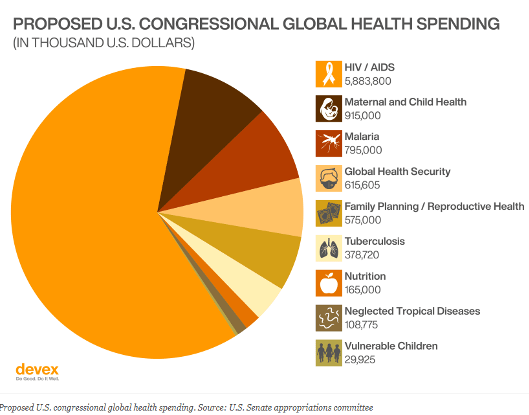
The proposed fiscal year 2026 foreign investment package allocates nearly $5.9 billion for HIV programming, underscoring Congress’s bipartisan commitment to sustaining the core global HIV response. As illustrated in the graphic below, HIV/AIDS programming takes up the largest share of the $9.4 billion global health budget.
The package includes $4.5 billion for PEPFAR, $1.25 billion for the Global Fund to Fight AIDS, Tuberculosis, and Malaria, and $795 million for the President’s Malaria Initiative, preserving essential prevention, treatment, and health systems as countries increasingly transition toward greater ownership.
Advocates emphasized that sustained investments through PEPFAR and the Global Fund, along with timely passage, clear implementation plans, and full disbursement of appropriated funds, are essential to accelerating country-led transitions and maintaining momentum toward ending AIDS as a public health threat.
For additional detail on global health funding, you can view KFF’s analysis of the fiscal year 2026 conference appropriations bill and explanatory statement.
Ally Updates
KFF has released a new resource that will track bilateral global health agreements signed under the America First Global Health Strategy. The resource will be updated as new agreements are made available to the public and offers a means to better understand how U.S. global health engagement is evolving toward country ownership and co-investment.
As of January 14, fifteen countries have signed multi-year MOUs, representing $17.7 billion in total announced funding. The agreements span core priorities including HIV/AIDS, malaria, tuberculosis, maternal and child health, and global health security, with an average country co-investment share of 36%.
Bush Institute Insights
Over 20 years of partnership through PEPFAR have made ending HIV/AIDS as a public health threat by 2030 a realistic possibility. Achieving this milestone depends on countries’ ability to meet the internationally agreed-upon 95-95-95 targets (that 95 percent of people know their HIV status, 95 percent of those living with HIV are receiving sustained antiretroviral treatment, and 95 percent of those on treatment have undetectable, and therefore untransmittable, levels of the virus in their blood).
While many countries are on track to meet the 95-95-95 targets by 2030, others will need more time and additional support. It’s critical that the U.S. preserves and enhances decades of progress as the U.S. integrates PEPFAR into broader U.S. global health investment and increases country ownership. It is also imperative that we do not leave partners behind.
In the latest chapter of the PEPFAR Beyond 2030 series, the Bush Institute argues that maintaining data-driven, community-centered support for these countries is not only critical for suppressing the HIV/AIDS epidemic, but also a national security imperative.
Infectious diseases know no borders, and uncontrolled epidemics can destabilize entire societies by threatening their political, social, and economic foundations. It’s essential that decisions about prolonged U.S. engagement consider a broader set of health and economic indicators, including levels of conflict, financial well-being, and the severity of each country’s HIV epidemic.
Two case studies – the Democratic Republic of the Congo (DRC) and the Republic of Mozambique – illustrate why a more gradual, targeted approach to winding down PEPFAR is essential in countries that are experiencing political instability, conflict, and extreme financial constraints. As the U.S. moves toward greater country ownership of PEPFAR programs, success will depend on patience and flexibility. A targeted, cost-effective approach that prioritizes the most vulnerable countries, while maintaining accountability and reform expectations, will help ensure a sustainable transition and protect the hard-won gains of the past two decades.
In the News
- January is cervical cancer awareness month – a time to celebrate progress, remember those who have experienced the trauma of the disease, and envision a future where cervical cancer is eliminated. This month, Go Further, a public-private partnership among the George W. Bush Institute, the President’s Emergency Plan for AIDS Relief (PEPFAR), and the Joint United Nations Program to End HIV/AIDS (UNAIDS), celebrates the tremendous progress we’ve made. By integrating cervical cancer screening and treatment into existing HIV services, Go Further has made cost-effective investments to ensure that women living with HIV don’t succumb to a preventable disease. Since 2018, the partnership has completed over 10 million screenings. To learn more, watch this video.
- While global health investments over the past 25 years have driven historic gains against HIV, tuberculosis, malaria, and child mortality, the current system has also produced unintended consequences, including fragmented national health systems and incentives for chronic underinvestment in domestic health financing. In a recent Think Global Health article, African health and finance leaders, alongside former UNAIDS Executive Director Peter Piot, outlined ten recommendations for reforming the global health ecosystem in 2026. The authors call for reforms that center on country-defined priorities, increase efficiency and equity, preserve global public goods such as surveillance and R&D, and better complement international financing with domestic investment.
- KFF’s recent issue brief examines how the America First Global Health Strategy may reshape U.S. procurement of health commodities like vaccines and medicine as countries assume greater financial responsibility. The America First Global Health Strategy commits to covering 100% of commodity costs in FY 2026, then gradually reduces support as partner countries increase co-investments. To manage this transition, the U.S. will consider greater use of pooled procurement mechanisms. The analysis reviewed eight global and regional mechanisms and found that several existing mechanisms already have a long track record, broad reach, and continued access for countries that have transitioned off donor support. Looking ahead, U.S. policymakers will need to decide how to use these systems, compare them with current U.S. procurement approaches, reduce barriers to country participation, and support emerging regional platforms.
- A new study published in The Lancet Global Health found that orphanhood incidence in Southern Uganda decreased from one in four children in the early 2000s to just 6.3% of children in 2022, with the sharpest decline following the introduction of HIV treatment and prevention programs. As Oxford University professor Lucie Cluver points out, the results are a “testament to the incredible impacts of PEPFAR, the Global Fund and the global HIV response.” The U.S. recently signed an agreement to invest up to $1.7 billion in Uganda over the next five years to combat infectious diseases.
- Sexual violence against children in the DRC has become entrenched and widespread, with the UN Children’s Fund (UNICEF) warning about a sharp rise in cases since 2022, particularly in conflict-affected eastern provinces. A recent UN report titled “The Hidden Scars of Conflict and Silence” documented tens of thousands of cases each year, widespread underreporting, and severe gaps in access to medical care, psychosocial support, and justice for survivors.


