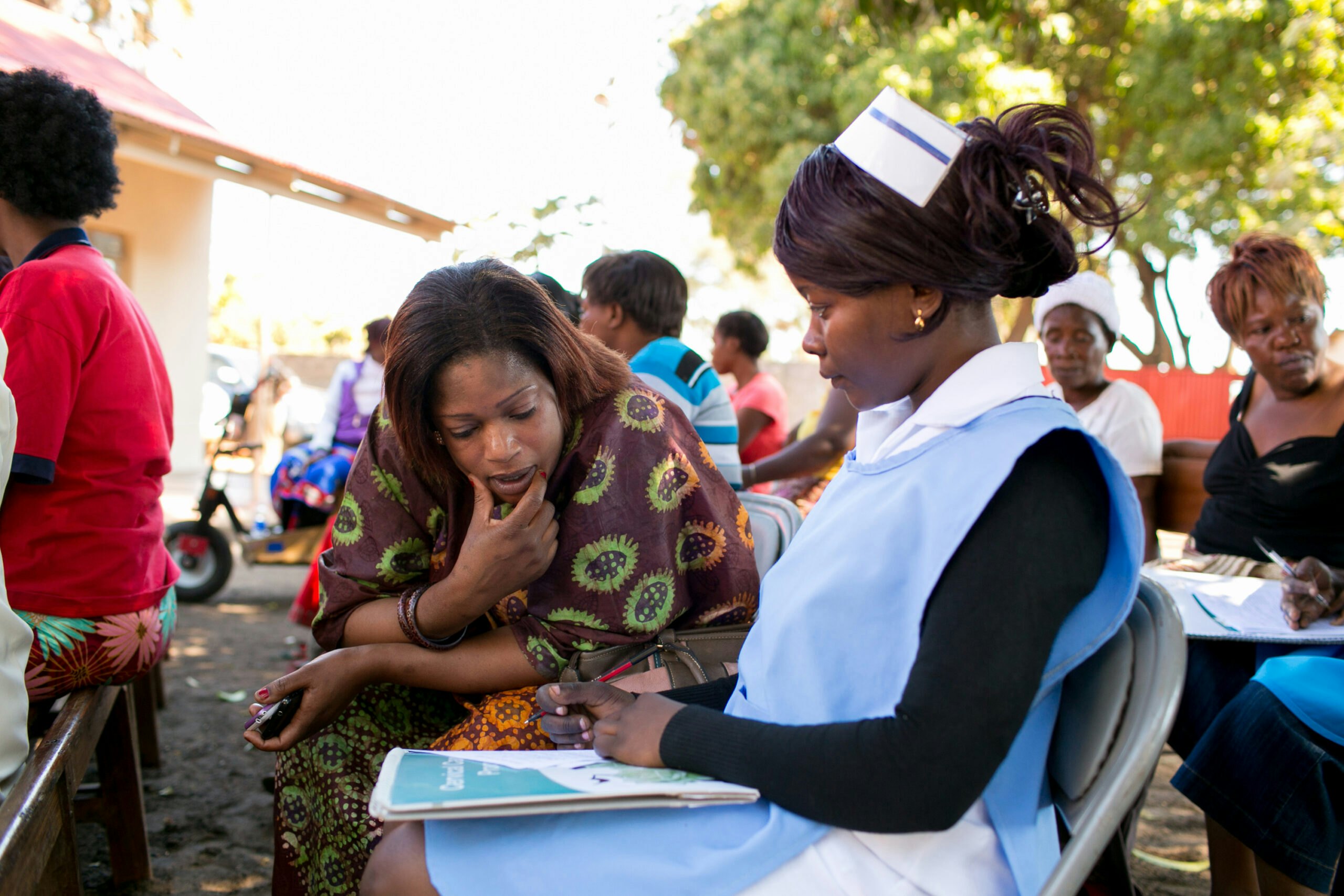
February 4 marked World Cancer Day, a moment to recognize the global burden of cancer in all its forms. Despite being one of the most preventable cancers, cervical cancer continues to kill an estimated 300,000 women each year, with more than 90 percent of deaths occurring in low- and middle-income countries.
Across Africa, innovative, community-centered approaches are helping ensure that women and girls can access cervical cancer screening and treatment. In Zimbabwe, health officials recently partnered with a regional girls’ soccer tournament to build trust in HPV vaccination by integrating health education into the event. Dance, music, and the opportunity to see famous soccer players drew families in, and many children were vaccinated on the sidelines at nearby clinics.
Community engagement and delivery also underpin Go Further, a public-private partnership between the George W. Bush Institute, the President’s Emergency Plan for AIDS Relief (PEPFAR), and the Joint United Nations Program to End HIV/AIDS (UNAIDS). By integrating cervical cancer screening and treatment into successful pre-existing HIV services at relatively low cost, Go Further has completed more than 10 million screenings since 2018, bringing cervical cancer elimination within reach. As countries take on greater responsibility of HIV programming, cervical cancer must remain a top priority for care for women living with HIV.
Ally Updates
ONE Data, in partnership with Google.org and The Rockefeller Foundation, announced the launch of the Development Finance Observatory, a first-of-its-kind platform designed to improve transparency and accountability in global development finance. The Observatory will integrate fragmented datasets across aid, debt, private finance, remittances, and domestic budgets.
This new tool is meant to help policymakers and program implementers in the United States and in partner countries better understand how financing decisions affect countries’ ability to invest in health systems and other core priorities and ensure that taxpayer dollars have the greatest impact.
Figure of the Week
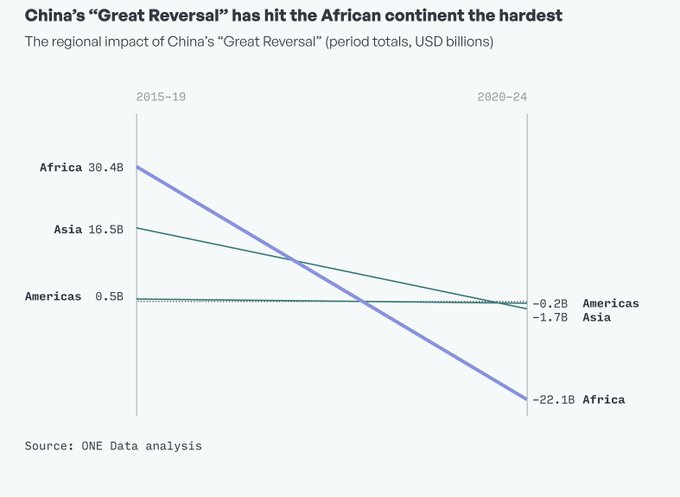
Africa has paid $22 billion in net flows to China over the last five years.
New analysis from ONE Data’s Development Finance Observatory found that Chinese financing has experienced a “great reversal.” China went from being the fourth largest net funding provider between 2010-2014 to the largest net extractor between 2020-2024.
As the graphic below shows, Africa has been hit hardest by this transition. During the same time periods, Africa went from receiving $30.4 billion in net flows from China to paying out $22.1 billion in net flows to China, a $52.5 billion swing.
As countries take on greater responsibility for their health systems, these extractions, primarily through loan repayments, reduce the ability of countries to invest in public health. To understand the resources available to governments to invest in core priorities such as health, education, and infrastructure, the analysis assessed both inflows and outflows of finance. Currently, multilateral development banks account for 56% of net finance flows, up from 28% a decade ago. This surge comes as bilateral foreign assistance and private financing decline.
For a more comprehensive picture of net public finance flows to developing countries, you can read ONE Data’s full “The Great Reversal” report.
In the News
- Diana Njuguna, a nurse and researcher whose work is focused on reducing the burden of cervical cancer in Kenya, wrote an opinion piece for Devex arguing that success in the fight against cervical cancer depends on the strength of community-level implementation. Njuguna emphasizes that sustained investment in implementation, nurse-led education, and community engagement will be critical to eliminate cervical cancer.
- Africa Centres for Disease Control and Prevention (Africa CDC) established a new Central Data Repository (CDR) to strengthen public health surveillance and improve how data is integrated, analyzed, and used across the continent. The platform will enable earlier detection of health threats and more coordinated cross-border responses. The launch comes as Africa faces the world’s highest burden of public health emergencies, with reported incidents rising 40% between 2022 and 2024. Africa CDC leaders emphasized that the CDR provides a trusted foundation for public health intelligence while preserving country data ownership through a federated model.
- Recent declines in reported food insecurity are more likely the result of reduced data availability than real improvements in addressing hunger. Center for Global Development senior fellow Charles Kenny urges Congress to ensure that U.S. global health investments include support for critical data systems, so that U.S. humanitarian and global health investments can appropriately forecast hunger needs and deliver assistance effectively.
- Sania Nishtar, CEO of Gavi, the Vaccine Alliance, recently warned that growing fragmentation in global health responses and declining multilateral cooperation are putting decades of work at risk. As an alternative path forward, she highlights Gavi’s transformation program, the Gavi Leap, which exemplifies mission-driven “minilateralist” coalitions. Through targeted support, simplified grant processes, and a stronger emphasis on country ownership, Gavi demonstrates how dialogue can turn into rapid action. Nishtar argues that building on and replicating this model can help overcome paralysis in traditional multilateral institutions while shifting the focus of global health to the world’s most vulnerable communities.
- PrEPWatch launched a new dashboard tracking progress toward expanding access to long-acting PrEP products. The tool provides a timely snapshot of regulatory approvals, procurement volumes, ongoing and planned implementation science studies, and non-profit prices for approved longer-acting PrEP options, including injectable cabotegravir, injectable lenacapavir, and the dapivirine vaginal ring. The dashboard will be updated quarterly by AVAC. As of January 2026, lenacapavir has received approval from 15 regulatory authorities, with nine additional approvals pending.
- Former U.S. Senator Roy Blunt says that an “America First” global health strategy must include U.S. investment in malaria control. Combatting malaria abroad delivers measurable returns by saving lives, strengthening partner countries’ economies, and protecting U.S. health and security interests. Blunt warns that declining investments risk reversing decades of progress, as malaria cases reached an estimated 282 million globally in 2024, and could create opportunities for China to expand its influence in high-burden regions.