
George W. Bush Institute and Center for the Study of Democracy
Russian Sanctions: Evasion in Europe

About the series
This three-part series details Russia’s strategic corruption in Europe and provides recommendations for European policymakers to stop Moscow’s harmful practices that seek to destabilize the West.
Policy Recommendations:
- The European Union and Europe’s new Anti-Money Laundering Authority (AMLA) must improve beneficial ownership efforts across member states.
- The EU should establish a singular body responsible for implementing and enforcing sanctions that resembles the Office of Foreign Assets Control (OFAC) in the United States.
- The European Commission should designate sanctions evasion hubs in the EAEU as high-risk jurisdictions due to their connection to terrorist financing.
- Members of the anti-money laundering and anti-corruption communities should be included in trade agreement negotiations to include a risk-mitigation perspective in trade deals.
- The European Union should establish a task force that investigates and prosecutes illicit military procurement of sanctioned items and dual-use goods.
1
INTRODUCTION
Western democracies’ response to Russia’s full-scale invasion of Ukraine in 2022 was unprecedented. Economic isolation quickly became key to the West’s strategy of deterrence, coming in the form of sanctions and export controls. While aiming to stave off further Russian advances into Ukraine and helping Ukraine defend itself, G7, NATO, and European nations also have hoped to cut off Russia from supply chains providing it with the military hardware to continue to wage war in Ukraine. Many of the measures took aim at Russia’s military-industrial base, prioritizing access to critical technologies.
The West’s message to the Kremlin and international community was clear – Russia will no longer have access to Western markets for as long as its military aggression continues. However, three and a half years after the Russian invasion of Ukraine, and despite public rhetoric that Europe has been decoupling from the Russian economy, the relationship persists.
Europe continues to discover the difficulty of decoupling after 30 years of unfettered integration of Kremlin-linked oligarchic structures into the global and European financial and economic systems. The European Union managed to introduce 18 (and counting as of September 2025) sanctions packages against Russia following its aggression against Ukraine. Yet, creating the institutions to enforce sanctions and export controls has been very slow and ineffective, with member states – most notably Hungary and Slovakia, but also others – continuously diluting or outright opposing joint actions. As a result, Russia still controls sizable energy infrastructure on EU territory, such as the Turk/Balkan Stream gas pipeline and the Lukoil oil refinery on Bulgaria’s Black Sea coast. And EU candidate countries, like Serbia and Turkey, even expand their economic cooperation with Russia.
In response to tightening sanctions, Russia shifted to opaque channels to access Western goods that are turning up on the front lines of the invasion as well as in stores in Russia proper. These new supply chains rely on several mechanisms, vulnerabilities, and loopholes, including policies that support corporate secrecy, front companies, trade agreements shrouded in confidentiality, and lack of enforcement capacity on the side of the EU. With these levers, Russia has effectively weakened the efficacy of sanctions efforts by relying on obscure supply chains that are difficult to detect and enforce. This has created a rising tide of illicit financial flows, circumventing EU sanctions regulations and feeding into a growing organized crime economy – spanning the globe, but particularly from Europe to the Middle East and Asia – which the Kremlin then leverages to further disrupt Western and European law enforcement.
Russian imports of foreign parts for its weaponry grant the West significant leverage. Russia’s military-industrial base is one of the world’s largest arms producers but lacks self-sufficiency because of widespread governance problems, rampant corruption, and reliance on past Soviet relations for logistical operations. Moscow has sought to aggressively continue importing Western technology to keep its war machine going by building numerous new alliances to prop up its military machine. Russia imports drones from Iran and oil from India, stockpiles munitions and missiles from North Korea, and ultimately relies on China to protect it from international isolation.
With Russia’s transformation into a full-blown war economy, Russian President Vladimir Putin will soon have to pay more attention to the domestic situation – not just the invasion – indicators show. Russia’s economy appears to be approaching a period of economic cooling, in which growth slows down, after domestic defense-industry spending inflated it immediately following the attack on Ukraine. During the 2025 St. Petersburg International Economic Forum, Russian Economy Minister Maxim Reshetnikov went so as far as to say that the Russian economy is on the brink of a recession.
With Kremlin insiders suggesting that Moscow’s economic woes are potentially only beginning, it is unlikely that Moscow will be able to build the ability to manufacture the technologies necessary to press onward with its attack. In that case, Moscow will intensify its dependency on Western equipment and amplify its discrete use of intermediaries and policy loopholes to access forbidden goods. It will also become more and more dependent on China, Iran, and North Korea for military technology, as well as on the rest of the world for keeping its economy going.
This development provides the Western community, particularly European nations, with an opportunity and responsibility to capitalize on tightening policies that inhibit Kremlin aggression. Moscow’s inability to replicate the same manufacturing capacities poses vulnerabilities in its operations. While sanctions and export controls aim to leverage this weakness, the Kremlin’s opaque operations have made its supply chains much more resilient to external pressure. The EU should also find ways to considerably strengthen its common enforcement mechanisms; develop Brussels-level sanctions and enforcement mechanisms, such as the EU Public Prosecutor Office; and engage more forcefully with the biggest transgressors, which currently include India and Turkey.
To counter Russian exploitation of global supply chains, Europe must harness its position as a global economic hub to exert its influence on other nations. Furthermore, it must bolster its policies that bring transparency into corporate structures, trade deals, and supply chains to reinforce sanctions and enforcement of export controls. It should invigorate existing policies that have been undermined by Russian tactics, such as by crafting new strategic approaches to prioritize combatting evasive practices.
The EU would also need to further align its technology and trade policies with the United States to ensure more leverage vis-à-vis Russia and third countries willing to disregard sanctions.
2
SHELL AND FRONT COMPANIES
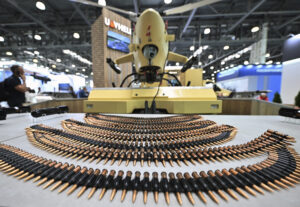
In retaliation for the global condemnation of its full-scale invasion of Ukraine in 2022, Russia leaned into a corrupt network of proxy companies to bypass restrictions. Moscow has been able to orchestrate a system of companies with links to Russian state-owned entities or oligarchs. The web of businesses is purposefully registered in third-party countries, which are often outside the network of sanctioning nations, to manipulate trade transactions that eventually land in the hands of the Russian military. However, in other cases, Russia discretely sets up companies in countries that are members of the international sanctions coalition. Local proxies and fronts that agree to safekeep assets operate within offshore havens and supply key military-grade goods and dual-use technologies to Russia.
Russia’s weaponization of the private sector takes advantage of glaring governance gaps that make third countries increasingly susceptible to Russian schemes. Among the most vulnerable are jurisdictions with weak rule of law or regulatory lapses that obfuscate the ultimate corporate ownership of enabling companies. Russia creates a chain of linked entities with no clear connections between the owners, managers, and the Kremlin. In addition, the EU relies overwhelmingly on its member states’ sanctions enforcement capacity, which makes the whole system only as strong as its weakest link. And there are multiple weak links, some of which are further debilitated by pro-Russian policies and politicians at the expense of common security.
EU companies with Russian ultimate beneficial ownership – a stake above 25% – fell to 26,400 at the end of 2023, the latest available date, from around 46,000 on the eve of the invasion, according to analysis by the Center for the Study of Democracy (CSD). The EU defines a Russian-owned entity as one with a stake of more than 40% held by a Russian person or business, whether directly or indirectly. Companies with a connection to Moscow or its military would have to be created by concealing any direct links to the Kremlin due to the EU’s announcement of several sanctions packages targeting Russia.
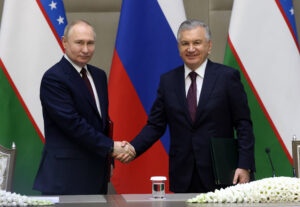
Certain countries outside the EU employ similar strategies, particularly those with governments that have friendly relations with the Kremlin. In one case, Putin met with Uzbek leadership to discuss an agreement that included procuring electronics for drones subject to sanctions. They agreed to establish intermediary companies in Uzbekistan as well as several enterprises to assemble military gear.
Similar practices have been widespread across countries in the Western Balkans and Black Sea regions, as highlighted in CSD’s recent analysis, “Illicit Financial Flows and Strategic Corruption.”
- In Moldova, three firms, Airrock Solutions (founded in November 2021), Aerostage Services (founded in April 2022), and Maxjet Service (founded in 2011) acted as intermediaries for Russia through shell companies and front entities that resold and delivered Western aircraft parts to Russian airlines such as Pobeda and S7 Engineering. The emerging trade relationship was valued at approximately $15 million just months after Russia’s invasion of Ukraine in February 2022.
- In Armenia, TAKO LLC – known as TACO LLC before the invasion of Ukraine in 2022 – continued to supply electronic components to Russia’s defense sector after the invasion, despite existing sanctions. Fully owned by a Russian national, the company collaborated with Russia’s Radioavtomatika – also under U.S. sanctions – to channel electronic and telecommunications equipment into Russia. Analogously, Milur Electronics LLC acts as a front for Milandr, a sanctioned Russian microelectronics company linked to Russia’s military industrial complex, allowing continued access to foreign suppliers. Operating out of Armenia, Milur Electronics evaded export controls by placing orders from foreign factories, producing microchips, and facilitating overseas sales on behalf of Milandr to Russia.
- Across the Western Balkans, the International Business Corporation Bar (IBC) in Montenegro acted as a front company to transship EU-originating industrial equipment and military supplies to Russia. Despite being registered in Montenegro, it was fully controlled by Sergey Kokorev, a Russian national who used IBC to export critical items for the aerospace and defense industries, including to AMS Tekhnika, a U.S.-sanctioned Russian firm supplying Russia’s military industrial complex.
- Furthermore, the Serbian companies Ventrade DOO and Soha Info were found to have facilitated the export of high-priority electronics to Russian military-linked companies. Founded in April 2022, Ventrade DOO was connected to Promsvyazradio, a Russian firm specializing in radio equipment and dual-use technology imports. Between October 2022 and July 2023, Soha Info exported $18 million in goods to Russia, including 30% in high-priority, dual-use electronics and $4.3 million in tightly controlled Intel components used in Russian weapons.
Through these intermediaries, Russia purchases military equipment from companies that manufacture essential technology in countries that have not sanctioned Russia but have refused to sell to Moscow directly, fearing secondary sanctions due to the circumvention of existing measures. Intermediary companies are then able to reach Moscow by indirectly selling the equipment to companies set up in pro-Russian or complicit countries, such as Uzbekistan, which then resells the sanctioned equipment to Russia in a process known as direct reexport. With no direct connection to Moscow, Russia can procure military goods, and companies can continue supplying them undetected, making sanctions enforcement daunting.
Russia utilizes these methods to access dual-use goods from Europe through two other avenues. First, is a process known as indirect reexport, in which the European intermediary, the Russian shell company in this case, sells the equipment to a proxy customer, which then resells them in foreign markets, eventually reaching Russia. Second is through fictitious trade, in which goods are falsely declared as being transited to a third-party country through Russia and the equipment is intercepted, remaining in Russian territory.
Using these methods, Russia has been able to purchase sanctioned military equipment from companies based in the Czech Republic, Germany, Bulgaria, and Austria.
A notable example of how Russia has developed and exploited supply chains in Europe to circumvent sanctions is the case of the Bosnian subsidiary of the German automotive firm Mann + Hummel. The company supplied auto parts to Turkish intermediaries, who subsequently reexported the goods to Russia, thereby avoiding direct violations of EU sanctions. In 2023, the Bosnian factory exported products worth €753,331 to Russia, including deliveries to major Russian automotive traders such as Yural (Favorit Parts) and F.A. Logistik (Forum Auto). Parts produced by the firm were also identified in captured Russian military vehicles, including the Tigr and Pantsir models. Trade records frequently list Turkish firms as the exporters rather than Mann + Hummel, underscoring how subsidiaries of European companies based in third countries can be exploited by intermediaries to maintain supply chains serving the Russian market despite sanctions.
Data analysts confirm that Czech-made goods also continue to appear in Russian import records via intermediary firms and third-country routing, despite EU export bans. In 2023, several Czech companies were found to have exported goods to Russia in violation of EU sanctions, according to customs data reviewed by Czech authorities. The investigation, prompted by a list from the office of Ukrainian President Volodymyr Zelenskyy, identified eight firms suspected of circumventing restrictions, including Czech Republic-based machinery manufacturer Pilous. Customs records show that metal-cutting machines and other sanctioned equipment continued reaching Russia, often routed through third countries such as Serbia. In one instance, machinery passed through two newly formed Serbian firms, FAF Invest and Vamars, which appear to act primarily as logistics intermediaries, though they lack prior experience in machinery sales. Pilous machines were documented arriving at the St. Petersburg address of its former Russian subsidiary, which the company claims it no longer controls following Russia’s invasion of Ukraine.
3
TRADE AGREEMENTS AND ECONOMIC COOPERATIVES
To dodge the raft of sanctions, Russia has leaned on economic partnerships to navigate global trade restrictions. Through partnerships and economic cooperatives, front companies placed throughout Europe have facilitated the flow of supply chains, eventually completing their life cycle with the Russian military.
Despite being ostracized economically, the Russian Federation obtains several benefits from these agreements and conditions. For one, trade agreements, particularly ones done outside of the guidance of the World Trade Organization (WTO) – which aims to safeguard ethical practices in international trade – are often conducted confidentially to prevent external pressure from influencing the terms and ratification of the trade deal. In such instances, dealings are deliberately conducted with opaque terms that protect immoral or unfair practices. While this can safeguard the strategic interests of the negotiators, it prevents analysts and anticorruption activists from detecting risk factors for unethical practices.
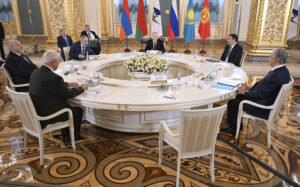
Economic collectives also pose challenges to promoting transparency. These unions are created when countries seek to improve trade by allowing a more seamless flow of goods, services, and workers.
One of the most significant in undermining the efficacy of sanctions for the Kremlin is the Eurasian Economic Union (EAEU), which comprises Armenia, Belarus, Kazakhstan, Kyrgyzstan, and Russia. Several other countries are affiliated with the union despite not being formal members, such as Cuba, Iran, Moldova, and Uzbekistan.
The trade union’s importance for Moscow changed dramatically following the 2022 invasion of Ukraine. In the years since the war started, concerns have grown over the role that EAEU countries outside Russia have become hubs for sanctions evasion, especially in military procurement. However, since union members do not manufacture the equipment, they operate as proxies that reship purchased equipment into Russia.
The EAEU was established in May 2014, a mere three months after Russia’s annexation of Crimea, and initially gained a little traction with the global community as a trade partner. Between 2015 and 2022, the EAEU exported approximately $3.5 trillion worth of goods, according to its 2023 integration report. For comparison, the EU, which is much larger economically, exported $2.5 trillion in 2023 alone.
But the growth in trade volume by countries within the Eurasian coalition in recent years may signal the extent of their reliance on Russian networks and how these economies can prop up Russia during sanctions. Tellingly, EU nations have ramped up their sales to the EAEU since 2022. Between 2014 and 2021, EU exports to Armenia averaged approximately €714 million. In 2022, exports surged to nearly €1.9 billion and officially surpassed the €2 billion mark in subsequent years. These numbers are based on a report published by the European Commission.
The export value of goods sent to Kyrgyzstan from the EU demonstrates an equally dramatic uptick, exceeding €2.7 billion between 2023 and 2024, after averaging €285 million over the eight years preceding the 2022 invasion. The latest figure dwarfs the volume seen in Armenia, even though Kyrgyzstan had a much more marginal relationship with the European bloc before the start of the war.
The links between the EAEU and the EU are growing at the same time that concerns over Central Asia’s weak enforcement of export controls and sanctions are intensifying. Experts continue to flag Kyrgyzstan as a back channel for dual-use goods – products that have both civilian and military use – entering Russia. While trade relations between the two regions are rising, exports from Kyrgyzstan to Russia have increased by nearly 50%. Relatedly, in 2022, over $1 billion in EU-origin dual-use goods went missing in transit to the EAEU through Russia, likely representing fictitious trade practices.
Aydemir/Anadolu via Getty Images)
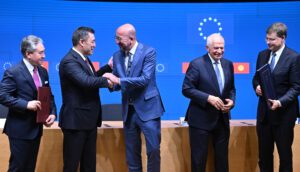
Trade agreements are potential enablers of the growing relationships between EU and EAEU nations. In 2024, the EU signed an enhanced partnership and cooperation agreement with Kyrgyzstan. Along with areas such as human rights and crisis management, trade was a pillar of the deal. In the announcement of the signing, Valdis Dombrovskis, the EU executive vice president and commissioner for trade, stated, “We are helping to create more opportunities for EU and Kyrgyz businesses and investors by facilitating trade flows and enhancing cooperation.” Armenia and the EU have a similar arrangement through their joint comprehensive and enhanced partnership agreement.
European nations outside the EU, such as Turkey, also engage in circumventing sanctions.
A close trading partner to EAEU member and observer states, Turkey’s shipment of dual-use goods to countries like Kazakhstan has spiked. Interestingly, these increases parallel decreases in the value of dual-use goods to Russia since the implementation of sanctions. Between 2019 and 2024, the total number of exports susceptible to sanctions evasion almost tripled, reaching a value of over €2.75 billion. The goods consist of machinery (including steel plates and structures-cutting equipment), rubber, plastic products, and electronics, which are all critical for the production of ammunition, explosives, and missile delivery systems. Despite not being a major importer of Turkish dual-use goods, the share of sales to Russia jumped to more than 15% of the total for electronic integrated circuits from around 1%, 7% to 10% for mechanical machinery, and 4% to 5% for plastics and rubber.
The EAEU has also ratified trade agreements with several nations, including Vietnam, Iran, China, Serbia, and Singapore, with several others under development. Deals such as these amplify the risks associated with evasion of sanctions, particularly in establishing chains that originate in the EU.
Despite EU sanctions, Austrian-made radial forging machines – critical for artillery barrel production – continue to reach Russia via third countries and offshore companies. These machines are indispensable: Russia cannot manufacture them domestically and is fully dependent on the Austrian producer GFM (Gesellschaft für Fertigungstechnik und Maschinenbau). GFM machines have been the backbone of Soviet and Russian artillery barrel production since the 1970s, and Russia remains 100% dependent on Austrian GFM equipment, as confirmed by independent defense experts. In 2022, Forward Technical Trade SL, a Barcelona-based company owned by David Candela Sauri, supplied a used Austrian GFM CNC forging machine (manufactured in 1983) to AZK Group LLC in Izhevsk, Russia. The machine, valued at $1.3 million and weighing 110 tons, was shipped from Albacete, Spain, under the cover of Scorpion’s Holding Group Limited, a Hong Kong–registered offshore intermediary. The deal surfaced in Russian court records, when Izhevsk-based AZK Group contested the customs classification of the machine – insisting it was a rotary forging press, while customs officials classified it as a radial forging press.
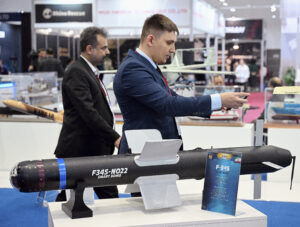
In August 2025, German prosecutors and customs investigators carried out raids on the machine tool manufacturer Spinner Werkzeugmaschinenfabrik GmbH, headquartered in Sauerlach, Germany, near Munich. The company is suspected of illegally supplying more than 20 high-precision machine tools – valued at approximately €5.5 million – to Russia, in violation of EU sanctions. Raids were conducted not only at Spinner’s facilities in Bavaria but also in Baden-Württemberg and Bulgaria, reflecting the cross-border dimension of the investigation. Three employees of the company have been formally charged in connection with suspected sanctions violations. A Spinner machine subject to export restrictions was previously confiscated in February 2025. Export documents listed Uzbekistan as the destination via Poland and Belarus, but investigators suspect the machine was ultimately delivered to a Russian company affiliated with Spinner. Evidence suggests additional deliveries through Turkey and China, pointing to a broader sanctions-evasion network. A TV documentary by Arte in April 2025 traced a
Spinner machine to Russia through falsified documents. In that report, Nikolaus Spinner, one of the managing directors, denied wrongdoing, claiming the machine had been sold to an Uzbek agricultural equipment manufacturer. However, a manager at the alleged Uzbek buyer contradicted this claim, telling reporters that no such purchase took place.
In March 2025, the Latvian national airline airBaltic faced allegations by Russian independent media Verstka that it continued purchasing Russian jet fuel until March 2024 in violation of EU sanctions. Using customs and trade data, Verstka reported 28 attempted fuel purchases, 13 of which were successful, from Gazpromneft-Aero and Tatneftaviaservice, totaling around 3,100 tons ($2.3 million). Some declarations were marked “canceled,” though experts say this could obscure actual deliveries. Observations of airBaltic planes refueling in Bulgaria at Lukoil facilities fueled further suspicion, though both airBaltic and Bulgarian authorities deny any Russian fuel use. AirBaltic rejects the allegations, stating it ceased cooperation with Russian suppliers shortly after the invasion of Ukraine and that the aforementioned customs database does not provide complete and verifiable information about the company’s transactions.
The Czech-Austrian industrial conglomerate Hennlich Group, headquartered in Schärding, Austria, continues to operate in Russia through its local subsidiary, LLC Hennlich, despite EU and U.S. sanctions targeting Russian defense entities. The subsidiary, based in Tver, Russia, with branches in Kemerovo and Yekaterinburg, employs around 57 people and derives most of its revenue from reselling imported components, although it maintains its own production facility. Between 2022 and 2024, LLC Hennlich received 583 product shipments valued at $2.9 million, including industrial rubber products and mechanical seals banned under EU sanctions. Ownership of LLC Hennlich is split among Austrian and Czech stakeholders. The subsidiary has continued supplying components to military-industrial enterprises, including the following:
- Ivanovo Heavy Machine Tool Plant (aerospace/defense)
- UEC-Saturn (gas turbine engines, EU/U.S./Japan sanctions since 2022)
- Kolomna Plant (naval diesel engines, EU sanctions 2023)
- Kamensk-Uralsky Metallurgical Works (aviation components, EU/U.S./UK sanctions)
- NPO Iskra (solid-fuel rocket engines, EU sanctions 2023)
Further, LLC Hennlich’s financial records reveal continued contracts with these defense clients and dividends paid to European shareholders. The company has also registered new products in Russia, such as coolers produced by Hennlich Cooling-Technologies GmbH, further demonstrating ongoing exports. Additionally, the group conducts business with Russian clients through third-country intermediaries, including German and Turkish firms. While Hennlich has publicly claimed that European operations ceased military-related exports to Russia in 2022, Russian procurement data, customs declarations, and internal financial reports contradict this assertion.
Further, at least 12 Czech manufacturers exported machinery to Russia in 2023 and 2024, according to Russian customs data. Exports included metal-cutting equipment, forming machines, and other dual-use devices. The total value of Czech machinery imports into Russia was approximately $18 million in 2023 and $12 million in 2024. Among the most active exporters, Šmeral Brno, Varnsdorf, and TAJMACZPS accounted for the majority of shipments, totaling around $8 million. Additional Czech exporters, including N.Ko, Prestar, Tachtech, Stroje Zeman Trade, and Permico, supplied specialized metalworking equipment such as pipe cutters and CNC lathes to Russian entities, some of which operate openly in the country. Most shipments were rerouted through third countries to obscure their final destination, including Estonia, Serbia, Turkey, and Latvia.
4
RECOMMENDATIONS
The European Union and Europe’s new Anti-Money Laundering Authority (AMLA) must improve beneficial ownership efforts across member states.
The war in Ukraine has elevated the priority level of Europe’s efforts to counter illicit finance and corruption. Through their several anti-money laundering directives, transparency levels concerning the beneficiaries behind EU-registered entities have seen significant progress. Despite the improvements, several gaps remain that make the EU vulnerable to corporate malpractice, particularly in the form of secretive structures that obscure the actual owners behind company structures.
While the European Parliament adopts the legislation that creates the necessary tools to counter the flow of illicit finances, it is up to member states to implement and enforce them. The result is a fragmented system that easily exposes vulnerabilities accessible to corrupt actors. Exacerbating the challenge of creating a more transparent ecosystem is a recent ruling by the Court of Justice of the European Union that limits access to beneficial ownership. These limitations create a burden for civil society actors, law enforcement, and investigative journalists looking into potential links to criminal activity.
Together, the AMLA and European Parliament should enforce beneficial ownership standards across all member states to create a concerted effort in showing the beneficiaries of corporations. Such a system could form a single database overseen by the AMLA, ensuring streamlined access for investigations. Blockades limiting access should be amended to lift accessibility challenges. This system should also integrate into a wider EU “sanctions enforcement red-flagging system,” enabling law enforcement, intelligence agencies, and the private sector to track ownership structures linked to sanctions evasion in real time.
The EU should establish a singular body responsible for implementing and enforcing sanctions that resembles the Office of Foreign Assets Control (OFAC) in the United States.
At present, member states implement sanctions nationally, which has led to fragmentation. With the unprecedented response to Russia’s 2022 invasion, the perception in European capitals has shifted: Sanctions are no longer a secondary tool, but a central instrument of foreign policy. The EU can impose sanctions as a formidable tool capable of influencing policy, but doing so requires consolidation of sanctioning authorities. Establishing a single entity responsible for enforcement similar to the U.S. Office of Foreign Assets Control, would increase coherence and resilience. The Council of the EU should retain decision-making authority, but the voting process should be shifted to qualified majority voting to reduce politicization.
Such a body should also be modeled on comparative best practices from OFAC, Office of Financial Sanctions Implementation (OFSI), Office of Trade Sanctions Implementation (OTSI), and the State Secretariat of Economic Affairs (SECO), equipped with investigative, licensing, and penalty powers. A feasibility study should outline a step-by-step roadmap, with milestones for legal, institutional, and resource changes required for centralization. Presently, the European Public Prosecutors Office (EPPO) is the best-equipped body to fulfill the responsibilities of a sanctions enforcement agency. Considering that the functions of the EPPO consist of investigating and prosecuting corruption, fraud, misappropriation, and money laundering, the agency has jurisdiction over all crimes consistent with sanctions evasion. Expanding the responsibilities to include sanctions should be the most feasible and seamless for the EPPO when compared with other existing agencies.
The European Commission should designate sanctions evasion hubs in the EAEU as high-risk jurisdictions due to their connection to terrorist financing.
In its latest review of high-risk jurisdictions, the European Commission failed to designate any central hub for sanctions evasion. According to the commission, any country with “strategic deficiencies in their anti-money laundering / countering the financing of terrorism regimes that pose significant threats to the EU’s financial system must be identified to protect the proper functioning of the internal market.”
By the commission’s definition, countries with a lackluster enforcement of Russian sanctions and export controls should be designated as a concern for Europe’s financial system. This is supported by the fact that in 2022, the EU declared Russia a state sponsor of terrorism.
The free flow of funds to purchase sanctioned equipment enables Russian aggression. Listing sanctions evasion hubs in the EAEU as high-risk jurisdictions would compel European financial institutions to be more diligent in approving transactions and bring increased scrutiny to trade finance involving dual-use goods. These designations should also be linked to enhanced due diligence obligations for EU companies under the forthcoming Directive (EU) 2024/1226, ensuring consistency across anti-money laundering (AML) and sanctions enforcement regimes.
Members of the anti-money laundering and anti-corruption communities should be included in trade agreement negotiations to include a risk-mitigation perspective in trade deals.
The opacity behind trade agreements can drive risks associated with illicit procurement by entities affiliated with the Kremlin. Such factors, including a lack of transparency into trade partners, the establishment of free trade zones with weak regulatory oversight, and anti-money laundering considerations, exacerbate the chances that nefarious actors will take advantage of beneficial trade perks.
Policymakers working on trade agreements should include considerations from the anti-money laundering and anti-corruption communities to propose rules that mitigate the risks associated with trade agreements. Likewise, policymakers should emphasize the national security threat that Russia’s corruption poses for member states.
Including members that focus on the link between finances and trade, with a particular emphasis on nefarious activity in trade negotiations, will embed risk-mitigation policies into trade negotiations to support security initiatives. This includes enforcing due diligence requirements on purchasers of dual-use goods and supporting customs departments, which operate as vital defenders against sanctions evasion in trade. Dedicated “sanctions and AML compliance chapters” should be introduced into EU trade agreements with Central Asian and Caucasus countries, backed by joint task forces to monitor their implementation.
The European Union should establish a task force that investigates and prosecutes illicit military procurement of sanctioned items and dual-use goods.
The EU should create a dedicated task force to counter illicit procurement practices, building on models already used to tackle disinformation and organized crime. This body should include economists, trade and sanctions experts, and anti-money laundering investigators to look into cases of illicit procurement. Collaboration with intelligence agencies and Europol would ensure stronger prosecutions against sanctions-evasion networks.
A task force addressing illegal trade practices could collaborate with intelligence agencies and Europol, the European Anti-Fraud Office (OLAF), and the Directorate-General for Financial Stability, Financial Services, and Capital Markets Union (DG FISMA) to prosecute individuals linked to networks involved in sanctions evasion. Likewise, establishing an information-sharing program with the private sector could clarify the risks and warning signs of evasion and procurement tactics related to Moscow.
The task force should also operate as a hub for public-private cooperation, providing guidance and red-flag indicators to subject matter experts, financial institutions, and logistics firms. Information-sharing agreements with OFAC, OFSI, SECO, and other international counterparts should be formalized to ensure joint investigations and cross-border case management.
About the authors
Albert Torres is a corruption and kleptocracy expert. He focuses on global issues that involve illicit financial practices and corruption in the public sector and most recently served as senior program manager of global policy at the George W. Bush Institute.
David J. Kramer serves as the executive director of the George W. Bush Institute and is a leading expert on Russia and Ukraine. He served eight years in the U.S. Department of State during the George W. Bush Administration, including as assistant secretary of state for democracy, human rights, and labor and deputy assistant secretary of state for European and Eurasian Affairs (responsible for Russia, Ukraine, Moldova and Belarus affairs as well as regional non-proliferation issues).
Ruslan Stefanov is the program director at the Center for the Study of Democracy (CSD), where he leads initiatives on economic security, anti-corruption, and geoeconomics across Europe and the Black Sea region. He is co-author of The Kremlin Playbook series and advises the EU and U.S. on countering state capture, sanctions evasion, and malign foreign influence.
Martin Vladimirov is director of the Geoeconomics and Energy Security Program at the Center for the Study of Democracy (CSD), focusing on the geopolitics of energy, sanctions enforcement, and Europe’s decoupling from Russian energy dependence. As co-author of The Kremlin Playbook series, his analysis shapes transatlantic policy responses to energy coercion, illicit financial flows, and hybrid economic threats.
About the George W. Bush Institute
The George W. Bush Institute is a solution-oriented nonpartisan policy organization focused on ensuring opportunity for all, strengthening democracy, and advancing free societies. Housed within the George W. Bush Presidential Center, the Bush Institute is rooted in compassionate conservative values and committed to creating positive, meaningful, and lasting change at home and abroad. We utilize our unique platform and convening power to advance solutions to national and global issues of the day. Learn more at bushcenter.org.
About the Center for the Study of Democracy
The Center for the Study of Democracy (CSD) is a European public policy institute dedicated to advancing democracy, freedom, and inclusive prosperity through evidence-based research, actionable policy solutions, and strategic dialogue. Founded in 1989 in Sofia, Bulgaria, CSD has grown to become one of the most influential think tanks in Europe, working to bridge the gap between analysis and policymaking in good governance, economic and energy security, the rule of law, information integrity, and social resilience. CSD is internationally recognized for its groundbreaking Kremlin Playbook series, which exposed the mechanisms of Russian economic influence and state capture across the globe. Learn more at csd.eu.