


Welcome back to the George W. Bush Institute’s education newsletter, where we examine how evidence-based literacy, meaningful assessment, data transparency, and strong accountability work together to raise expectations and improve outcomes across K–12 education. This month, in recognition of its growing national momentum, we have also included a dedicated section on school choice.
Across the country, there are clear signs that progress in education is not only possible, it’s already happening. From New York City schools dramatically outperforming expectations in teaching low-income students to read to governors strengthening teacher preparation and embracing evidence-based literacy instruction, policymakers are showing what can be achieved when high expectations are paired with strong implementation. These bright spots remind us that student outcomes are not predetermined by demographics; they are shaped by decisions.
Evidence-based instruction, aligned assessments, meaningful accountability, and thoughtful oversight do not yield results overnight. But when leaders remain focused and persistent, the impact on students can be profound. With sustained effort and clear priorities, more students will graduate ready for their next step.
If you’re new to the Bush Institute, welcome. We are a nonpartisan organization committed to promoting freedom, opportunity, accountability, and compassion. If this newsletter was forwarded to you and you’d like to receive future editions, we’d be glad to add you to our list.
Thank you for reading.
Monthly snapshot
75% of U.S. parents enrolled or considered enrolling their child in a different school in 2025
A new report found that a staggering 75% of U.S. parents –approximately 46 million – considered, searched for, or enrolled at least one child in a new or different school in 2025. That marks the highest level recorded in five years and sends a powerful signal that an increasing number of families place a premium on educational choice and opportunity for their children.
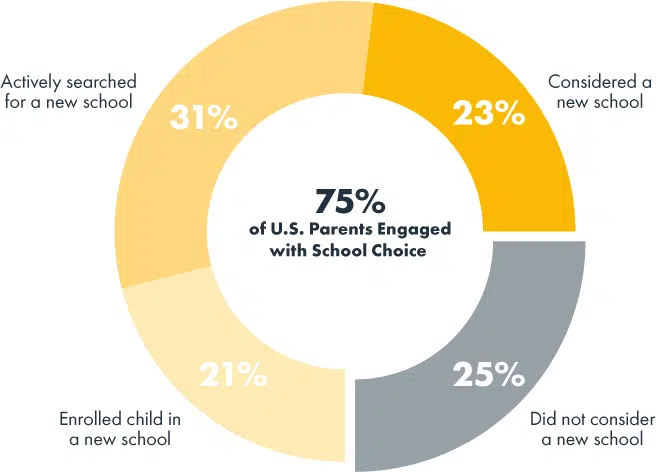
Source: National School Choice Awareness Foundation’s January 2026 survey of 3,960 U.S. parents of school-aged children
State spotlight
New Mexico advances structured literacy and math reforms
The New Mexico State Senate unanimously passed two bills to strengthen K-3 math and reading instruction by standardizing evidence-based teaching and expanding early intervention.
- The High Quality Literacy Instruction Act requires instructional materials aligned with the science of reading, mandates K-3 reading screenings, ensures support plans for struggling students, and deploys literacy coaches to schools with low reading rates.
- The Math Requirements for Teaching License Act strengthens math instruction by adding coursework requirements for teacher licensure, requiring K-3 math screenings, and mandating targeted interventions and progress reporting. According to state Senator Bill Soules, teachers say the changes will increase their confidence in teaching math.
Science of reading
- A recent Bright Spots analysis by The 74 found that 138 New York City charter and district schools are outperforming expectations in teaching low-income students to read. In these schools, 66% to 92% of students qualify for free or reduced-price lunch and third-grade reading proficiency ranges from 90% to 97% – well above the statewide average of 43%.
- Building on this success, New York City has launched New York City Reads, a citywide literacy initiative requiring schools to adopt one of three phonics based programs with strong records of improving student outcomes.
- New York Governor Kathy Hochul announced that the State University of New York (SUNY) will update its educator preparation programs to align with the science of reading. The governor’s Back to Basics reading plan will equip SUNY’s teachers with coursework and clinical experiences grounded in evidence-based literacy instruction, including phonemic awareness, phonics, fluency, vocabulary, comprehension, writing, and support for English learners and students with disabilities. The policy ensures future educators enter classrooms prepared to deliver strong literacy instruction from day one.
- In an Eduwonk column, Andy Rotherham, co-founder of Bellwether, urges policymakers to prioritize evidence-based reading instruction and stronger support for teachers and schools. He calls for an ambitious national goal: every child reading proficiently in the early grades, expanding support for struggling adolescents, and strengthening instruction for students with disabilities. Rotherham argues this goal is achievable through the science of reading and emphasizes the need for high expectations, high-quality materials, and effective teacher training to ensure all students become strong readers.
Measurement matters
- U.S. Senator Bill Cassidy of Louisiana, Chair of the Health, Education, Labor, and Pensions Committee, recently put out a Request for Information on fair measures of school quality and the best ways to engage families and inform lawmakers. Robin Berkley offered recommendations that emphasize:
-
- the critical role states play in leading education policy
-
- the importance of the federal requirement that state’s deliver annual, statewide assessments aligned to state standards
-
- why clear, accessible, and transparent information about school performance, including assessment results disaggregated by student subgroups, matters for parents, educators and policymakers
-
- the importance of rigorous assessments, aligning state standards and cut scores with the National Assessment of Education Progress (NAEP) benchmarks, and strengthening state accountability systems to include both measures of academic achievement and student growth
- In a recent edition of her Minding the Gap newsletter, Natalie Wexler examines Louisiana’s Innovative Assessment pilot, which aligns state reading tests with the specific content students were taught rather than relying solely on unfamiliar, skills-based passages. The goal was to assess both literacy skills and subject-matter knowledge, recognizing that background knowledge is essential for reading comprehension. Early results are promising: Students reported higher engagement and confidence, achievement gaps were smaller than on the traditional state test, and teachers shifted instruction away from isolated skill drills toward deeper, content-rich learning. The pilot offers a compelling example of how states can better align assessments with knowledge-building instruction.
- Cincinnati Public Schools began including students’ reading and math achievement levels based on state assessment data on report cards and expressed in terms of grade-level performance, notes Jessica Poiner, Senior Education Policy Analyst at the Fordham Institute. This change will help families more clearly understand whether their children are meeting grade-level expectations and take action when additional support is needed.
- While 79% of parents report that their children earn mostly A’s and B’s, national and state assessment data show that many students are performing below grade level in reading and math. Because report card grades often reflect effort, participation, and growth in addition to mastery, families relying solely on letter grades may miss early warning signs that their child is struggling academically.
- A January 2026 report from the Fordham Institute finds that Ohio’s state math and English exams are strong predictors of students’ postsecondary outcomes. Students who score at the Accomplished or Advanced levels are far more likely to attend and graduate from four-year colleges than peers who score lower. Importantly, test-score growth also matters. Students demonstrating stronger growth from third grade through high school were 6 to 9 percentage points more likely to attend and complete college. These findings reinforce the value of assessments in signaling college readiness and monitoring student progress over time.
School Choice
- Governors across the country are rapidly embracing school choice, according to The Daily Wire. To date, 19 states have announced plans to participate in the new federal tax credit scholarship program, which allows taxpayers to contribute up to $1,700 annually to nonprofit scholarship organizations in exchange for a dollar-for-dollar federal tax credit. Scholarships may be used for tuition, books, tutoring, transportation, and services for students with special needs.
- Nebraska Governor Jim Pillen was the first to opt in, calling the program a “game-changer” that will help families send students to the school of their choice. Several Republican governors quickly followed. In December, Colorado Governor Jared Polis became the first Democratic governor to announce plans to participate, saying he “would be crazy not to.” Because scholarships may only be awarded in states that formally opt in, governors’ decisions will ultimately determine whether students in their states can access the program’s benefits.
- Bush Institute experts Robin Berkley and Nina Rees, senior fellow, recently submitted comments to the U.S. Department of the Treasury and the Internal Revenue Service regarding the new federal tax credit for individual contributions to Scholarship Granting Organizations (SGOs), established under the One, Big, Beautiful Bill. They argue that the federal tax credit scholarship has significant potential to expand educational opportunity for low- and middle-income families. However, realizing that promise will require a supporting framework that ensures continuous program evaluation and improvement, transparent reporting for parents and policymakers, and clear guidance for state implementation.
- Jeanne Allen, founder and CEO of the Center for Education Reform, writes in RealClearEducation that the school choice debate is too often framed as a political fight when, in reality, it cuts across traditional party lines. Citing results from the Center’s annual Parent Power! Index, she argues that parents from very different backgrounds and geographies support school choice because it expands opportunity for their children. Allen’s bottom line is that “education choice is not ideology,” but a genuine commitment to empower families with real authority, information, and resources to give every child a chance to succeed in school and life.
Learn about charter schools, magnet programs, education savings accounts, and other school choice policies from Robin Berkley, Will Cullen, and Nina Rees here.
Bush Institute Insights
- In honor of Presidents Day, President George W. Bush reflected on the leadership of George Washington in a Substack essay for In Pursuit. President Bush highlighted Washington’s humility as foundational to American democracy and a powerful lesson in civic responsibility.
- The New York Times recently featured Shilo Brooks, president and CEO of the George W. Bush Presidential Center, in an article examining the troubling decline in boys’ reading skills relative to girls. In discussing potential solutions, Brooks emphasized the importance of modeling reading at home, particularly by fathers and other male role models. He argued that boys are more likely to develop an interest in reading when they see the men in their lives engaging with books themselves.
- “The same way a boy becomes interested in football because he sees his father watch it every Sunday afternoon, he can become interested in reading because he sees his father read for an hour every Saturday morning,” Brooks said. “Books of authentic literary and philosophical merit can widen a boy’s conception of what a man can do, become, suffer from, overcome, and wonder about.”


