


“We need to challenge the soft bigotry of low expectations. If you have low expectations, you’re going to get lousy results. We must not tolerate a system that gives up on people.” – President George W. Bush, 2006
Nearly two decades later, those words remain strikingly relevant. As we close out 2025, student proficiency stands at some of its lowest levels in years – an unmistakable signal that the status quo is failing too many children.
And yet, there is reason for optimism. Just last week, the Bush Institute convened governors and education leaders from 28 states around a shared goal: turning the tide on reading. Many of these states are already seeing encouraging gains. Decades of research show that the science of reading, paired with high-quality assessment and strong accountability, is essential to identifying gaps, intervening early, and delivering real results – especially for students who have been historically underserved.
Welcome back to the George W. Bush Institute’s education newsletter, where we explore how evidence-based literacy, meaningful assessment, and accountability work together to raise expectations and improve outcomes across K-12 education. If you’re new to the Bush Institute, we are a nonpartisan organization committed to promoting freedom, opportunity, accountability, and compassion. If this newsletter was forwarded to you and you’d like to receive future editions, we’d be glad to add you to our list.
Thank you for reading.
Monthly snapshot
90 Trillion
Stanford economist Eric Hanushek recently calculated that the U.S. economy would be $90 trillion larger by the end of this century if student achievement had not deteriorated over the past decade and instead remained at peak 2013 levels.
Bush Institute Insights
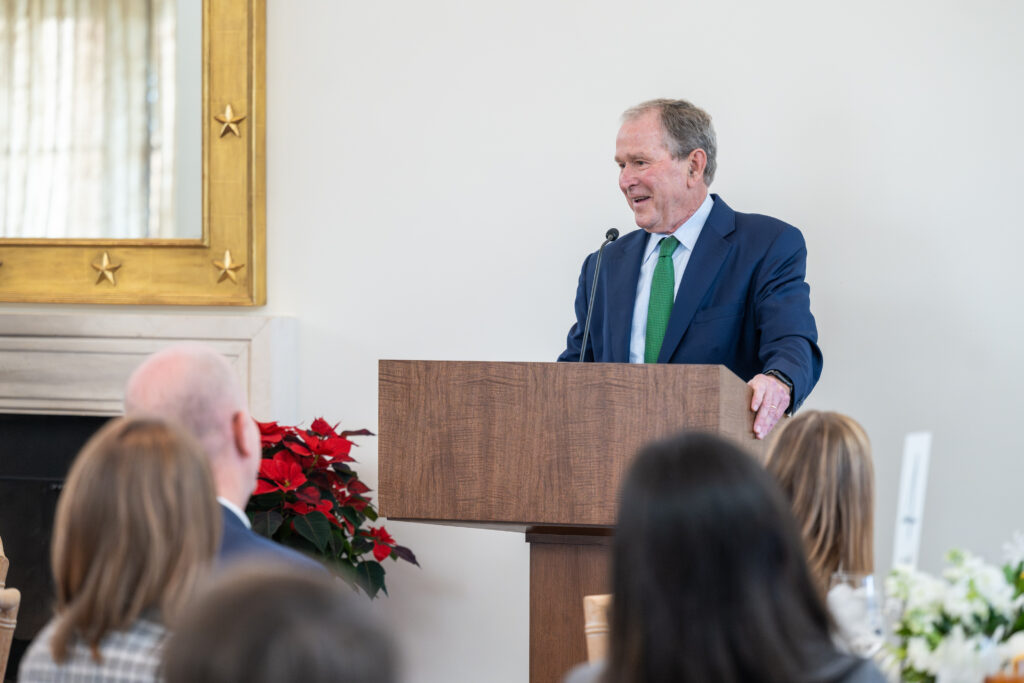
President and Mrs. Bush welcomed 12 sitting governors and a bipartisan group of senior policy leaders from 28 states to the Bush Institute Dec. 8 and 9 for the Governors Forum on Reading, an off-the-record discussion about how state leaders can address the nation’s literacy crisis.
Speakers included former governors Jeb Bush and Bill Haslam; Kristen Baesler, assistant secretary of the U.S. Department of Education’s Office of Elementary and Secondary Education; and Margaret Spellings, former Secretary of Education and current CEO of the Bipartisan Policy Center.
The Bush Institute provided a state-specific briefing packet for each of the 28 states in attendance. The packets were designed to support informed, action-oriented conversations with leaders about advancing effective reading reform. The packets also provided a concise snapshot of where the states stand on 15 indicators of quality policy, implementation, and continuous improvement for the science of reading. They also included a data snapshot with NAEP results and state reading data to highlight strengths, gaps, and trends, alongside evidence-based best practices for improving reading outcomes. The Bush Institute will provide state-specific packet to all 50 states in January. A generic version is available to the public.
State spotlight
Ohio – steady leadership and a comprehensive approach to reading reform
Ohio offers a reminder that sustained, evidence-based policymaking can move a state in the right direction, writes Chad Aldis in the Ohio Gadfly Daily. This year, Ohio Governor Mike DeWine and Stephen D. Dackin, director of the state’s Department of Education and Workforce, doubled down on literacy by strengthening Ohio’s science-of-reading framework, investing in high-quality materials, and expanding teacher training.
That commitment was reinforced on Dec. 16, when Governor DeWine announced the results of a new state audit identifying 10 Ohio colleges and universities that aren’t complying with state law requiring teacher preparation programs to provide instruction aligned with the science of reading. The identified programs have one year to fully transition away from unsupported reading approaches; otherwise, the Ohio Department of Higher Education will revoke state approval of their programs.
Science of reading
- Public data provide little insight into how well middle and high school students read beyond broad state test scores, but a nationally representative fall 2025 survey of about 700 educators by Stephen Sawchuk and the Education Week Research Center reveals deep concern: Nearly 60% of educators report that at least a quarter of their secondary students struggle with basic reading skills.While 40 states have passed laws aligned with reading research, most focus on early grades, leaving older students’ needs largely unaddressed, even as academic demands increase and students are expected to learn complex content through challenging texts. Compounding the issue, support systems largely disappear after elementary school: Fewer than four in 10 educators report professional development in secondary reading intervention; only one in five received such training during teacher preparation; and access to screening tools and dedicated intervention time declines sharply in high school.
- In her article for the Thomas B. Fordham Institute’s Wonkathon, Amy Rhyne, former director of the Office of Early Learning at the North Carolina Department of Public Instruction, argues that early literacy gains from science of reading reforms will not sustain themselves without long-term commitment and continuous improvement. Passing laws or funding initial training alone is insufficient; states must invest in ongoing implementation support, data use, coaching, and accountability. Successful systems treat literacy improvement as a continuous cycle – monitoring results, refining instruction, and scaling what works – rather than a one-time reform. Policymakers play a critical role by maintaining funding, aligning assessments and instructional materials, and supporting state and district capacity to sustain high-quality literacy instruction over time.
- In their article Science of reading 2.0, Edmund W. Gordon, professor emeritus of psychology at Yale University and Columbia University, and Eric Tucker, CEO and president of The Study Group, note that while the science of reading has produced impressive results – such as those seen in Mississippi – sustained progress depends on continuous monitoring and support. They emphasize that assessments must be designed and administered to serve learning. Every quiz, screening, and exam should help teachers adjust instruction, not simply audit student performance. For instance, a brief phonemic awareness check with a small group on Friday could enable a first-grade teacher to reteach a blending skill on Monday – addressing a need immediately rather than discovering a monthslong gap later. By embracing this kind of instructionally useful assessment, the authors argue, states can advance toward what they call “Science of Reading 2.0”: a system that, much like a GPS, continually recalibrates the path until every child reaches reading success.
Measurement matters
- On December 8, Robin Berkley and Andrew Kaufmann, vice president of communications and marketing at the Bush Center and host of The Strategerist podcast, sat down with Dr. Katie Jenner, Indiana’s secretary of education, to discuss her vision for education and her state’s ESSA waiver request to provide flexibility on federal accountability requirements. If approved by the Department of Education, the waiver would allow the state to shift away from the traditional federal framework toward a new system that includes “soft skill” measures like collaboration and communication in addition to test scores and graduation rates. Indiana’s proposed waiver would also re-direct federal funds intended to improve low-performing schools to follow students rather than targeting campuses.Dr. Jenner describes the state’s waiver request as “a valuable opportunity to ensure federal funding supports Indiana’s priorities, reduce time spent on bureaucratic compliance tasks, and devote more time to directly supporting student success.” But critics of the request are concerned about its lack of detail. Hear more about Jenner’s vision and how she responds to her critics here.
- In the December 12 edition of Mike Petrilli’s newsletter, Schooled, he examines Indiana’s request for a federal waiver from key ESSA accountability requirements and the debate it has sparked among education policy experts. While many acknowledge Indiana’s ambition to modernize accountability –particularly by incorporating measures like communication, collaboration, and work-based learning – critics argue that the proposal lacks sufficient clarity, rigor, and technical readiness.Several experts raise concerns about unresolved details, especially how Indiana would identify schools for improvement, ensure subgroup accountability, and avoid a “choose-your-own-adventure” approach to indicators that could allow schools to game the system or lower expectations for some students. Others caution that proposed measures of “soft skills” and credentials are not yet well validated and risk creating inflated or misleading accountability signals.Conversely, supporters of Indiana’s waiver request argue that current systems have produced disappointing results and that states should be allowed room to innovate. Supporters highlight Indiana’s student-centered approach to school improvement and its willingness to rethink rigid, school-based interventions in favor of supports that follow students.
Ultimately, Petrilli argues for a middle path: Federal officials should neither fully reject nor broadly approve Indiana’s request, but instead impose clear guardrails – requiring transparency, strong subgroup protections, limited and well-defined flexibilities, and public reporting – before granting any waiver. He posits that experimentation may be necessary, but only if accountability remains meaningful, credible, and resistant to manipulation.


