As of March 1, the Department of State has completed 24 bilateral health agreements under the America First Global Health Strategy, designed to transition the United States toward jointly financed health programs with partner countries. As these are finalized and the implementation planning process begins, Congress has an important role to play.
The fiscal year 2026 budget, signed into law in February, provides Congress the opportunity for oversight to ensure successful implementation of these MOUs. The budget also requires the State Department to provide a plan to Congress outlining the transition of the U.S. President’s Emergency Plan for AIDS Relief (PEPFAR) programming to country ownership by 2030.
In a new piece for The Hill, I outline several concepts and lessons learned from PEPFAR’s success that should be at the forefront of Congress’s mind as it begins the process of collecting and reviewing these transition plans. They include programming that is informed by data to direct resources where they’re needed most; validating data received by partner country governments; ambitious yet attainable annual targets and metrics; civil society feedback and input; and continued monitoring and oversight beyond 2030.
Exercising oversight and including these mechanisms will support a successful transition of PEPFAR by 2030.
Figure of the Week
70 million lives saved by the Global Fund partnership
Since 2002, the Global Fund partnership has saved an estimated 70 million lives from AIDS, tuberculosis, and malaria. This includes the 26 million lives saved as a result of PEPFAR partnerships. Over the same period, the combined death rate from the three diseases has declined by 63%. The Global Fund directs 93.8% of its resources to lifesaving programs, drives down the cost of key treatments such as antiretroviral therapy and drug-resistant TB treatment, and encourages partner countries to co-finance health programs.
To prevent a resurgence of malaria and accelerate progress against HIV and TB, continued U.S. investment remains vital. A Congressional appropriation of $1.533 billion to the Global Fund in fiscal year 2027 could help save 1.9 million lives, avert 34 million new infections, and generate an estimated $27.5 billion in economic returns, as illustrated here and below.
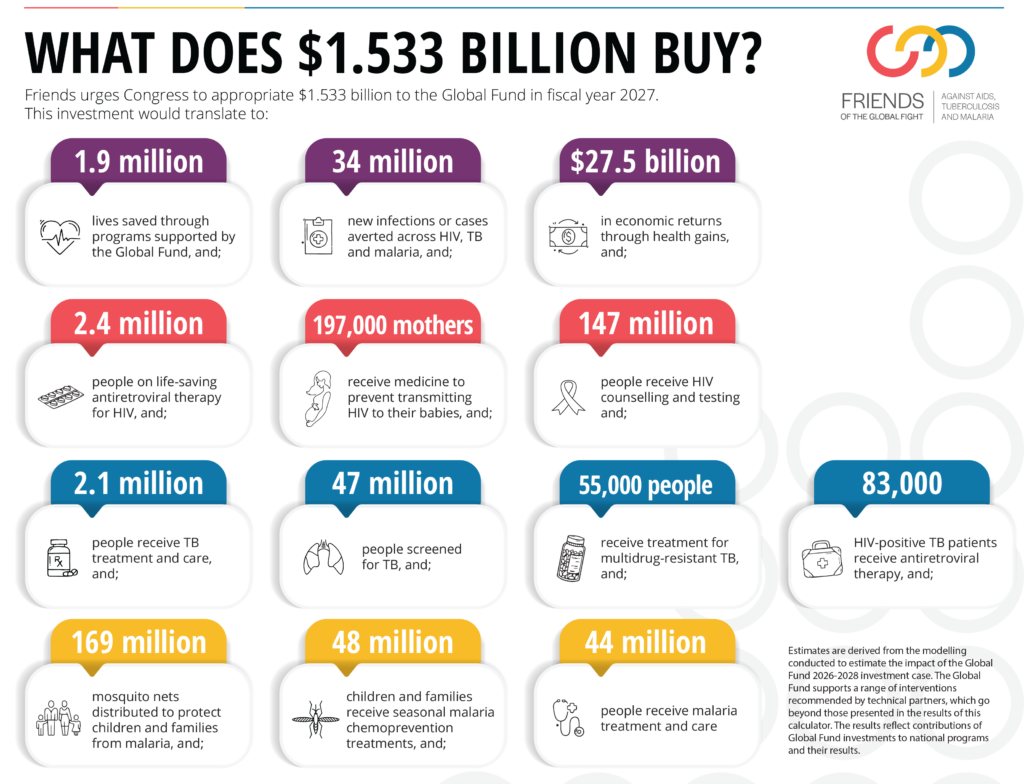
Source: Friends of the Global Fight Against AIDS, Tuberculosis, and Malaria
Bush Institute Insights
In the fine print of the nearly $10 billion global health budget for fiscal year 2026, Congress gave the secretary of state just three months – until May – to submit a plan to transition the President’s Emergency Plan for AIDS Relief (PEPFAR) to a model in which partner countries take financial and programmatic ownership over the next few years.
Through U.S. leadership, PEPFAR has saved 26 million lives since its inception in 2003 and is the country’s most successful foreign investment project ever. For years, Congress has played an important role in PEPFAR’s success by monitoring the program and ensuring accountability from partners. In this new phase of PEPFAR, this oversight is more important than ever.
As Congress reviews these transition plans, they must provide feedback and oversight to ensure a responsible, data-driven transition to country ownership. This includes:
- Ensuring the use of data-driven programming and metrics that depend on outcomes – such as lives saved or declining rates of HIV – rather than outputs like the number of commodities delivered or patients served. These data should be collected and validated by the State Department, as countries may not provide the most accurate results.
- The use of ambitious, but attainable, targets and goals for countries to transition PEPFAR programming and funding to country ownership.
- Pathways for long-term civil society partners and implementers to provide input and feedback on the transition plan.
- Continued U.S. oversight beyond the expiration of bilateral agreements.
To read more, see my latest piece located here.
Ally Updates
Malaria No More hosted a Congressional Breakfast to recognize American leadership in accelerating progress against malaria with next-generation medicines, vaccines, and vector control tools.
The organization honored Rep. Mario Díaz-Balart and Rep. Lois Frankel with the Malaria Action Award for their bipartisan support of U.S. malaria programs.
Rep. Ami Bera, Rep. Bryan Steil, SC Johnson Chairman and CEO Fisk Johnson, and Malaria No More CEO Dr. Bill Steiger gave remarks, highlighting how U.S.-led innovation is saving lives and strengthening economic growth at home and abroad. “This moment underscores what’s possible when the United States leads with science, collaboration, and commitment,” Dr. Steiger said.
In the News
- World Relief and the 2030 Collaborative recently hosted a virtual town hall with former Senate Majority Leader Bill Frist, M.D., to reflect on the legacy and future of PEPFAR. Sen. Frist recalled witnessing the devastation of HIV/AIDS in sub-Saharan Africa in the 1990s, when more than three million people were dying each year. Bipartisan leadership under the President George W. Bush administration and faith-based advocacy helped launch PEPFAR in 2003, which has saved more than 26 million lives and reduced AIDS-related deaths by 74 percent globally. Sen. Frist emphasized that ending AIDS as a public health threat by 2030 is within reach, but only if the U.S. sustains the political will to finish what it started.
- UNAIDS released a new Global AIDS Strategy for 2026-2031. Prior strategies have guided the global response to end HIV/AIDS as a public health threat. The new Strategy will shape the June 2026 UNGA High-Level Meeting on Ending AIDS and its political declaration and includes new targets for 2030 and resource needs estimates. Much like years past, it provides guidance to actors in the field to overcome challenges and to ensure effective, sustainable, and country-led responses.
- The U.S. Department of State has signed its first bilateral health agreements with several countries in the Western Hemisphere including Panama, Guatemala, the Dominican Republic, and El Salvador.
- The U.S. has signed 24 Memorandums of Understanding (MOUs) with partner countries to date, totaling $20.2 billion in combined health financing for 2026 to 2030. These 24 agreements all underscore a global shift toward co-financing, country ownership, and strengthened health security systems. For a comprehensive view of MOU signing progress, you can view KFF’s interactive tracker here.
- The U.S. has faced roadblocks in negotiating bilateral health agreements with Zambia and Zimbabwe, reports Health Policy Watch. Zambia has acknowledged that parts of the proposed agreement did not align with the country’s interests. Meanwhile, Zimbabwe has paused discussions on the MOU, citing concerns related to data sharing and pathogen access. The Zimbabwe College of Public Health Physicians and the Zimbabwe National Network of People Living with HIV emphasized the importance of sustaining HIV treatment and other essential health services during this transition period and encouraged continued dialogue. The Africa Centre for Disease Control and Prevention also affirmed its commitment to support countries that have signed MOUs as they move into implementation.
- Devex recently released a new report examining the downstream effects of U.S. foreign financing disruptions one year later, drawing on 348 documented areas of impact across health, food security, education, and governance. The report finds that reductions in investment have strained national data systems used to track hunger, disease, and service delivery, disrupted integrated programs such as school feeding and accelerated learning, and shifted some previously free health services to fee-based models. The findings also highlight erosion of trust in institutions following program closures and interruptions in training pipelines tied to health workforce development. The Aid Report Impact Tracker offers a detailed view into these documented impacts.