Subject:
Global Health Newsletter for December 2024
From Name:
Igor Khrestin, George W. Bush Institute
From Email:
Ikhrestin@bushcenter.org
Reply Email:
hjohnson@bushcenter.org
Date and Time:
11/01/2024 12:00 am


The Bush Institute Global Health Newsletter
Hello,

Advancing global health is a win-win for American leadership and our allies abroad. It allows the United States to partner with growing economies, prevents diseases from spreading to us here at home, and strengthens national security by advancing free and healthy societies. Amid upcoming government transitions in the United States and across the globe, many policies will be up for debate, but public health should remain a nonpartisan, universal priority.

To mark World AIDS Day on Dec. 1, George W. Bush Institute Senior Fellow Dr. Deborah L. Birx and Global Policy Program Manager Hannah Johnson wrote in Devex about the path forward for the U.S. President’s Emergency Plan for AIDS Relief (PEPFAR).

The op-ed offers concrete recommendations for U.S. policymakers to ensure the program is sustainable and efficient, including the reauthorization of PEPFAR for an additional five years. Reauthorization will allow PEPFAR to continue to be driven by granular data and country-specific goals – connecting program funding to real, positive results.

Sincerely,

Igor Khrestin
The Bradford M. Freeman Managing Director of Global Policy
George W. Bush Institute


Figure of the Month
630,000

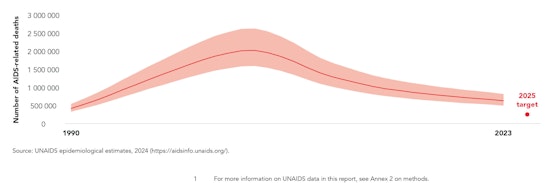
According to UNAIDS latest annual report, AIDS-related deaths have declined to around 630,000 in 2023 compared to 2.1 million in 2004. Programs like PEPFAR and the Global Fund to Fight AIDS, Tuberculosis, and Malaria have given countries and communities access to lifesaving antiretroviral medication, making it possible for people living with HIV to live longer, healthier lives. Despite this progress, many countries are not on track to meet the 2025 interim targets for AIDS-related deaths. The Bush Institute recently released key considerations for policymakers to ensure that countries not only meet these targets but sustain them for years to come.

Despite significant declines, the number of global AIDS-related deaths is not on track to meet the interim UNAIDS 2025 target.

Source: UNAIDS


Bush Institute Insights

In 2016, the U.N. General Assembly endorsed three ambitious goals meant to help governments, civil society, and communities focus their efforts to end HIV/AIDS as a public health threat by 2030. These targets are:

  1. 95% of people living with HIV should be aware of their HIV status;
  1. 95% of people living with HIV should be receiving treatment; and
  1. 95% of all people on treatment should have undetectable levels of the virus in their blood (known as viral load suppression).

Progress toward these goals is dramatically uneven. The Bush Institute recently published a series of reports on the status of the 95-95-95 targets across three case studies, which examine countries that have met the targets, those that are on their way, and the countries that are lagging behind.

The key findings of the case studies highlight the importance of data-driven, community-focused approaches to achieve the 95-95-95 targets for HIV. Success stories like Botswana and Zambia demonstrate that reinforcing political will, tailoring interventions, and decentralizing resources have significantly reduced new infections and improved treatment outcomes.


Ally Updates

The Kaiser Family Foundation (KFF) released a new policy brief analyzing opportunities for PEPFAR to adopt a new co-financing policy. Programs like the Millennium Challenge Corporation (MCC) and the Global Fund to Fight AIDS, Tuberculosis, and Malaria use co-financing to ensure that countries can have more ownership over programs while maintaining the progress made alongside partners like PEPFAR for years to come.

Launched in 2004 under President Bush’s administration, MCC requires countries to meet specific criteria to receive assistance, linking funding to results. In the process, these requirements foster sustainability by holding countries accountable and instilling democratic values that support future investments.

Policy considerations in KFF’s brief include implementing mission-driven, income-tailored financing with clear, measurable results with consequences for non-compliance – key lessons from MCC’s success. As PEPFAR moves toward long-term sustainability, these models would emphasize national ownership and mutual accountability, guaranteeing success beyond initial funding.

 

In the news
  • Bush Institute Senior Fellow Dr. Deborah L. Birx joined MSNBC’s Morning Joe to share the lessons learned from PEPFAR and the need to use data-driven programming to ensure babies born HIV-free over 20 years ago continue to live healthy lives.
  • On World AIDS Day, the White House hosted AIDS advocates and survivors to remember those lost to HIV/AIDS and celebrate the gains made to end the pandemic through PEPFAR.
  • In late June, a drug trial found that lenacapavir–a drug currently used to prevent HIV-related infection – prevented all female participants from contracting HIV. Researchers hope that the drug may be a turning point in the battle against HIV.


Igor Khrestin
THE BRADFORD M. FREEMAN MANAGING DIRECTOR OF GLOBAL POLICY

GEORGE W. BUSH PRESIDENTIAL CENTER

T: (214) 200-4315
E: IKhrestin@bushcenter.org

www.bushcenter.org


About the George W. Bush Institute

The George W. Bush Institute is a solution-oriented nonpartisan policy organization focused on ensuring opportunity for all, strengthening democracy, and advancing free societies. Housed within the George W. Bush Presidential Center, the Bush Institute is rooted in compassionate conservative values and committed to creating positive, meaningful, and lasting change at home and abroad. We utilize our unique platform and convening power to advance solutions to national and global issues of the day. Learn more at www.bushcenter.org


George W. Bush Presidential Center
2943 SMU Boulevard
Dallas, Texas 75205

Privacy policy | Donate Today