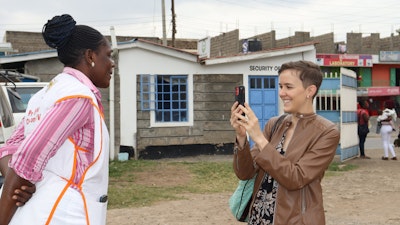
Cervical cancer is one of the deadliest cancers among women in sub-Saharan Africa. Women living with HIV are up to six times more likely to develop cervical cancer, and roughly 110,000 women are diagnosed with cervical cancer annually in the region. For this year’s Cervical Cancer Awareness Month, we are highlighting the stories of women like Dinnah, a PEPFAR beneficiary and healthcare worker at Dandora II Health Center in Kenya. She spoke to us about the work she does to ensure that women living with HIV know about their risks and receive proper cervical cancer testing and treatment.
Cervical cancer is easily detected and prevented through routine screenings and the treatment of precancerous lesions.
In 2018, the George W. Bush Institute, PEPFAR, and UNAIDS partnered to launch Go Further, a public private partnership that aims to eliminate cervical cancer among women living with HIV in 12 African countries. Since 2018, Go Further has supported over 7.4 million cervical cancer screenings and conducted over 302,000 treatments for precancerous lesions. Thanks to Go Further’s strategic partnerships with governments, civil society, and the private sector, health centers like Dandora II are able to ensure that women who survive HIV don’t succumb to cervical cancer.
Dinnah, who was diagnosed with HIV in 2011, now uses her story to support other women: "I always tell them there is life after HIV… Being HIV-positive doesn't mean it's the end of life. My work is to encourage the mothers and to ensure we get HIV-negative babies." Since Dinnah began working at Dandora II, 90% of babies born have been HIV-free.
Go Further and PEPFAR are making great strides in the fight to eliminate cervical cancer in sub-Saharan Africa. It's time to reauthorize PEPFAR, and provide needed Congressional support and oversight, so healthcare workers like Dinnah can continue to lead the fight against HIV/AIDS and cervical cancer.
Kind regards,
Igor Khrestin
The Bradford M. Freeman Managing Director of Global Policy
George W. Bush Institute