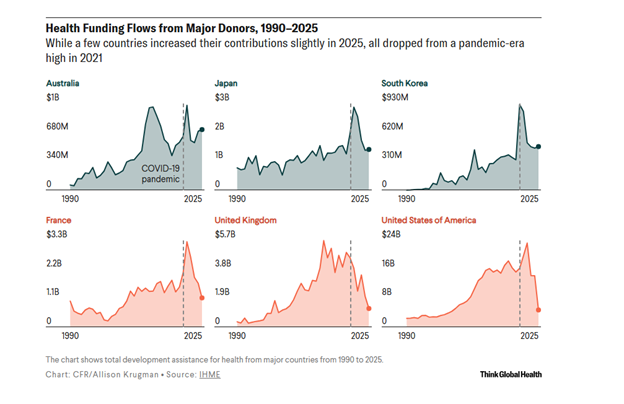
- The National Association of Evangelicals is imploring members of Congress to maintain strong commitments to foreign investments that provide humanitarian relief, reports Politico. Margaret Schuler shared with Politico that World Vision, the world's largest evangelical aid group, "has been forced to stop emergency humanitarian programs in all regions of the world, over 20 countries, leaving over a million people without emergency assistance" due to interruptions in funding.
-
Russia is recruiting HIV-positive individuals, prisoners, and residents of Russian-occupied territories to replenish its military, reports the Kyiv Independent. Although Russian law exempts those with HIV, tuberculosis, and hepatitis C from service, recruiters are reportedly using social media and coercive tactics to promise bonuses and debt relief to these groups, as well as forming assault units with HIV and hepatitis-positive people. Many are sent to the front lines without medical support. These practices raise serious concerns for the treatment of vulnerable populations in conflict zones, such as Ukraine, where diseases like HIV and hepatitis are nearing an epidemic.
-
At the 2025 Africa Health Sovereignty Summit, leaders emphasized the need for sustainable domestic financing models to protect recent progress as international developmental investment declines, reports Health Policy Watch. Proposals included redesigning the continent's global health governance, establishing a health fund under the African Development Bank, and mobilizing local resources to plan for sustainability.
-
AVAC released a new report, Getting PrEP Rollout Right This Time, which highlights actionable lessons from the rollout of oral PrEP, Dapivirine Vaginal Ring (DVR), and injectable cabotegravir (CAB) across Brazil, Kenya, Nigeria, South Africa, Vietnam, Zambia, and Zimbabwe. The analysis informs recommendations to strengthen regulatory pathways, normative guidance, demand generation, stakeholder engagement, and health system readiness to accelerate equitable access to long-acting PrEP.
-
During its first meeting under the current administration, the Millennium Challenge Corporation (MCC) Board took decisive steps to reshape the agency and affirm its value in aligning foreign aid with strategic U.S. interests. The Board approved a new compact for Fiji and a threshold program in Tonga, reinforcing long-standing U.S. partnerships in the Pacific. Simultaneously, the MCC began phasing out some existing programs, particularly in countries previously flagged during the Foreign Assistance Review. Additional information on the termination will be announced following the required notifications to Congress.
|