Subject:
Global Health Newsletter for November 19, 2025
From Name:
Hannah Johnson, George W. Bush Institute
From Email:
info@bushcenter.org
Reply Email:
hjohnson@bushcenter.org
Date and Time:
01/10/2025 12:00 am


The Bush Institute Global Health Newsletter
Hello,
With the U.S. government reopening, the Department of State’s Bureau for Global Health Security and Diplomacy (GHSD) now faces a narrow window to finalize new multi-year agreements for key global health initiatives. The success of the America First Global Health Strategy, and the shift toward time-bound, bilateral agreements, will depend on revitalizing negotiations between the United States and partner countries.

Initiatives like the President’s Emergency Plan for AIDS Relief (PEPFAR) and the President’s Malaria Initiative are well positioned to implement this new framework and sustain progress as the U.S. redefines its role in global health. However, GHSD must ensure that agreements are created through mechanisms that have made PEPFAR so successful such as civil society engagement, continuous monitoring and evaluation, data-driven implementation, and timelines that reflect country needs. This will allow programs to help recipient countries achieve self-sufficiency, strengthen existing health systems, and advance American national security interests.

Sincerely,

Hannah Johnson
Senior program manager of global policy
George W. Bush Institute


Figure of the Week

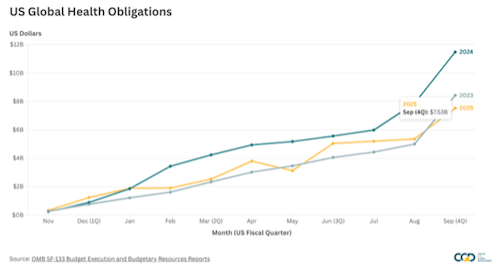
$7.53 billion

That's how much the United States obligated for global health programs, including PEPFAR, in the final quarter of fiscal year 2025, a 34% decline from 2024, according to the Center for Global Development, as shown in the graph below. Data recently published by the Office of Management and Budget (OMB) show that global health obligations rebounded in September, reaching levels more consistent with previous years. This late increase reflects bipartisan support in Congress and points to the continued resilience of flagship programs such as PEPFAR and the Global Fund.

Source: Center for Global Development


Ally Updates
The African Union (AU) and the Global Fund to Fight AIDS, Tuberculosis, and Malaria signed a memorandum of understanding to strengthen collaboration against AIDS, TB, and malaria across Africa. The partnership emphasizes domestic resource mobilization, community health integration, digital innovation, and health security. The agreement also calls for a coordinated response to emerging health threats and support for the Global Fund's upcoming replenishment.

"By working together more strategically, with African leadership, we tackle today's toughest health challenges… while building systems that deliver equitable, sustainable care for all," says Global Fund Executive Director Peter Sands.


Bush Institute Insights
In the Bush Institute's recent piece, "The United States must act now to reduce the horrors of Sudan's current Darfur genocide," my colleague Natalie Gonnella-Platts and I call for the U.S. and the global community to increase pressure on those perpetuating violence, corruption, and abuse of power in Sudan – including the Rapid Support Forces (RSF), the Sudanese Armed Forces (SAD), and various external actors.

The scale of suffering in Sudan is staggering. For more than 900 days, civilians have been trapped in a cycle of starvation, displacement, and violence. Families have watched helplessly as their loved ones are targeted, tortured, or killed. Such a humanitarian catastrophe breeds instability and overwhelms the already fragile health systems.

As part of this humanitarian catastrophe, the global health impacts have been severe. Outbreaks of preventable diseases are escalating. Medical and aid workers risking their lives to deliver aid in North Darfur have been abducted or killed. Over 460 patients and caregivers were murdered in late October at the Saudi Maternity Hospital, El Fasher's last functioning medical facility. Without renewed U.S. engagement and leadership in Africa, the horrors in Sudan will continue.

The administration's recent outreach to Arab partners to help broker peace in Sudan was a positive first step. But far more must be done to end the atrocities and support a freer, more stable future for Sudan and the region.


In the News
  • The U.N.-backed Integrated Food Security Phase Classification (IPC) has confirmed famine conditions in Sudan's al-Fashir and Kadugli following months-long conflict between the paramilitary Rapid Support Forces (RSF) and the Sudanese army, Reuters reports. In al-Fashir, food supplies have been cut off for 18 months under the RSF's siege, and hunger has been spreading in Kadugli since the start of the war. The IPC estimates that 21.2 million Sudanese, or about 45% of the population, face acute food insecurity, with gradual stabilization and improved access in areas where the Sudanese army took control.
  • The U.S. has been working with both sides of Sudan's conflict to secure a humanitarian truce, while the International Criminal Court (ICC) investigates atrocities in famine-hit el-Fasher. The city, besieged for 18 months by the RSF, recently fell after reports of mass killings and sexual assaults. The RSF had agreed to a ceasefire proposal, although the U.S. indicated a final deal had not been struck yet. Members of Congress on both sides of the aisle have condemned the escalating atrocities in Sudan, calling for accountability and expanded humanitarian access.
  • The European Commission is revising future investments for global health initiatives, including Gavi, the Vaccine Alliance, and the Global Fund, Euractiv reports. The European Union (EU) bloc aims to redirect financing toward programs where it can "shape governance," mirroring recent shifts in U.S. global health engagement. The Commission said it is maintaining an "open and frank collaboration" with these organizations amid evolving priorities that emphasize country ownership, health integration, and strengthened health systems.
  • Former European ministers and Commissioners, in a joint article, call for the EU to make a defining choice in its leadership to fight against HIV/AIDS, tuberculosis (TB), and malaria. Amid declining international engagement, climate change, conflict, and drug resistance, global leaders argue that "the real question is no longer whether the EU can afford to invest in the Global Fund, but whether it can afford to let these hard-won gains unravel." With the upcoming G20 summit and the Global Fund's replenishment cycle, the EU has a unique opportunity to continue support for the Global Fund, which has saved more than 70 million lives and deployed extraordinary scientific innovations.
  • A new Think Global Health analysis identifies key questions about the implementation of the America First Global Health Strategy, which seeks to transition U.S. global health programs to time-bound, bilateral agreements that emphasize country self-sustainability. To avoid creating gaps in global health services and financing and ensure a smooth transition to new models of engagement, the U.S. needs to consider the issues outlined: assessing current service capacity and early warning indicators to prevent backsliding; designing predictable graduation and cofinancing policies; further analyzing the role of non-frontline investments in HIV outcomes; and maintaining access for key and vulnerable populations.
  • A new report from the Global Council on Inequality, AIDS, and Pandemics warns that inequality is increasing the likelihood, severity, and cost of pandemics. Research reveals that social determinants, such as education, income, and housing, create health inequities in non-pandemic times and drive pandemic risk and vulnerability. To address the "inequality-pandemic cycle," governments can take steps towards removing fiscal barriers for health investment, strengthening social protection, treating pandemic health technology as public goods, and building community-led pandemic infrastructure.


Hannah Johnson
SENIOR PROGRAM MANAGER, GLOBAL POLICY

GEORGE W. BUSH PRESIDENTIAL CENTER

T: (214) 200-4375
E: Hannah.Johnson@bushcenter.org

www.bushcenter.org


About the George W. Bush Institute

The George W. Bush Institute is a solution-oriented nonpartisan policy organization focused on ensuring opportunity for all, strengthening democracy, and advancing free societies. Housed within the George W. Bush Presidential Center, the Bush Institute is rooted in compassionate conservative values and committed to creating positive, meaningful, and lasting change at home and abroad. We utilize our unique platform and convening power to advance solutions to national and global issues of the day. Learn more at www.bushcenter.org


George W. Bush Presidential Center
2943 SMU Boulevard
Dallas, Texas 75205

Privacy policy | Stay connected