Subject:
Global Health Newsletter for October 1, 2025
From Name:
Hannah Johnson, George W. Bush Institute
From Email:
info@bushcenter.org
Reply Email:
hjohnson@bushcenter.org
Date and Time:
01/10/2025 12:00 am


The Bush Institute Global Health Newsletter
Hello,
On Sept. 18, the White House released the America First Global Health Strategy, which outlines priorities for the U.S. Department of State’s global health portfolio, including the President’s Emergency Plan for AIDS Relief (PEPFAR), for the coming years.

The strategy is a welcome showcase of America’s commitment to advancing the health of people across the globe. It also introduces forward-thinking, cost-effective blueprints for investments across diseases including HIV/AIDS, tuberculosis, and malaria.

Over the next several months, the U.S. government will strive to reach signed bilateral agreements with countries receiving the most U.S. health investments and develop implementation plans by March 31, 2026. While these plans are underway, PEPFAR will execute a six-month “bridge funding” plan. These plans are meant to ensure that funding waived earlier this year in the State Department’s emergency humanitarian waiver is immediately available. They also seek to address several challenges the program is facing, some of which are outlined in my recent piece titled PEPFAR needs direction. Here’s how the program can get back on track.

Below and on the Bush Institute’s website, I outline several lessons from PEPFAR’s success that the State Department and PEPFAR must keep in mind as they start to implement these plans.

Sincerely,

Hannah Johnson
Senior Program Manager of Global Policy
George W. Bush Institute


Figure of the Week

2 million

That's the number of people in up to a dozen primarily low- and lower-middle-income countries who could receive lenacapavir by 2028 through the new partnership among the U.S. Department of State, PEPFAR, Gilead Sciences, and the Global Fund to Fight AIDS, Tuberculosis, and Malaria. This partnership will strengthen access to the highly effective, life-saving medication where it matters most. Gilead Sciences will prioritize 18 countries that account for over 70 percent of new HIV infections for accelerated approval submissions.

By broadening access to lenacapavir, public and private partners will help facilitate greater self-sustainability for recipient countries in the fight to eradicate HIV.


Ally Updates

Earlier this month the Global Fund to Fight AIDS, Tuberculosis, and Malaria released its annual Results Report to share the latest on its work to end the three deadliest infectious diseases in the world. Since the Global Fund’s inception in 2002, nearly 70 million lives have been saved, and the combined death rate from AIDS, tuberculosis, and malaria has declined by 63%.

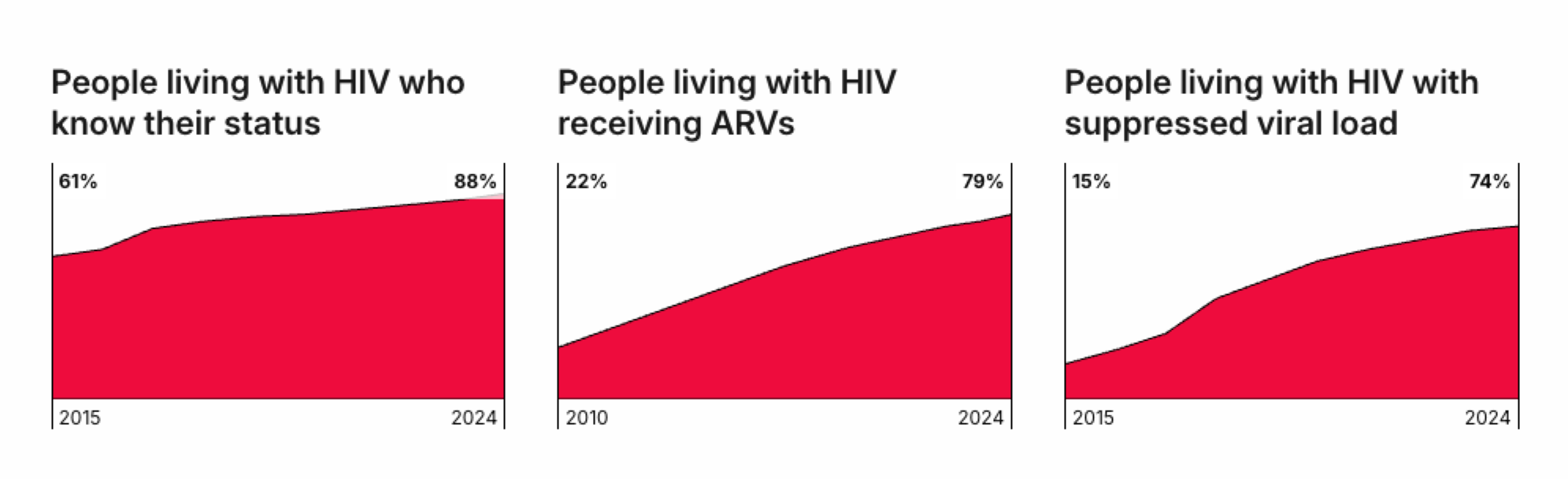
The report showcases how the Global Fund and PEPFAR are a one-two-punch in the fight against HIV/AIDS, working together to address the needs of all people most vulnerable to the disease. In 2024, 88% of people living with HIV in Global Fund-supported countries knew their status, 79% were on antiretroviral therapy, and 74% had a suppressed viral load, marking the highest levels ever recorded for each of these indicators.

As the landscape for U.S. global health investment changes, the Global Fund will become even more critical in the fight to end HIV/AIDS by 2030.


Source: The Global Fund to Fight AIDS, Tuberculosis, and Malaria 


Bush Institute Insights

In my most recent piece, The America First Global Health Strategy is a step in the right direction, but we still have a way to go, I outline several lessons from the past that the Department of State should integrate into the new global health strategy to ensure sustainable results. This includes:

  • Using a data-driven and population- and geographic-specific approach to when drafting bilateral agreements.
  • Continued work alongside civil society, faith-based groups, multilateral partners like Gavi and the Global Fund, and the private sector across all aspects of planning and implementation.
  • Tying global health resources to real outcomes and impact rather than based on inputs and outputs.
  • Close collaboration with country governments to ensure that community health care workers and wrap-around HIV/AIDS services continue to be supported.


In the News
  • Ahead of the United Nations General Assembly meetings and the UN’s 80th birthday, UN Secretary General António Guterres released a new progress report, Shifting Paradigms: United to Deliver. The report includes what is known as “UN80” reforms. One of the proposals is to sunset the Joint United Nations Program on HIV/AIDS (UNAIDS) by the end of 2026. UNAIDS has begun to develop transformation plans to consolidate the agency and integrate into the larger UN system, as outlined in a press release in response to the report.
  • Prior to the release of the America First Global Health Strategy, the Center for Global Development outlined three strategic shifts in U.S. global health policy that if adequately resourced and operationalized could serve as the foundation for PEPFAR’s next chapter. They include support for global roll-out of life-saving American innovations, country partnerships through global health compacts, and a smaller PEPFAR footprint for the poorest and most fragile countries.
  • Humanitarian groups are warning of the on-the-ground impact of recent cuts to PEFAR. World Vision, an international Christian humanitarian organization, told CNN that a major PEPFAR program in Kenya serving orphans and vulnerable children had been shut down. A Doctors Without Borders representative also said that cuts are "crippling the logistical backbone of HIV care" in Zimbabwe, noting that transport for distributing essential supplies has virtually collapsed.


Hannah Johnson
SENIOR PROGRAM MANAGER, GLOBAL POLICY

GEORGE W. BUSH PRESIDENTIAL CENTER

T: (214) 200-4375
E: Hannah.Johnson@bushcenter.org

www.bushcenter.org


About the George W. Bush Institute

The George W. Bush Institute is a solution-oriented nonpartisan policy organization focused on ensuring opportunity for all, strengthening democracy, and advancing free societies. Housed within the George W. Bush Presidential Center, the Bush Institute is rooted in compassionate conservative values and committed to creating positive, meaningful, and lasting change at home and abroad. We utilize our unique platform and convening power to advance solutions to national and global issues of the day. Learn more at www.bushcenter.org


George W. Bush Presidential Center
2943 SMU Boulevard
Dallas, Texas 75205

Privacy policy | Email Preferences